
How to Write Meta Descriptions
Write meta descriptions for the leftover question and the click, then fit snippet width. Character count is a truncation check, not the writing method.
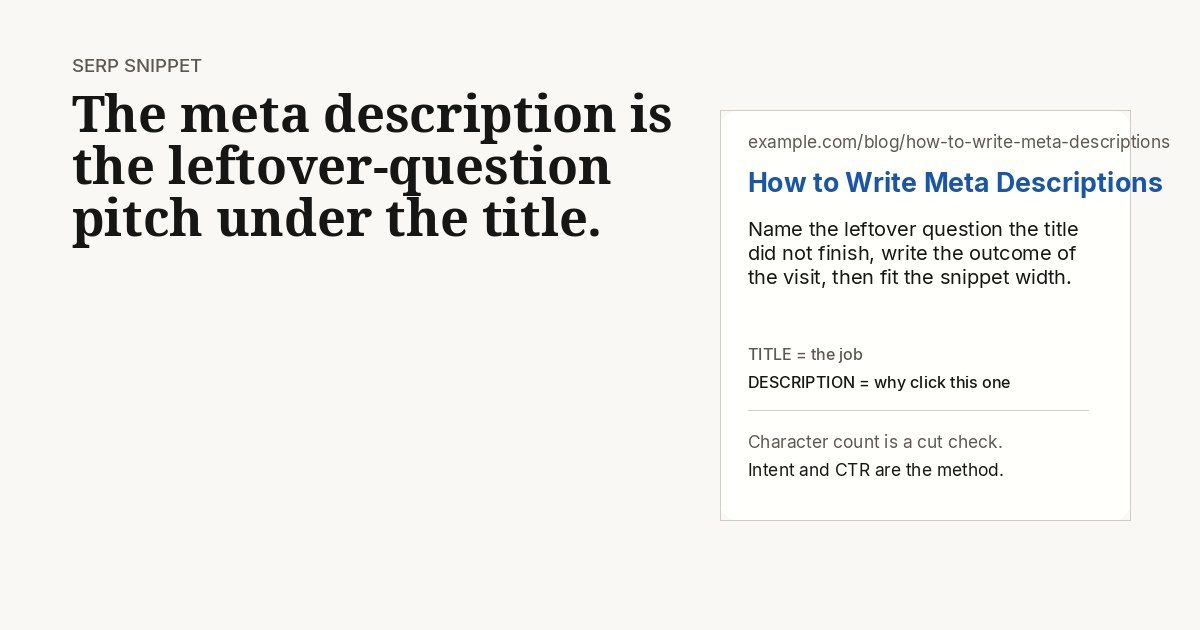
How to write meta descriptions: name the leftover question the title did not finish, write the outcome of the visit, then fit the snippet width. Character count is a truncation check after the writing, not the method.
A meta description is the <meta name="description"> element in the document head. Google may show it as the supporting sentence under the title link, or it may lift a different passage from the page. The writing job is the same either way: one URL, one intent, one pitch a person would choose. This page is that method. The meta tag checker is the inspection step for a description that is already live. The DIY SEO playbook is the wider on-page loop this description sits inside.
What a meta description is (and is not)
A meta description tells a searcher what they get if they click the title. Google's snippet guidance is blunt: descriptions are a pitch that should convince someone the page is exactly what they are looking for. That is a click job. It is not a character budget, and it is not a ranking lever Google requires you to fill.
Teams mix four jobs into the same field:
| Job | What it answers | What it is not |
|---|---|---|
| Title tag | What this URL is, in a line a searcher would click | A second description, or a 60-character keyword dump |
| Meta description | The leftover question under the title link, plus the outcome of the visit | A paste of the first paragraph, or a ranking switch Google turns on |
| Featured snippet | An extractable answer box Google may lift from the page body | The meta description field, rewritten larger |
| Open Graph description | The share-card sentence in social apps and messengers | A substitute for the search snippet |
The title names the job. The description sells the visit. They should agree. They should not be the same sentence. Google primarily builds snippets from page content and may use the meta description when that line describes the page better than a body extract. A weak description is how a rewrite starts. The featured snippet playbook is the companion when the SERP is offering an extractable answer box. This page stays on the classic snippet under the title. Inspect a live page with the meta tag checker. Do not spend this page rewriting titles.
Practical rule: if you cannot say why this result is the one to click after the title is already read, you are counting characters on a line that is not finished.
Why CTR and snippet intent beat character count
Character count answers one question: will the unique part of the pitch still be visible when the snippet is cut? Google's snippet document does not give a character limit. It says the snippet is truncated to fit the device width. The common 150 to 160 character range is a display heuristic. It is useful after the line is worth showing.
Two other facts matter more than the count:
- Snippet intent. The description must finish the job the title started. A how-to query still needs the method, the audience, or the constraint. A comparison query still needs the axis. A product query still needs the outcome. Google's SEO starter guide asks you to match the page to what the searcher wants. The snippet is the second place that match is visible.
- Click-through rate. On a results page the title is the choice and the description is the reason. Two URLs can both be relevant. The one that names the leftover question, the audience, or the proof usually wins the click. A description that only proves it fit 158 characters does not.
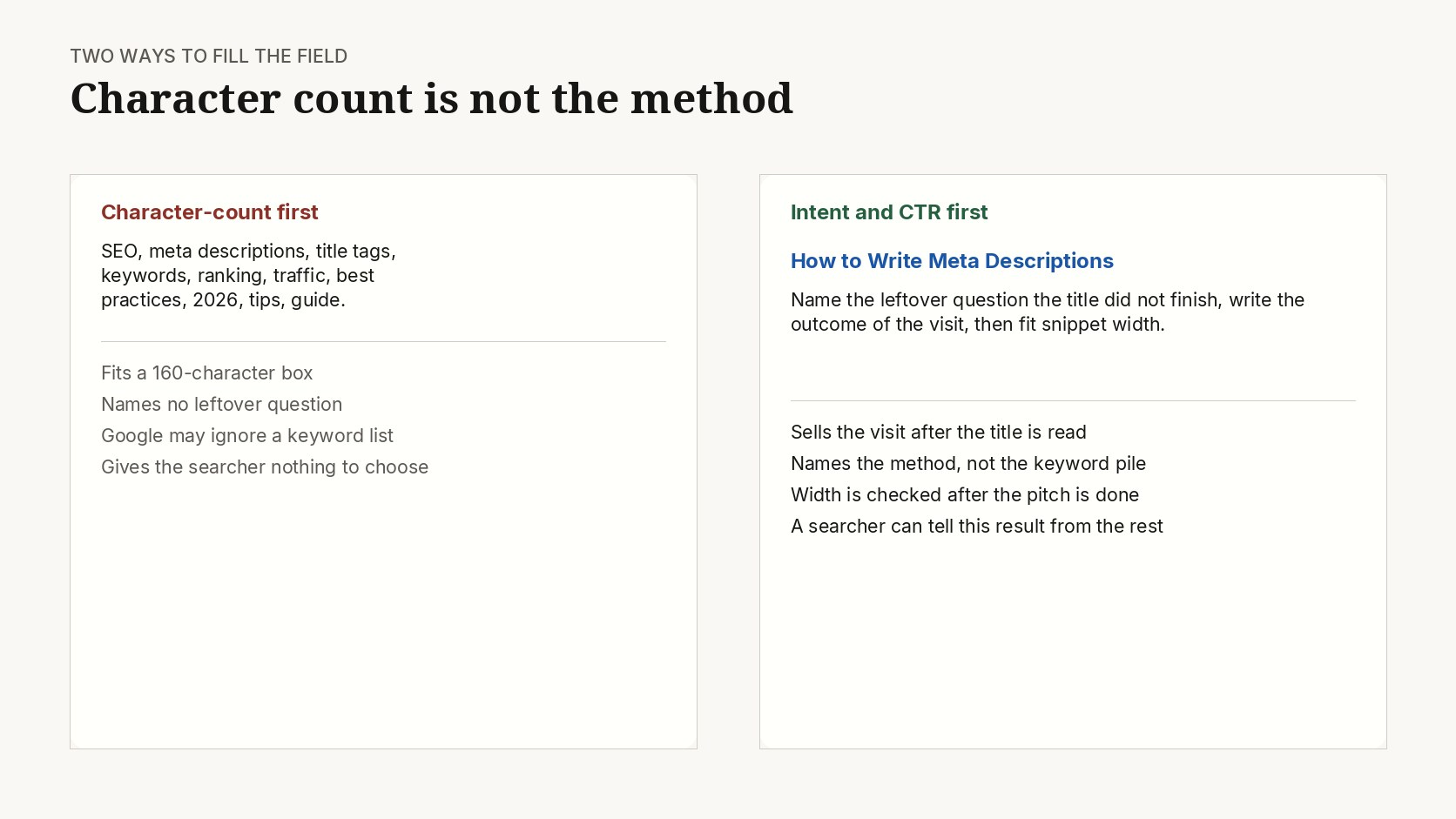
Google also builds snippets from more than the meta description. It can lift a passage that better matches the query, and it can show a different snippet for a different search. It skips a description that is vague, stuffed, boilerplate, or missing. That is why a stuffed 160-character string is not "optimized." It is a rewrite invitation.
1. Name the leftover question
Do not open the description field on a blank summary. Open the query the URL is allowed to own, then ask what the title left unfinished. The keyword research guide is the companion when you still need to pick that query. Come back here when the URL already has a job and the description is the line that has to sell the visit.
Write one sentence the searcher would still say after reading the title:
- "Yes, but will this show me how to write a snippet that gets clicks, not a character rule?"
- "Yes, but does this payroll tool fit a restaurant, and what does it cost?"
- "Yes, but how is this different from the product I already pay for?"
That sentence is the leftover question. The description is a compressed version of it, plus the outcome of the click. If the page cannot finish that question, do not write a description that promises it. Change the page or change the URL. Google's people-first content guidance asks whether the work satisfies the need. A description that oversells the page is how you earn a bounce and a rewrite.
2. Write the outcome, not the first paragraph
Write the specific pitch first. Cut it second. The order matters because a description written inside a 160-character box becomes a pile of keywords with the unique fact trimmed off.
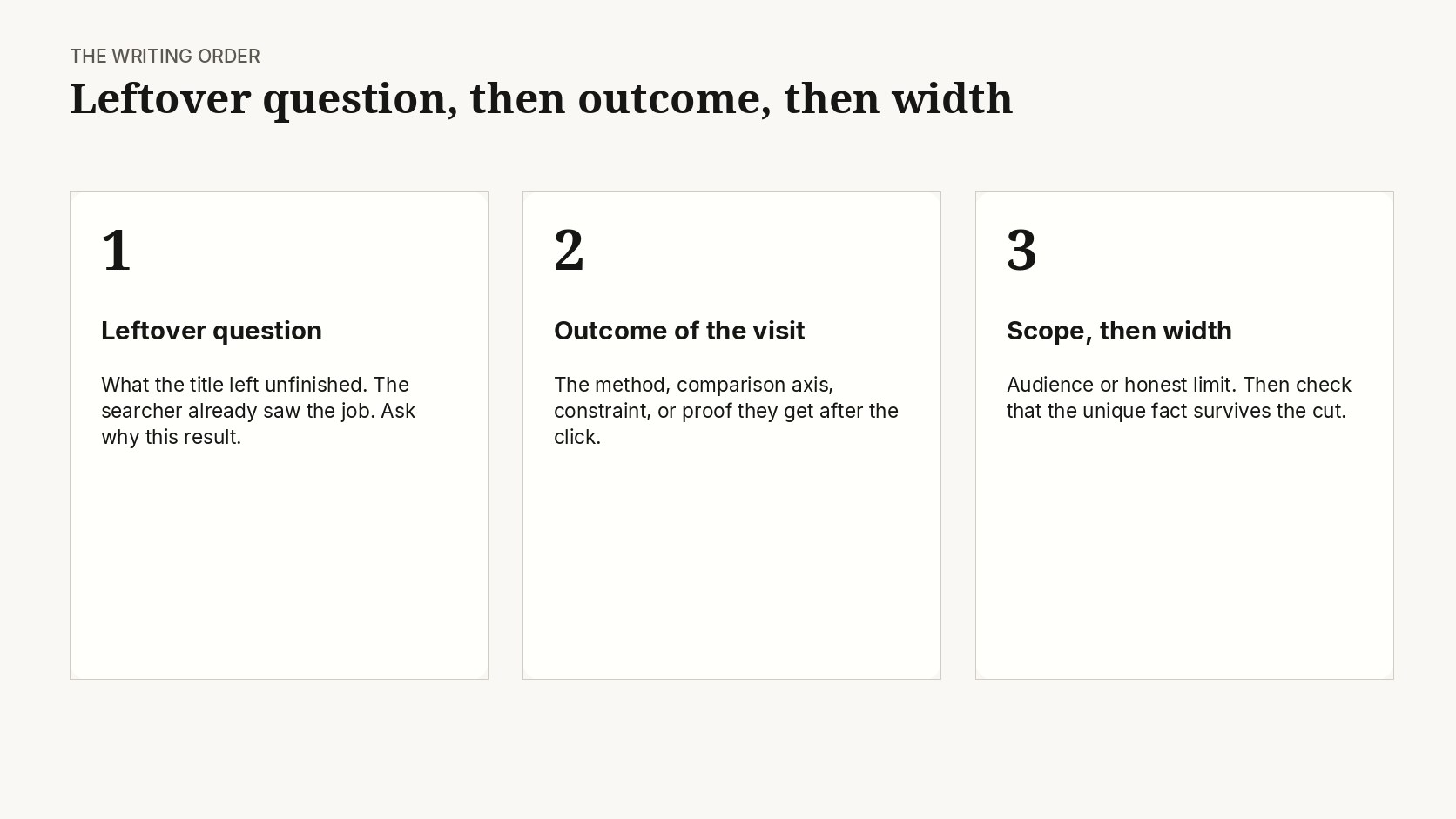
A useful description usually has three parts, in this order:
- The leftover question the title did not finish.
- The outcome of the visit: the method, the comparison axis, the constraint, or the proof.
- The scope a searcher can use: audience, format, or honest limit.
Google's snippet page says a description should inform and interest people with a short, relevant summary. It also says the field does not have to be one generic sentence. Product pages can pull price, audience, and manufacturer into one line. Articles can name the method, not the byline. The test is whether the line would work as ad copy for this URL. If you would not run it next to the title, rewrite it before you ship the template change.
Avoid the two paste failures that look like craft:
- Copying the opening paragraph. The reader who clicks will see that sentence again. The searcher who has not clicked needs a reason, not a preview of paragraph one.
- Listing keywords. Google's own examples call a keyword list a bad description. The supported meta tags list treats description as a short page summary, not a ranking field you stuff.
3. Fit the snippet width after the pitch
Then check the width. Paste the description into a snippet preview, or count characters as a first pass. If the leftover question and the outcome are still visible at typical result width, stop cutting. If the cut lands on the outcome, rewrite the line. Do not delete the fact that made someone click so you can keep a filler word.
Avoid the two length failures that look like craft:
- Padding to hit 160. Extra synonyms do not make a description more complete. Google lists long keyword strings as less likely to be shown.
- Cutting the unique fact. "Write meta descriptions for CTR and snippet intent, then check the live URL" is better than "SEO meta descriptions, tips, guide, best practices, 2026" even if the first line is a few characters longer.
Years and "best" belong in a description only when the page can defend them. A year that is not updated is one of the stale-snippet cases teams keep shipping by habit. If you stamp a year, you have also accepted a maintenance job.
4. Match the SERP without cloning it
Open an incognito window and search the exact query. Read the snippets already winning. You are looking for the shape, not a sentence to copy.
- If page one is "how to" methods, do not describe your page as a definition.
- If page one is comparisons, do not describe your page as a feature list.
- If page one names an audience ("for SaaS", "for developers"), the query is qualified. Your description should qualify too, or you are bidding on a different job.
Then write a line the current results leave unfinished. That is usually a constraint, a format, or an honest limit. Cloning the top snippet is how ten results become indistinguishable and Google lifts body copy from the weakest ones. The featured snippet playbook is the companion when the SERP is offering an extractable answer box. This page stays on the supporting sentence under the title link.
5. One description per URL, one URL per intent
Duplicate descriptions are not a templating convenience. They are how two URLs compete for the same impression. Google's snippet guidance calls out identical or similar descriptions as unhelpful: searchers cannot tell the pages apart, and Google is more likely to ignore the field and extract something else.
The test is simple. If two pages can share a description after you remove a city name, a product SKU, or a year, they are sharing an intent. Either combine them or rewrite until each description names a fact only that URL can own. The keyword cannibalization explainer is the companion when several URLs are already splitting one query. The SEO content strategy guide is the companion when the missing piece is the map of which URL owns which job.
Practical rule: if you can swap two descriptions and a searcher would not notice, one of those URLs should not exist.
6. Check the live snippet, then rewrite losers
A description is not done when it ships. It is done when the live snippet matches the leftover question and earns the click it was written for.
- Inspect the live
<meta name="description">with the meta tag checker. Confirm there is one description, it is not empty, and it matches the page you think you published. - Search the query in an incognito window. Compare the snippet Google shows with the description you wrote. A rewrite is data. If Google swapped in a body sentence, your description was the weaker pitch for that query.
- In Search Console, sort the URL's queries by impressions and look at CTR. High impressions and a weak CTR is a snippet problem before it is a content problem. The SEO checker for a website is a second pass when you want the description beside headings and other on-page facts.
Rewrite the descriptions that get seen and not chosen. Leave the descriptions that already earn the click. A quarterly sweep of the impression winners is enough for most sites. Daily snippet tweaks on pages nobody searches are theater.
If the page itself never appears, the description is not the first fix. The guide to getting a site to show on Google covers crawl and index issues that sit upstream of the snippet.
Worked rewrites
These are the failures that show up on real sites, and the rewrite that names the leftover question.
| Weak description | Why it fails | Rewrite |
|---|---|---|
| Welcome to our website. We offer many products and services for all your needs. | Site greeting, no job, no outcome | Restaurant payroll with tip pooling, tax filings, and a setup you can finish this week. |
| SEO, meta descriptions, title tags, keywords, ranking, traffic, best practices. | Keyword list. Google may ignore it | Write meta descriptions for the leftover question and the click, then fit snippet width. |
| First paragraph of the article copied into the field. | Repeats the opening. Adds no pitch | A six-step method for snippet intent, plus a live-URL check after you publish. |
| The same "quality content and expert team" line on every category page | Boilerplate. Pages are indistinguishable | Each category names the leftover question it owns, then the outcome of that visit |
| Learn more about our 2024 product updates and news. | Year went stale. "Learn more" is not an outcome | What changed in billing, roles, and exports, with the limits that still apply. |
| Home | Names a template, not a product | Payroll software built for restaurants that already run tips, overtime, and multi-location pay. |
Notice the rewrites are not shorter for their own sake. They are more specific. Several are longer than the weak line and still better, because the unique fact survives the cut.
Meta description diagnostic
Use this on any URL before you publish, and again when Search Console shows impressions without clicks. A "yes" on the first four rows means the line is ready for a width check. A "no" means rewrite, do not trim.
| Check | Pass | Fail |
|---|---|---|
| Leftover question | The line finishes a question the title left open | The description repeats the title with extra adjectives |
| Outcome | You can name what the visitor can do or learn after the click | The line is a greeting, a keyword list, or "learn about" |
| Honest match | The page finishes the job the description names | The description promises a comparison, a price, or a method the page skips |
| Not stuffed | No repeated synonyms or stacked "best" phrases | The same noun appears in three forms to hit a count |
| Unique on the site | No other live URL uses this description | A template stamped the same promise on a set of pages |
| Width | Question and outcome stay visible at snippet width | The cut lands on the only reason to click |
If you want a second set of eyes on the live head, start at the free SEO tools hub. The meta tag checker reads the description that is actually on the page. That is the artifact Google can see. A draft in a CMS field is not.
What Orchory writes into the description
Orchory is not a meta-description generator. It is the SEO agent that plans the next page and writes the page, including a description that sells the visit that URL owns. The description is part of a cite-ready page, next to the title, the opening answer, and the internal links. That is the same order this guide uses: pick the intent, then write the pitch, then keep the page honest.
Orchory Pro costs $990/mo for one plan, cancel anytime, with no seat limits. You can start free without a credit card. The auto SEO workflow is the full loop from research to a page you review. If the fit is right, send your site and a person walks the first page with you on a call before you pay.
If you are still choosing a stack, the 2026 AI SEO tools guide compares tools by the artifact they leave you with. The cite-ready pages guide is the companion when the snippet also has to survive an AI answer, not only a blue link. For the engineering half of on-page work, SEO for developers covers crawlability and the rest of the head around the description.
