SEO Content Strategy for Founders Who Don't Have Time for SEO
A practical SEO content strategy framework for bootstrapped SaaS teams: how to plan pages, build briefs, and ship reviewed pull requests instead of guessing.
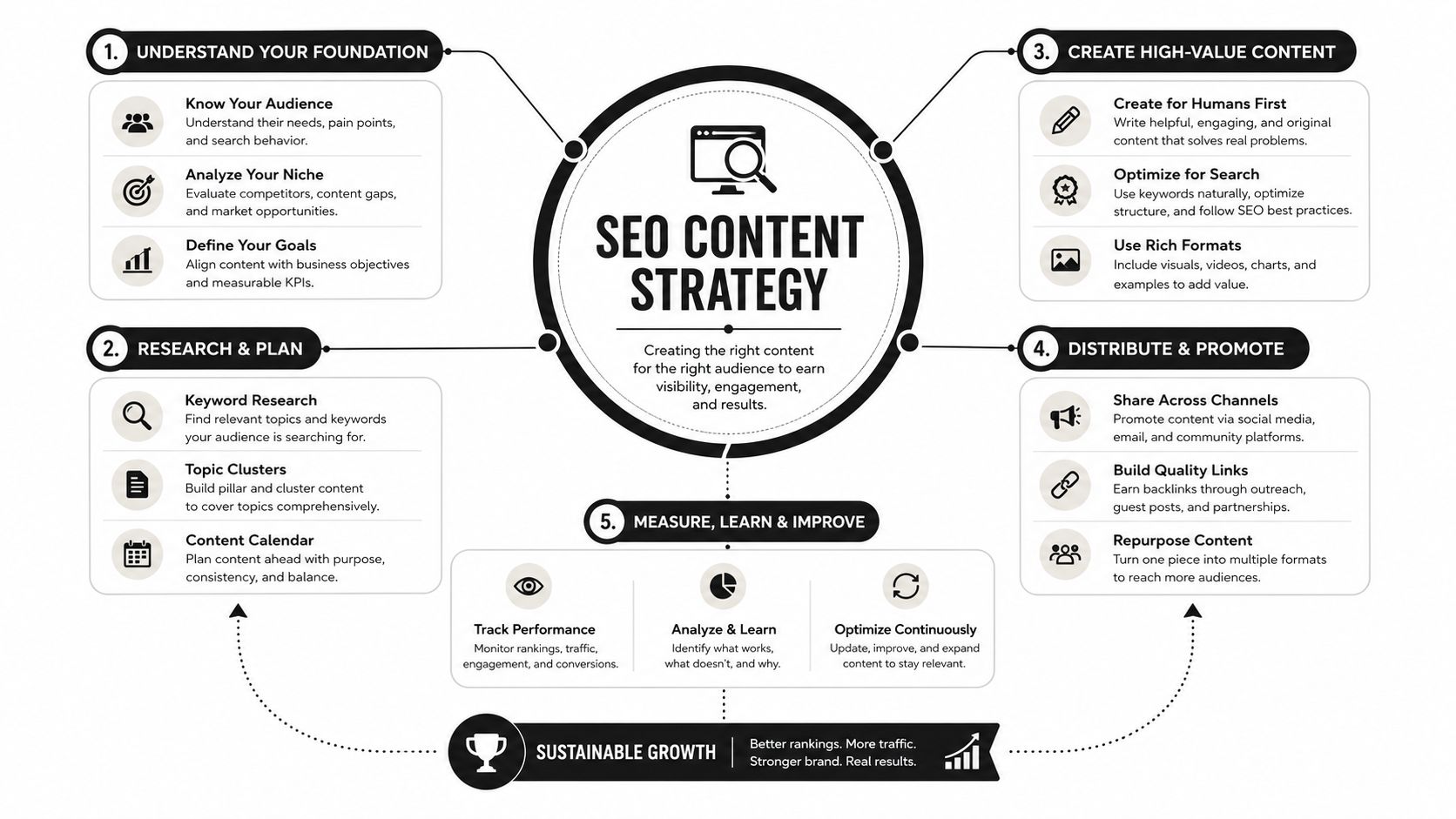
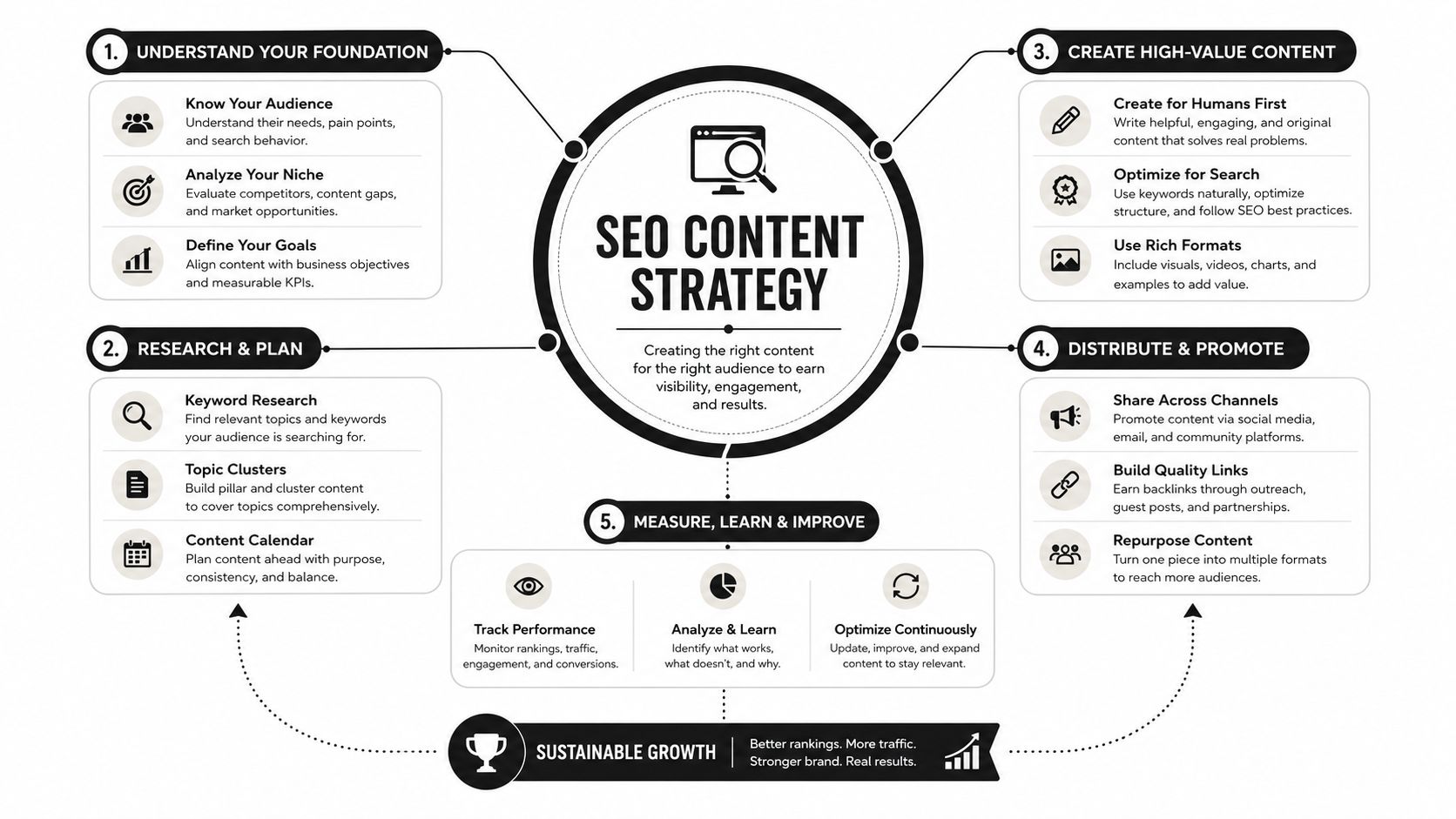
You're probably in the same spot a lot of bootstrapped SaaS teams end up in. Features are shipping, the roadmap is packed, and SEO lives in the same bucket as "we should really get to that." The site has a blog, maybe a few landing pages, but nobody owns the system behind them, so publishing becomes reactive and the best pages never get the follow-through they need.
That's a bad place to stay, because organic search still drives massive discoverability at scale. One industry compilation puts organic search at 53% of all website traffic globally, another reports 49% of tracked website traffic from organic search in 2024, and the #1 Google result earns an average click-through rate of 25.84% (SEO content strategy statistics). The same source set also says 60% of Google searches end without a click (SEO content strategy statistics), which is the part founders feel immediately now, because ranking alone doesn't guarantee visits. It means the pages that do work need to be chosen carefully, structured cleanly, and built for visibility in the result itself.
The Founder's SEO Reality
A founder with no SEO person usually does SEO in the cracks. You scan Search Console between commits, skim keyword exports after a product review, and tell yourself you'll map content next week. The problem is that "next week" keeps getting displaced by launch work, customer issues, and the PR queue.
That's exactly why organic search deserves attention even when you don't have bandwidth for a full content program. Search demand is still large, but click distribution is concentrated near the top, so one page ranking well can matter far more than a stack of thin posts. The benchmark that matters here is not just traffic volume, it's how much of that traffic the top result captures, because the winner often takes the majority of the visible attention.
Practical rule: if a keyword can't plausibly support a page that can rank, convert, or support a product decision, it doesn't belong in your queue yet.
For a small team, that means opportunity scoring beats broad publishing. You want the pages with the highest ranking potential, the clearest intent match, and the strongest business tie-in, then you want to build those first. That's a much better use of founder time than writing whatever topic looks easy on a given afternoon.
The hard part is that SEO content strategy isn't just writing. It's deciding which pages deserve to exist, how they relate, and what "done" means for each one. If your team can only ship a few pages a month, the roadmap has to be selective, not aspirational.
What SEO Content Strategy Means
SEO content strategy is the system that decides which pages to build, how those pages connect, and what search intent each page should satisfy. It is not a keyword dump. It is a connected plan for information architecture, where each page earns its place because it helps users and search engines understand the site.
Google's own starter guidance emphasizes discoverability through sitemaps, internal links, canonicalization, and relevant anchor text (SEO Starter Guide). That matters because pages do not rank in isolation. They rank as part of a site structure that tells crawlers what exists, what is primary, and how related content fits together. On a small SaaS site, that usually means a few clear page types, comparison pages, use case pages, glossary entries, and location pages, all linked in a way that reinforces the same topical neighborhood.
A concept map for connected pages
View the site as a cluster system rather than a pile of articles. A topic cluster includes a primary page, usually a high-intent page, plus supporting pages that answer adjacent questions and strengthen topical coverage. A glossary entry can support a comparison page. A use case page can link back to a pillar. A location page can inherit relevance from broader product content when the intent is local.
The part founders often miss is cannibalization. If two pages target the same query shape, Google gets mixed signals and your internal authority gets split. Unique titles, clear intent boundaries, and deliberate internal links fix that before it becomes a ranking problem. If you can explain the page relationship to a cofounder in one sentence, the structure is probably good enough to ship.
For teams without an SEO hire, the useful version is a pipeline, not a spreadsheet. Orchory's developer-focused SEO workflow is one way to connect keyword research, page briefs, and reviewed pull requests without handing the whole process to marketing. That keeps the work close to the codebase, where technical constraints, internal links, and schema decisions are easier to check before a page goes live.
Core Components You Must Ship
A working SEO content strategy has to include the same building blocks every time, even if the execution is lean. You need to know who the content is for, what query or job it serves, what type of page it should be, and how it will be measured after launch. Skip any one of those and the page turns into a guess.
The practical shift is away from publishing more and toward publishing deeper. Long-form content tends to earn more links and more organic attention when the query needs room to answer properly. That does not mean every SaaS page should be long. It means depth usually beats filler when the page has real search intent behind it.
Pages that win answer the job cleanly, not the ones that try to appear thorough by padding every section.
Long-tail coverage matters for the same reason. Search demand is spread across many narrow queries, so modern teams cluster related terms instead of building one page per keyword in isolation. For a small B2B SaaS site, that can mean one comparison page, one integration page, and one glossary page working together around the same product category.
Planning also has to reflect the way people search. The strongest pages usually serve a specific intent, then connect to adjacent queries through internal links and supporting content. That structure gives you more chances to rank without forcing every page to do the same job.
Planning benchmarks worth watching
| Metric | Value | Implication |
|---|---|---|
| Long-form word count | Deep pages in the 2,000-plus word range | Thorough pages often outperform thin posts for organic traffic |
| Backlink lift for long-form | More backlinks than shorter articles | Deeper pages are easier to cite and reference |
| Long-tail share | About 70% of all search traffic | Topic clusters matter more than single keywords |
| Low-volume keyword prevalence | 94.74% have 10 or fewer monthly searches | Most opportunities are niche, not broad |
| Traffic refresh effect | 106% increase after refresh | Updating existing pages can be as valuable as new publishing |
The planning stack should also include a measurement path, not just a publication path. If you cannot tell whether a page is earning visibility, clicks, or downstream engagement, you will keep guessing about what to build next. Tools can help with that. Orchory AI Keyword Research Tool is one option for turning search terms into a structured opportunity set, and the technical side of seo for developers is worth reading if your team needs the work mapped cleanly to shipping.
Build a Repeatable Planning Framework
A repeatable framework starts with a hard constraint, not a brainstorm. One practical planning model is to identify 50 to 200 high-value transactional keywords and assign each one to a unique page on the site, then keep updating those pages over time (SEO content strategy, a clear explanation). That changes keyword research from an open-ended list into a finite roadmap.
The reason this works is simple. Founders don't need more ideas. They need fewer, better decisions that can be executed by a developer or a coding agent without endless back-and-forth. Once the page set is finite, prioritization becomes concrete. You can rank opportunities by intent fit, business value, competitive difficulty, and whether the page has a clean place in the existing site structure.
A minimal brief your team can execute
A usable brief doesn't need a lot of prose. It needs enough structure that a developer can build the page without guessing. Keep it short and consistent.
- Target page type: comparison, use case, glossary, location, or landing page.
- Primary intent: what the searcher is trying to do.
- Primary keyword cluster: the head term plus related variants.
- Internal links: what pages should point here, and what this page should point to.
- Acceptance criteria: what must exist before the page is reviewable, including title, outline, and canonical target.
A brief is successful when the first draft already looks close to a merged PR.
That structure pairs well with factual density. One published template recommends drafting 4 to 8 extractable fact sentences, then adding a short explanation and a source link for each fact, plus a short data table, a few examples, and a changelog or provenance section (factual density as an SEO advantage). For a founder team, the lesson is useful even if you don't follow the template exactly. Build pages that can be verified, not just pages that read smoothly.
The workflow itself is straightforward. Research the keyword set, cluster related terms, score the opportunities, write the brief, and hand the brief to the person or agent building the page. The overview of AI SEO tools by delivery model helps identify which category supports each part of that loop. If a page can't make it through those steps cleanly, it probably shouldn't be in the queue yet.
Example From Keyword Map to Pull Request
A seed-stage SaaS team can run this without hiring an SEO lead. The process starts with keyword expansion and validation, then moves into clustering and scoring, and ends with a ranked queue of page opportunities. Each opportunity gets a page type, intent map, and build prompt, so the work is ready for a coding agent instead of waiting on a manual rewrite.
That's the shape Orchory is designed around. It takes the research output, turns it into prioritized build instructions, and hands the work off as a prompt that a coding agent can use to open a pull request. It fits the kind of workflow where the team already uses GitHub, Cursor, or Claude Code and wants the SEO plan to land as reviewed code, not as a spreadsheet nobody revisits.
From cluster to reviewed PR
A comparison-page cluster is the cleanest example. You start with the commercial query set, group the terms into one intent bucket, and score the page based on relevance and effort. The output is a single opportunity with a clear page type, not three competing articles that all try to rank for the same idea.
From there, the handoff is mechanical. The build prompt tells the coding agent what to create, the agent opens a PR, and the team reviews it like any other production change. Nothing reaches the live site until someone approves the merge, which keeps production control with the team instead of the tool.
Practical rule: if your SEO workflow can't end in a PR, it's still research, not execution.
The useful part is speed without bypassing review. A weekly pipeline can refresh the queue, surface new gaps, and keep older opportunities from going stale. In practice, that gives a founder a repeatable way to move from keyword map to shipped page without adding a separate SEO headcount line. If you want a lightweight place to start, the Orchory Free SEO Tools page is there for utility checks, while the core planning workflow stays centered on the PR handoff.
Common Mistakes That Stall Rankings
The most expensive mistake is treating SEO content as something written for search engines first. Google's helpful content guidance is explicit that pages should be created for people, with firsthand expertise and intent satisfaction at the center (helpful content guidance). If the page exists only to hit a keyword shape, readers notice, and the site usually does too.
That shows up in a few familiar ways. Teams publish thin pages that repeat the same point three different ways. They create two posts for one intent and split internal equity between them. They launch pages that are technically indexable but poorly governed, so canonical signals, crawl health, or Core Web Vitals issues keep the content from earning consistent visibility.
What to check before you publish
- Intent match: the page answers the actual query shape, not a related one.
- Unique page purpose: no competing page already owns the same intent.
- Technical governability: the page can be crawled, indexed, and canonicalized cleanly.
- Firsthand value: the content includes specifics, examples, or analysis that generic summaries miss.
- Internal pathing: the page has a clear inbound and outbound link structure.
Technical checks matter because content ROI depends on template-level performance and crawl health, not just editing quality. Practical audit workflows usually start with Search Console coverage data, crawl the site in both standard and JavaScript-rendered modes, and batch-test templates with PageSpeed Insights to spot render differences and bottlenecks (technical SEO audit checklist). If a page is blocked, duplicated, or slow, the content plan won't save it.
The fix is disciplined, not flashy. Write for a human job, make each page own one intent, and keep the technical layer clean enough that the crawler can trust what it sees.
Your SEO Content System in Motion
A good SEO content system is boring in the best way. Keyword research feeds a finite page roadmap, the roadmap turns into briefs, the briefs become reviewed pull requests, and the merged pages keep getting updated instead of abandoned. That's what makes the work compounding instead of random.
For a small team, the first move is usually the simplest one. Map your first 50 keywords, group them into clusters, and assign one page to each intent bucket. Then decide which pages deserve immediate build prompts and which ones should wait until the site structure can support them cleanly.
The shift is mental. SEO content strategy stops being an audit you glance at and becomes a production system you ship through. Once that happens, the team isn't asking whether SEO matters. It's deciding which page gets built next, who reviews it, and how the result feeds back into the queue.
If you're ready to turn keyword research into shipped pages instead of another spreadsheet, visit Orchory and look at how the planning workflow turns clustered opportunities into reviewable PRs. It's built for teams that want SEO to move through Git, not sit in a doc.
FAQs
What is SEO content strategy, exactly?
How many keywords should a small SaaS team start with?
Why does keyword cannibalization matter for a small site?
What should a page brief include so a developer or coding agent can build it?
What's the most common mistake that stalls rankings?