How to Do SEO by Yourself: A Solo Founder's Shipping-First Playbook
A practical, ship-first playbook for solo founders doing DIY SEO: crawl audits, query picks, on-page fixes, weekly cadence, and a 12-week plan.

You open your analytics in the morning, look at the graph, and see almost nothing worth acting on. The product backlog is already full, the homepage still feels generic, and the one blog post you published last month isn't pulling its weight. At that point, how to do SEO by yourself stops being a theory question and becomes a shipping problem.
The good news is that solo SEO doesn't require a strategist, a writer, and a technical lead. It requires a tight loop: crawl the site, pick a few queries you can win, ship pages that match intent, connect them with internal links, and measure what changes. Google processes about 40,000 search queries per second, roughly 3.5 billion searches per day and 1.2 trillion searches per year worldwide, so even small improvements can matter at scale, and the #1 organic result gets 39.8% CTR while position #10 gets 1.6% (WebFX SEO statistics).
The DIY SEO Reality for a Solo Builder
The first real SEO decision usually comes late at night, after the sprint review, when the founder looks at traffic and sees that product-led growth is not covering every query the business needs. The site has content, but not enough pages that map to real search intent. The instinct is to “do SEO,” but for a solo operator that has to mean work that can be shipped.
DIY SEO is not a campaign, it's a build pipeline. You are not waiting for an agency deck, you are making a pull request that improves crawlability, targets a query, or tightens a page that already exists. Google's own SEO Starter Guide keeps the foundation simple, use sitemaps and links so Google can find content, make resources accessible so pages can be crawled and rendered, and keep the content high-quality, unique, user-focused.
What solo SEO looks like
For a bootstrapped B2B SaaS founder, the work is usually a mix of product work and marketing work. SEO has to fit into the same operating model as feature shipping, one issue, one change, one review, one merge. Broad checklists sound useful, but they fall apart when you only have a few hours a week.
The practical model is closer to a weekly release cycle than a quarterly marketing plan. One week, you fix a crawl issue. The next week, you pick a query cluster. After that, you rewrite one page, add internal links, and move on. One detailed DIY workflow recommends 15 to 30 target queries after week 2 and one page per query, because a page that tries to serve five intents usually serves none of them well (The Stacc DIY SEO guide).
Practical rule: if a recommendation can't become a pull request, it is too vague for a solo builder.
That is the lens for the rest of the process. A good solo workflow does not ask for more meetings, more tools, or more content volume. It asks for clearer choices, tighter page scope, and work that can be merged. A 12-week cadence helps here, because it forces sequencing, first make the site crawlable, then choose query targets, then ship pages, then measure what changed. AI assistants and coding agents fit into that loop when they help draft outlines, surface internal linking opportunities, or generate page-level edits from a defined brief. If you need to choose one, compare AI SEO tools by the work they deliver. They become a liability when they start producing thin pages that look complete but do not answer a search intent.
Instrumentation and a Crawl-First Audit
SEO work without measurement is guesswork with cleaner jargon. Before writing anything new, set up the basic telemetry and check whether search engines can reach the pages you want indexed. If the site is not measurable and crawlable, new content just adds noise.
The 30-minute setup that matters
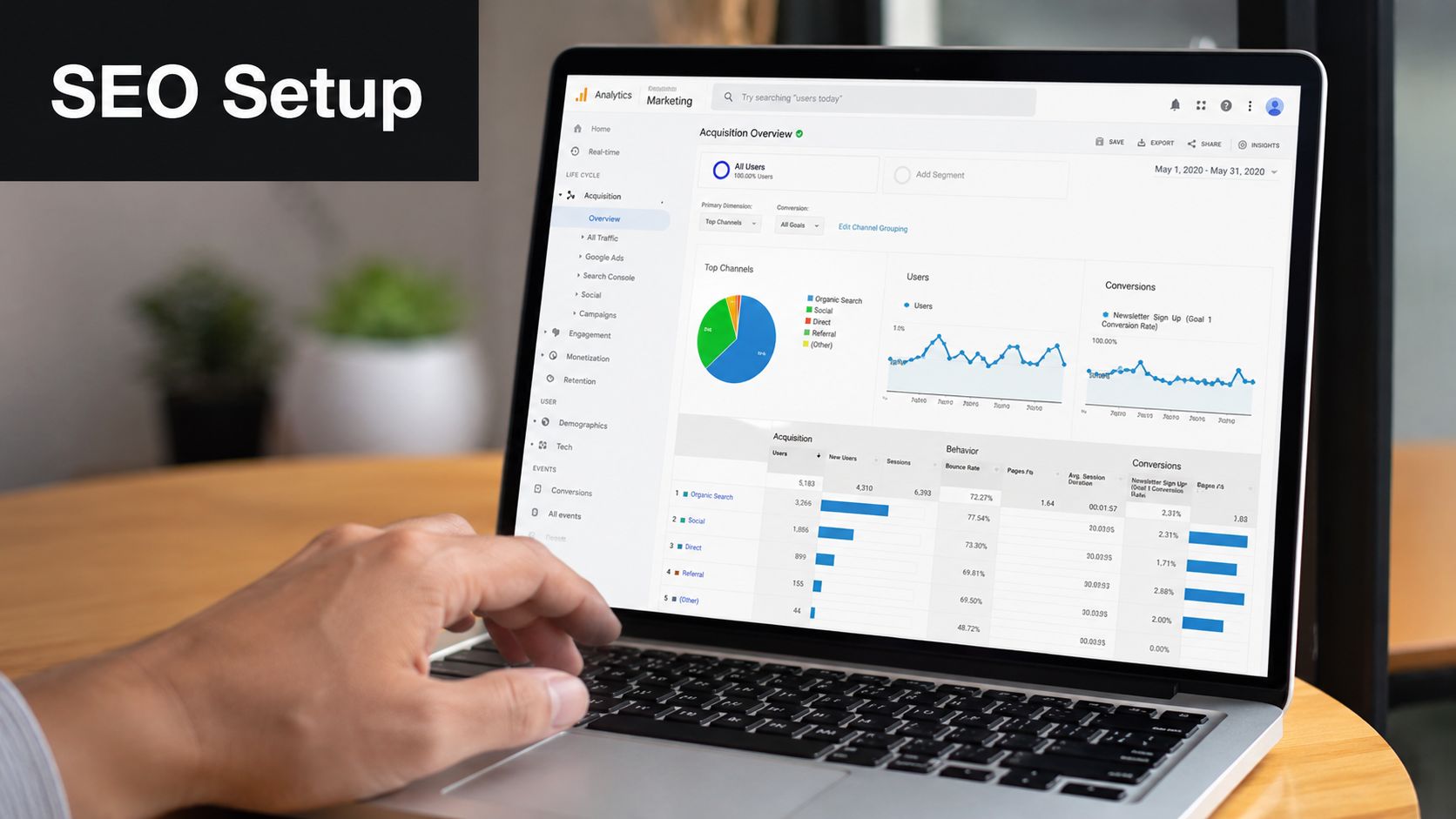
Start with Google Search Console and Google Analytics 4. Verify the domain property in Search Console, confirm GA4 is collecting pageview data, then bookmark the views you will use every week, queries, pages, and indexing coverage in Search Console, plus acquisition and conversion views in GA4. That gives you a baseline before you change anything.
If you want a quick place to sanity-check SEO tools before wiring up the deeper workflow, Orchory Free SEO Tools is a catalog entry worth knowing about. The useful part is not the label, it is that your stack needs a fast way to inspect search data before you start shipping pages.
The crawl-first audit comes next. Confirm the XML sitemap is current, confirm CSS, JavaScript, and images are not blocked by robots rules, and confirm every important page is linked from somewhere crawlable. If search engines cannot find or render the page, the rest of the work does not matter.
Fix the broken stuff before adding pages
A short technical checklist catches most solo-site problems.
- 5xx spikes: check whether server errors are blocking crawl and rendering.
- Redirect chains: collapse them so important pages do not leak crawl efficiency.
- Orphaned pages: make sure no page you want indexed sits outside crawlable navigation.
- Missing canonicals: ensure duplicate or near-duplicate URLs point to one preferred version.
A crawl-first audit prevents the classic mistake of publishing on top of broken foundations. It also makes later decisions easier, because when traffic changes you can tell whether the cause is content quality, internal linking, or a technical failure. Without that baseline, you end up guessing at the wrong layer.
Picking the First 15 to 30 Queries You Can Realistically Rank For
Keyword research is usually treated like a broad harvesting exercise. For a solo builder, it works better as triage. The goal is not to collect every possible query. It is to identify the next 15 to 30 searches that can map cleanly to pages you are willing to build and maintain.
Use Search Console first, then widen carefully
Start with the queries already showing impressions in Search Console. Look for terms where your site appears, even if the ranking is weak, because those are the fastest opportunities to improve relevance without starting from zero. After that, widen into long-tail variants, especially the exact phrasing people use in support tickets, demos, and onboarding emails.
A simple filter helps. Open the first page of results and check whether it is dominated by large brands with clear authority advantages. If it is, move on. That same workflow also recommends checking whether bigger sites control the first page before you commit to the keyword, which is the right kind of sanity check for a solo operator.
Orchory AI Keyword Research Tool fits naturally here as a planning aid for building a ranked queue, especially when you want query expansion and prioritization in one pass. The output still needs judgment, but the workflow is easier when the shortlist is already grouped by intent and page type.
Map one intent to one page
The page architecture matters more than the spreadsheet size. A one-page-per-query model reduces keyword cannibalization and makes the site easier to reason about. Broad pages often compete with themselves instead of building relevance, so a single clear search intent per page is the safer default.
| Query | Search Intent | SERP Difficulty | Page Type | Priority |
|---|---|---|---|---|
| Best CRM for small SaaS teams | Comparison | High | Comparison | Medium |
| How to track trial-to-paid conversions | How-to | Medium | Use case | High |
| What is keyword clustering | Definition | Low | Glossary | High |
| SaaS onboarding checklist | Checklist | Medium | Use case | Medium |
| Alternative to manual keyword research | Comparison | Medium | Comparison | High |
The table is not about precision theater. It forces a real decision about what gets built now and what waits. If a query has a clear intent, a realistic SERP, and a page type you can ship in one sitting, it belongs in the queue. If it does not, it stays out.
Decision rule: if you cannot describe the page in one sentence, you have not picked the right query yet.
If clustering feels fuzzy, the internal model matters more than the label. Group nearby queries into a cluster, choose one page as the primary target, and let the others support it. This keyword clustering guide is a useful companion reference if you are turning a keyword list into a page map.
On-Page Optimization as a Per-Page Checklist
On-page work is the highest-return solo task because it lives inside pages you already control. You do not need permission from engineering, sales, or design to make the title clearer, tighten the opening, or clean up the link structure. You need a checklist and the discipline to apply it the same way every time.
The page elements that move the needle
Start with the title tag. Put the target query near the front, keep it descriptive, and make it sound like a result a buyer would click. Use one H1 that matches the search intent, not a brand slogan. Write a meta description that earns the click, use a clear URL slug, and make the first 80 to 120 words prove the page answers the query.
Google's guidance on helpful content asks you to evaluate pages by originality, completeness, and value, and to consider who created the content, how it was produced, including automation or AI usage, and why it was created (Search Central helpful content guidance). That means the opening cannot be generic filler. It needs a real point of view or a real operational answer.
If you are checking page-level structure across a few pages, the same rule applies. Clear pages are easier to rank than vague ones, and branded search presence usually improves when the page itself is specific enough to deserve attention.
A concrete rewrite
Generic version:
“Welcome to our guide to SEO. Search engine optimization can help your business grow. In this article, we'll cover the basics and show you what to do.”
Search-aligned version:
“How to do SEO by yourself for a B2B SaaS site starts with pages that match one query each. This guide shows how to set up measurement, choose realistic keywords, and ship pages that answer buyer questions without needing a content team.”
The second version tells the reader exactly what the page covers, who it is for, and why it exists. The first version could belong to almost any site.

Internal links need to be part of the page, not an afterthought
Every new page should be linked from at least two existing pages. That helps crawl discovery and keeps relevance signals from getting stranded on isolated URLs. Build the link in both directions, from the new page to its hub, and from the hub or related pages back down to the new page.
<iframe width="100%" style="aspect-ratio: 16 / 9;" src="https://www.youtube.com/embed/gDYjjkvtOVo" frameborder="0" allow="autoplay; encrypted-media" allowfullscreen></iframe>A page that ships without internal links usually needs extra work later. Add the links while you are editing, not after the fact, because that is when the context is fresh and the surrounding copy can support the target page naturally.
A Weekly Content Cadence That Ships Consistently
Solo SEO falls apart when content production depends on mood. A predictable cadence works better for founders who are already balancing sprint work, customer issues, and product roadmaps. The target should stay boring on purpose, one new or rewritten page a week, plus one refresh of an existing page.
How AI fits without lowering quality
AI assistants are useful for outline generation, semantic gap discovery, and metadata drafts. They are not useful for owning the page. The human job is to keep the intent narrow, verify the claims, and make sure the page reflects a real customer question instead of a recycled pattern.
Helpful content guidance still comes down to why the page exists, whether it shows clear sourcing, and whether it reads like it was written by someone who understands the topic. That matters more once AI speeds up the draft stage. If a page can be produced in ten minutes but does not show original thinking, it is not ready.
Use AI to compress blank-page time, not to inflate page count. If the draft repeats what the top results already say, kill it or narrow it. Thin, duplicated, or overly generic pages create maintenance debt that a solo builder will feel later.
A real weekly rhythm
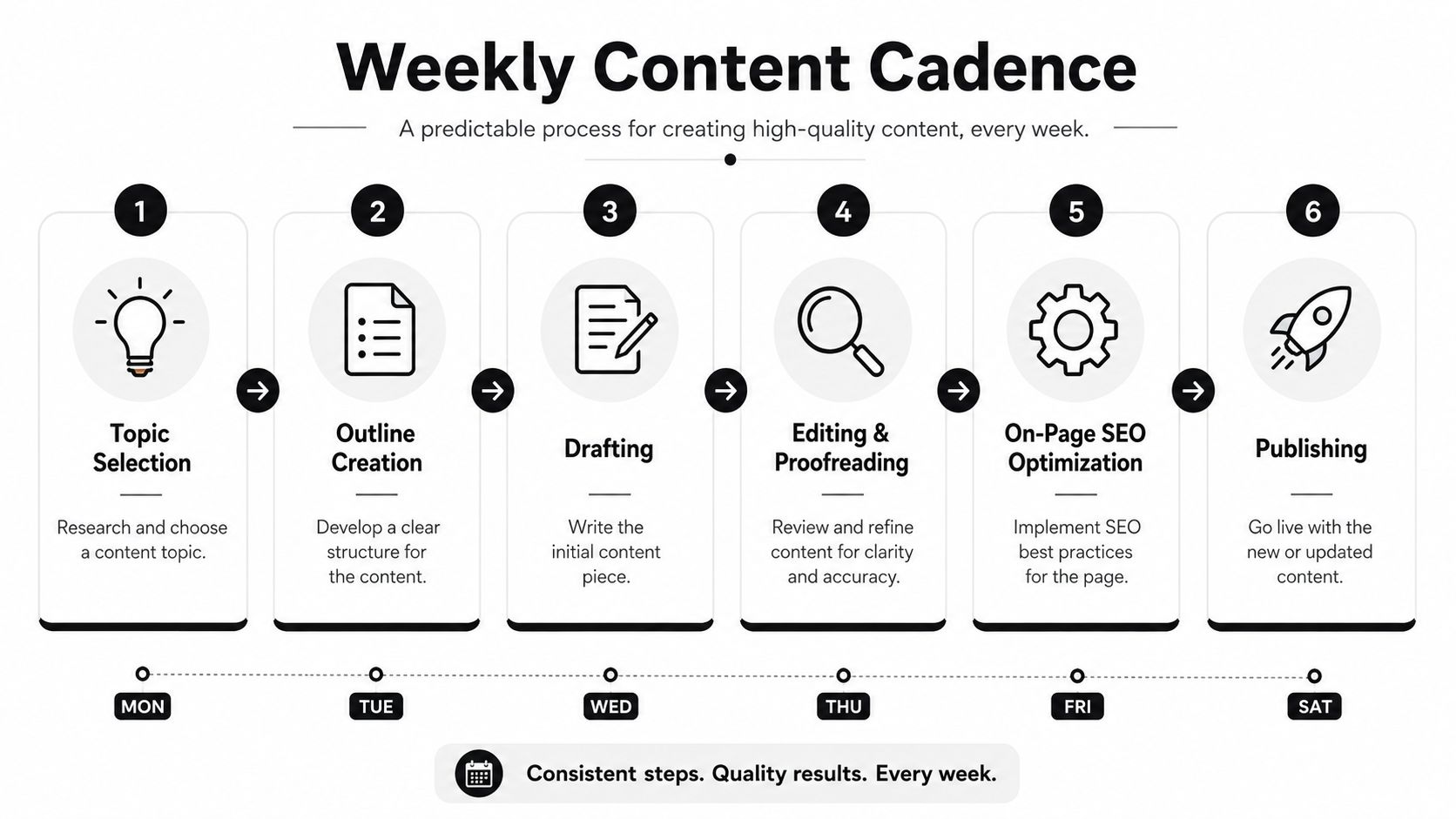
Monday, choose the target query and collect the supporting notes. Tuesday, generate the outline and draft the opening. Wednesday, add one real example from the product, a support thread, or a customer conversation. Thursday, edit for clarity, add links, and tighten the title and meta description. Friday, publish or merge.
That loop works best when the steps are small enough to finish without context loss. A practical content production workflow keeps the handoff tight, even if one person is doing the whole job. AI can help inside that loop, but it should stay in the drafting and synthesis stages, not in the final judgment call about whether the page earns a place on the site.
The page still needs to read like it came from someone who has shipped software. That means naming the author, using first-hand process detail where it matters, and tying the page back to a real buyer problem. Search engines do not need theatrical personality, they need evidence that a human with domain knowledge produced the page.
Quality control rule: if two pages could rank for the same query, one of them is probably too broad.
For a solo operator, a key test is whether the cadence survives a bad week. If the process still works when product work spikes, customer support is noisy, and drafting has to happen in short blocks, the workflow is tight enough to ship consistently.
Lightweight Link Building and Internal Linking
For a solo founder, link building should feel like compounding, not campaigning. The highest-return work is usually not mass outreach. It's building a few assets other people want to cite, then doing a small amount of targeted outreach around them.
What to build and what to ignore
Original data, templates, and comparison pages earn citations more naturally than generic opinion posts. If your site has a practical calculator, a useful checklist, or a comparison that saves buyers time, those pages have a better chance of attracting links. The outreach can stay small, a handful of genuine emails each week to people who already publish about the topic.
Directories can help when your buyers search them. If a category page or niche listing is part of the buyer's research flow, it's worth the setup time. If it's just a random directory with no audience fit, skip it. The same goes for PBNs, cheap guest-post farms, and link exchanges, they eat time and usually add little that lasts.
Internal links do most of the heavy lifting early
A simple architecture beats a tangled one. Use hub pages for broad topics, then link out to supporting pages that go deeper on a query or subtopic. Each supporting page should link back to the hub and to one or two sibling pages where the intent overlaps. That's how you keep relevance concentrated instead of scattered.
Many DIY sites miss the obvious. They publish a page, hope it ranks, and never wire it into the rest of the site. A linked cluster is easier for crawlers to understand and simpler for readers to browse.
Publish fewer pages, but make each one part of a visible cluster.
That rule also protects your time. It's easier to maintain ten connected pages than fifty orphaned ones, and the return on each new page is higher when the site structure already reinforces it.
Measurement, Iteration, and a 12-Week Operating Cadence
SEO without measurement turns into optimism with dashboards. The metrics that matter for a small site are impressions, clicks, average position, and which pages are gaining query coverage in Search Console. In GA4, watch the paths that lead to signups, trials, or demo requests.
What the first 12 weeks should look like
DIY SEO usually takes time to show up. One benchmark report says results often take 3 to 6 months to appear after implementation (Databox SEO statistics). That timing fits the way search engines re-crawl and re-rank pages, so the job is to keep shipping while the data catches up.
| Week | Focus | Output | Review Signal |
|---|---|---|---|
| 1 | Instrumentation and crawl audit | Search Console, GA4, sitemap, technical fixes list | Baseline exists |
| 2 | Query discovery | 15 to 30 target queries and page map | Clear intent per page |
| 3 | On-page fixes | Titles, H1s, intros, meta descriptions | Better relevance signals |
| 4 | On-page fixes | Internal links and URL cleanup | Fewer orphaned pages |
| 5 | New page | One published or merged page | First indexed update |
| 6 | New page | One published or rewritten page | Rising impressions |
| 7 | New page | One published or rewritten page | Query coverage expands |
| 8 | New page | One published or rewritten page | More pages entering the SERP |
| 9 | Refresh | Update an existing page | Content stays current |
| 10 | Refresh | Update an existing page | Clicks improve on older page |
| 11 | Review | Identify winners and weak pages | Queue is trimmed |
| 12 | Backlog | Next-quarter page list | Next cycle is ready |
When to wait and when to pivot
If pages are getting impressions but not clicks, the title and description probably need work. If pages get clicks but no conversions, the page intent or CTA is off. If nothing is moving after a meaningful runway, the query may be too competitive or the page may be too broad.
The point of the 12-week cadence is not to force results in a fixed window. It's to keep the work inspectable. By the end of that block, you should have a baseline, a page-level content map, and a next-quarter backlog, which makes the next cycle a lot less speculative.
If you want a workflow that turns keyword research, clustering, and page prioritization into something your team can ship, Orchory is built for that handoff. It takes search opportunities, scores them, and outputs ready-to-run prompts that a coding agent can turn into pull requests, which fits the solo-builder SEO process you just read.
FAQs
How many target queries should a solo founder pick when starting DIY SEO?
How long does DIY SEO take to show results?
What should I fix before publishing new pages?
How should I use AI in the content workflow without hurting quality?
How many internal links should a new page have?