Keyword Clustering: Turning a Messy Keyword List Into Page Decisions
Keyword clustering turns a raw keyword export into page decisions (build, merge, or skip) so small teams can ship pages without overlap.
You're staring at a CSV with thousands of keywords, a small team is waiting on feature work, and nobody has time to turn research into a clean page plan by hand. That's usually where keyword clustering starts, not in a strategy deck, but in a spreadsheet full of terms that look similar until you decide what deserves a page, what belongs in a paragraph, and what should never be built at all. Keyword clustering is the process that turns that mess into page decisions.
Opening the Keyword Spreadsheet and Finding the Real Problem
The usual scene is familiar. A founder opens a keyword export, sees 5,000 rows, and realizes the list is not a plan. It's a pile of questions, and the site still needs product pages, comparisons, glossary entries, and a dozen other pages that support revenue.
The core issue isn't keyword volume. It's deciding which terms should land on the same URL, which ones need a new page, and which ones should be folded into an existing page instead of spawning another thin asset. That's what keyword clustering solves, and that's why it matters more than another round of research.
The page decision problem
A small SaaS team usually doesn't need more keyword ideas. It needs a page map that a developer can ship without creating overlap. If two terms answer the same search intent, they should usually not become two separate pages competing against each other.
Practical rule: treat clustering as a publishing decision, not a brainstorming exercise. The output should tell you what to build, what to merge, and what to leave alone.
That framing changes how the spreadsheet gets used. Instead of asking, "What do these keywords mean?", the useful question is, "Which of these become a page, which become a paragraph on an existing page, and which get deleted from the build queue?"
The answer matters because your team's attention is finite. If the spreadsheet doesn't produce a page plan, it's just research theater. If it does, it becomes a shipping artifact the team can hand to a coding agent, review in a PR, and merge into the repo.
The Definition That Holds Up
Keyword clustering is the practice of grouping queries that Google already treats as the same page, so one URL can rank for the full group instead of splitting signal across separate pages. The grouping axis is search intent, not word similarity. Two terms can look different on the surface and still belong on the same page if Google serves nearly the same results for both.
The cleanest practical test is SERP similarity. A useful benchmark is 3 to 4 overlapping URLs in the top 10 results. If two queries share that much overlap, they usually belong in the same cluster because Google is signaling that one page can satisfy both intents. Nightwatch's clustering guide describes that overlap rule as a working benchmark, and Semrush's overview frames clustering the same way, as a SERP-driven method for grouping queries by shared intent.
A fast decision test
Check the top 10 results for each term. If Google returns largely the same ranking pages, the terms belong together. If the pages differ in a meaningful way, they probably need different URLs.
A good cluster does not mean the phrases look similar. It means one page can satisfy the user need behind both phrases. That distinction keeps teams from building separate pages for near-duplicates, then wondering why neither one ranks well.
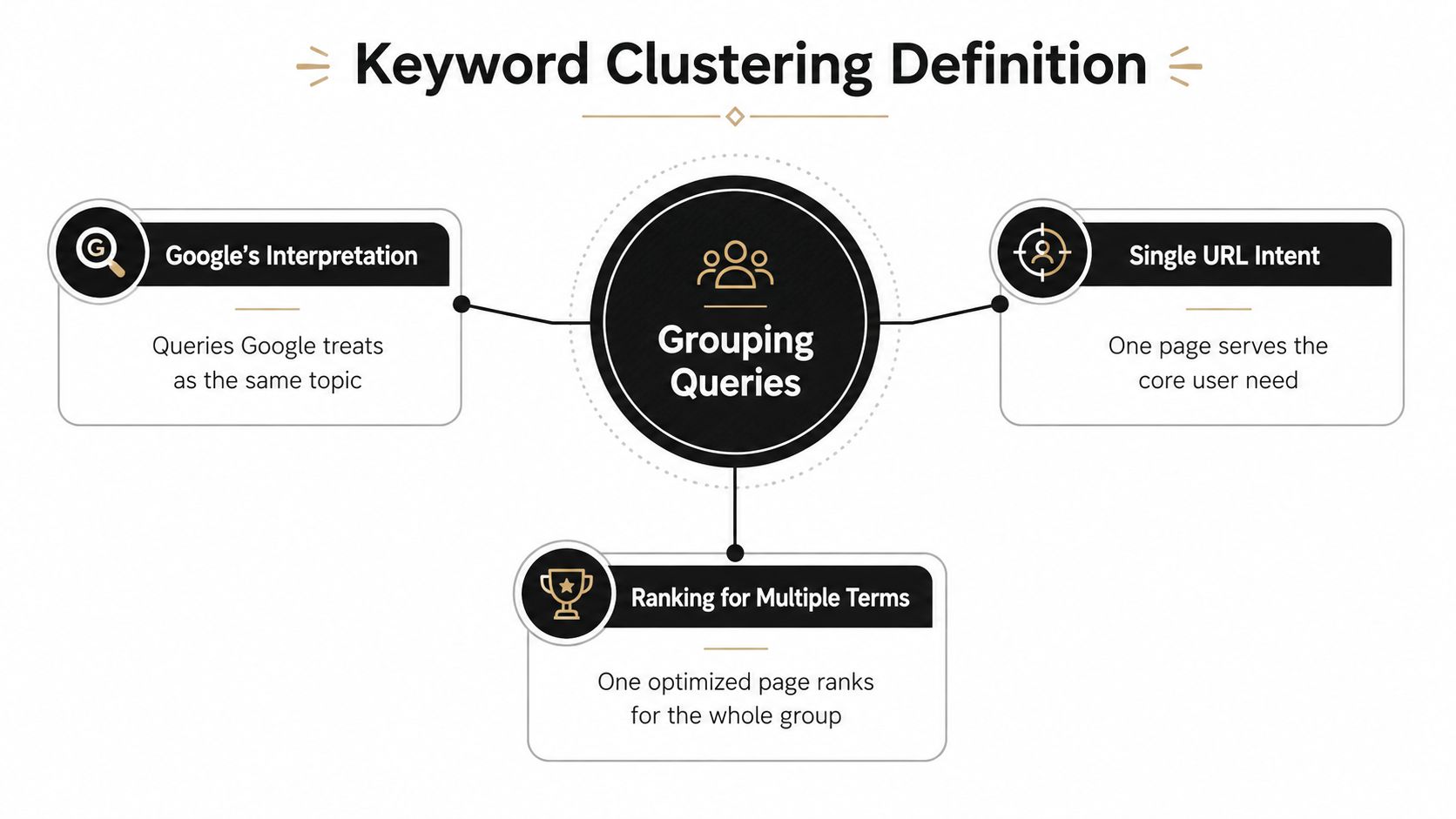
When the overlap is strong, the decision is simple. One cluster, one page, one primary keyword, and a set of secondary variants that support the same intent. That is the part teams miss when they treat clustering as a spreadsheet label instead of a page-level rule.
The Main Ways Teams Cluster Keywords
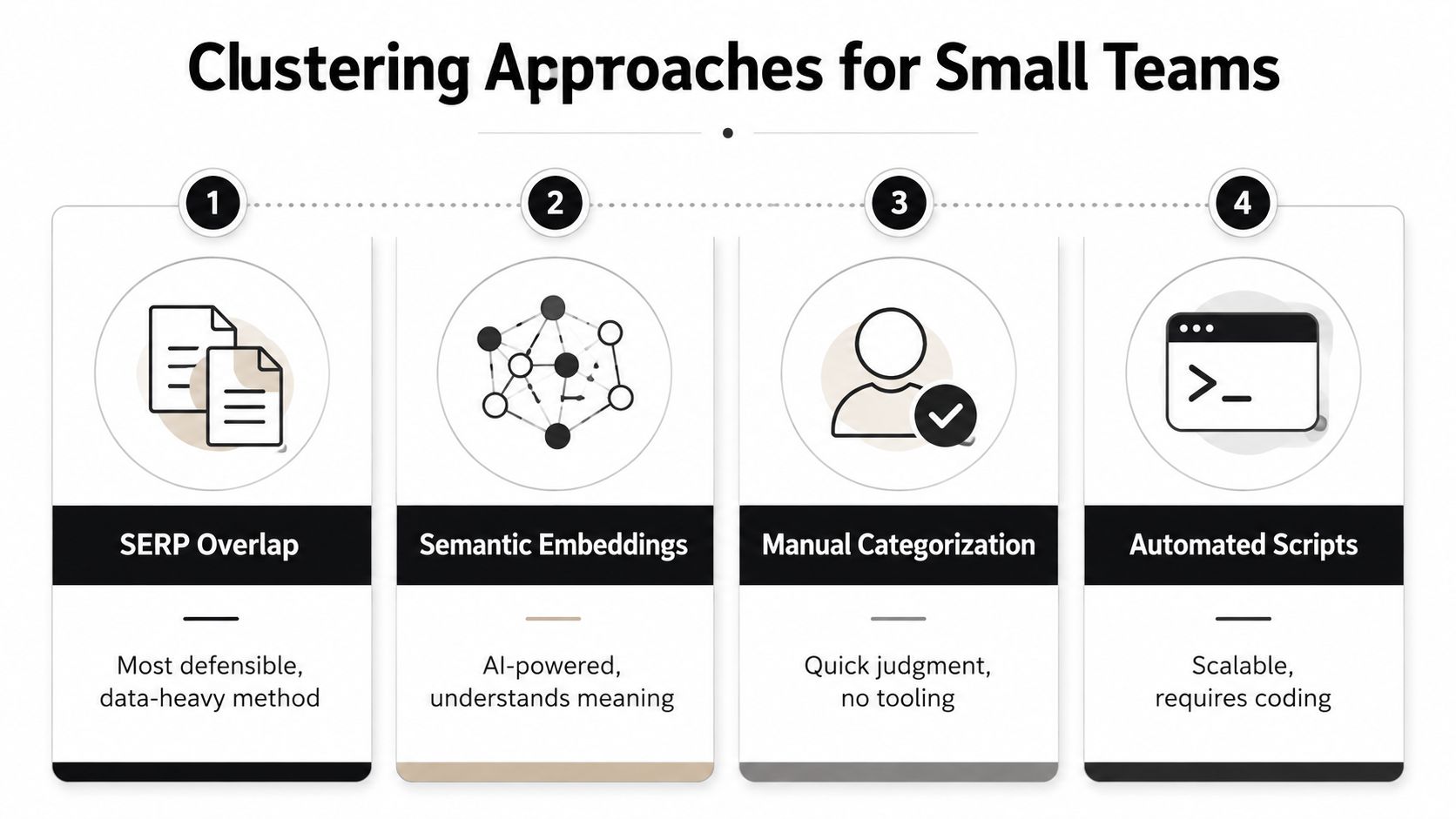
Small teams usually end up with one of four clustering approaches, and the choice depends on how much data they have and how much they trust it. The right method is the one that gives you a page decision you can defend in a PR review.
SERP overlap, the most defensible option
SERP overlap looks at the actual top 10 results for each keyword and groups terms that return similar URLs. It is the most concrete approach because it uses the search engine's own behavior as evidence. The trade-off is simple: it takes more data collection work up front.
This is the method I trust most when a site already has enough search visibility to generate useful query data. It is also the easiest to justify to engineers, because the rule is explicit and reproducible.
Semantic embeddings, the fastest early pass
Semantic methods group terms by meaning, not by live SERP similarity. They help when you need a first-pass structure before you have enough ranking data to compare results. The trade-off is that meaning alone can miss how Google is currently treating a query set.
That matters because similar words do not always mean similar intent. A semantic cluster can look tidy and still produce the wrong page split.
Manual categorization, the lightweight option
Manual grouping works for tiny sites or very narrow content sets. A founder or marketer can look at a small list, group obvious matches, and move on. The risk is inconsistency, because hand-built taxonomies tend to drift as the site grows and new terms come in.
GSC-driven clustering, the safest starting point for live pages
For existing sites, Google Search Console can make clustering more practical than a full-from-scratch keyword exercise. ContentForce's workflow uses a filter of over 1,000 impressions and under 3% CTR before exporting queries for clustering, then mapping each cluster back to existing pages. That turns clustering into prioritization, not just taxonomy.
| Method | Best use | Main failure mode | Page decision it supports |
|---|---|---|---|
| SERP overlap | Existing keywords with enough data | More setup work | Build, merge, or update a page |
| Semantic embeddings | Early research and fast grouping | Can miss live intent shifts | Draft topic buckets |
| Manual categorization | Very small sites | Inconsistent judgment | Quick page outline |
| GSC-driven clustering | Existing pages with query data | Can ignore low-volume opportunities | Update or consolidate pages |
The practical takeaway is simple. If you need a rule that a coding agent can execute without guesswork, SERP overlap wins. If you need a rough map before you have SERP data, semantic grouping can help. If you already have traffic, GSC gives you the cleanest starting point for deciding which pages deserve work first.
A Repeatable Workflow From Raw Keywords to One Page
Open a keyword sheet with 300 terms and the job shows up fast. You do not need prettier groups. You need a rule that decides whether those terms become one page, several pages, or no new page at all.
That is why clustering works best as a page-decision engine. The output should be something a coding agent can turn into a PR: create /feature-x-vs-y, expand /glossary/z, merge two overlapping articles, or leave a term alone because it does not justify a page.
From raw list to cluster
Start with keywords from research exports and live queries from Search Console. Clean obvious duplicates first. Then pull the top 10 ranking URLs for each term and compare them pair by pair.
The rule I use is simple. If two keywords share 3 to 4 URLs in the top results, they are strong candidates for one page. Three shared URLs is a good working floor. Four shared URLs gives you more confidence when intent looks messy. Below that, clustering turns into opinion, and opinion does not scale well across a content backlog.
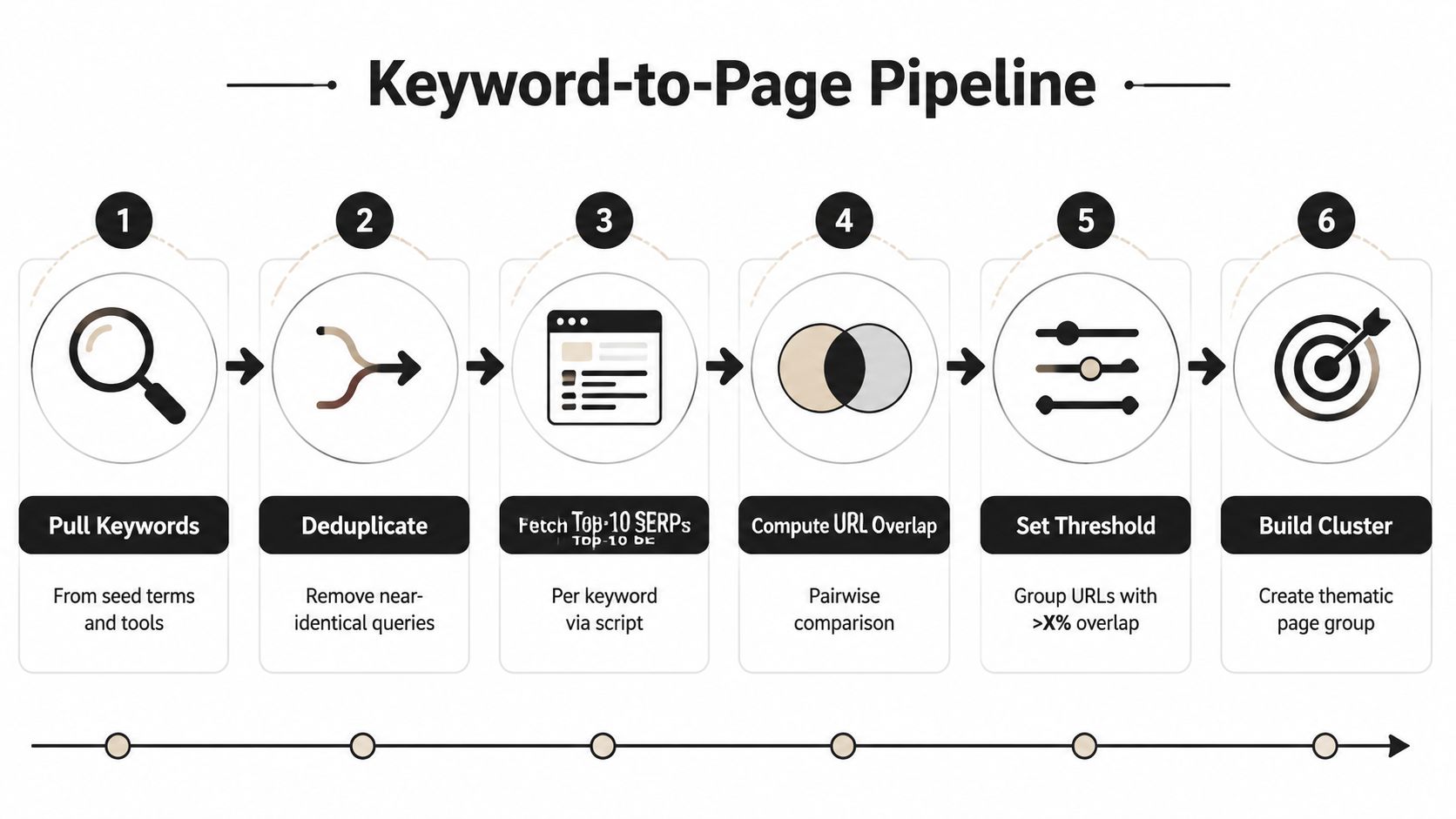
A practical pipeline looks like this:
- Export keyword ideas and live queries.
- Remove duplicates and near-duplicates.
- Fetch the top 10 ranking URLs for each term.
- Measure URL overlap across keyword pairs.
- Group keywords that meet the overlap threshold.
- Assign each group to a page action: new page, update, merge, or ignore.
That last step matters most.
A cluster is only useful when it maps to one URL decision. If a group of terms still points to two candidate pages, the cluster is not finished. Resolve the conflict before anyone writes copy or opens a PR.
A small batch example
Say a batch includes six terms around the same product comparison. Three share four of the same ranking URLs. Those belong on one comparison page. Two other terms overlap with an existing glossary article but do not support a standalone page, so they become new sections on that URL. The last term has weak overlap and low value, so it stays in the backlog.
Now the handoff is clear:
- build one new comparison page
- expand one existing glossary page
- skip one term for now
That is the point of the workflow. It removes debate from the middle of the process and replaces it with a rule a coding agent can execute.
I usually keep the machine work and the human judgment separate. The agent fetches SERPs, calculates overlap, drafts the cluster file, and proposes the page action. A human reviews edge cases, especially terms with mixed intent, branded modifiers, or thin SERPs. That split keeps throughput high without pretending the model should decide every editorial nuance on its own.
Measuring Whether the Clustered Page Worked
A clustered page worked if it changed the page decision in the SERP. One URL should start picking up the query set you intended to consolidate. If Google still splits those terms across multiple URLs after a reasonable indexing window, the cluster rule was wrong, the page type was wrong, or the page did not cover the intent tightly enough.
Start with query-level data in Search Console. URL-level clicks alone hide the failure case where traffic goes up but the cluster never consolidates. I keep the baseline simple. Export the target queries before publish, map them to the intended URL, then compare again after the page has had time to get indexed and re-ranked.
If you used the earlier filter for existing-page opportunities, use the same slice again so the before-and-after comparison stays clean. The goal is consistency, not a new report.
| Signal | Where to look | Threshold to watch | What it tells you |
|---|---|---|---|
| Query consolidation | Google Search Console | More cluster queries begin resolving to the target URL | Google accepts the page as the main result for that topic |
| CTR movement | Google Search Console | Previously weak queries improve from the baseline | The title, snippet, and page framing match intent better |
| Ranking URL count | SERP checks or rank tracker | Fewer site URLs appear across the same query set | Cannibalization is dropping |
| Intent fit | Manual SERP review | The page still matches the dominant result type for the cluster | The cluster should stay one page instead of being split |
I also rerun the SERP overlap check on the live cluster terms. That matters because clustering is a page-decision engine, not a one-time research task. If the terms still share roughly 3 to 4 ranking URLs in the top results and your page is the URL Google chooses for them, the rule held up in production. If overlap falls apart after launch, the cluster probably mixed adjacent intents that looked similar in a spreadsheet.
Two failure patterns show up all the time.
The first is unresolved cannibalization. A comparison page ranks for one variant, a glossary page ranks for another, and neither wins the whole cluster. In practice, that usually means the consolidation stopped halfway. The fix is usually to merge sections, tighten internal links, canonically favor the intended page, or remove overlapping copy from the weaker URL.
The second is over-clustering. One page tries to serve a buyer query, a definition query, and a how-to query at once. Rankings get shallow across all three. I would rather split that cluster and ship two narrower pages than keep defending a page that never had a clean SERP pattern behind it.
For a small SaaS team, the easiest review loop is to treat measurement as another PR artifact. Save the query baseline, post-launch query export, and current cluster verdict in the repo so a coding agent can compare them on the next pass. A workflow built around agent handoffs for SEO tasks makes this easier because the agent can update the cluster status from "new page" to "validated", "needs merge", or "split cluster" without anyone reinterpreting the rules from scratch.
If the page does not absorb the cluster, do not leave it in limbo. Pick a corrective action. Tighten the page scope, split the cluster, merge into the stronger URL, or demote the term set back to the backlog.
Wiring Clustering Into a Coding Agent Workflow
The cleanest way to ship clustering in a small SaaS team is to split the work into code-sized steps. Each part should produce an artifact a coding agent can handle and a reviewer can inspect in a PR.
Map the pipeline to repo outputs
SERP fetch can be a script that writes ranked URLs to a file. Overlap calculation can be a small function that turns those URLs into cluster assignments. The cluster result can be saved as JSON, CSV, or both, depending on what your build process already accepts. That makes the output easy to diff and easy to review.
Then the page build step becomes a prompt for Claude Code, Cursor, or a similar tool to generate the page draft or page scaffold. If you want an example of how an agent-oriented workflow can be structured, this overview of an AI SEO agent shows the general handoff pattern. One option in that class of tools is Orchory, which produces keyword clusters and ready-to-run prompts for coding agents rather than touching the site directly.
The important part is not the tool name. It's the handoff format. The agent should output something your repo can accept and your reviewer can approve without extra interpretation.
What the weekly PR should contain
A good weekly batch should include the latest keyword inputs, the cluster assignments, and the page action for each cluster, new page, update, or merge. It should also include the prompt a coding agent can use to produce the page content or page change set.
That gives the team a repeatable loop. Research becomes code, code becomes a PR, and the PR becomes a shipped page after review. No dashboard is needed to move the work forward, because the artifact itself already contains the decision.

Keeping Clustering Sustainable as the Site Grows
The sustainable version of keyword clustering is weekly, not continuous. One batch a week keeps the queue moving without turning SEO into a permanent engineering interruption.
The owner still makes the important calls
A system can rank opportunities and group queries, but a founder still needs to decide which page types matter most, which market or segment to expand into next, and when a cluster should be retired because the page no longer serves the business. That judgment is the difference between a clean pipeline and random content production.
Orchory's topic-cluster content strategy overview fits this kind of workflow because it treats clustering as planning input, not a final answer. The useful output is a ranked queue and a prompt that a coding agent can turn into a reviewed PR.
The key habit is to keep the loop small. One weekly batch, one prioritized list, one review pass, one merge. That cadence is enough to keep the site organized as new queries arrive and old pages drift.
If you want keyword clustering to stay useful, treat it like infrastructure. Keep the rule for when terms belong together, keep the page map current, and keep the team's review step in the loop.
If you want this turned into a repeatable workflow for your SaaS site, visit Orchory and use it to generate clustered page opportunities, search intent mapping, and coding-agent prompts your team can review and ship. It's built for founders and developers who want the SEO plan to become pull requests, not another spreadsheet.
FAQs
What is keyword clustering?
How much SERP overlap counts as a cluster?
What are the main methods for clustering keywords?
How do you measure whether a clustered page worked?