A Topic Cluster Content Strategy for Bootstrapped SaaS Teams
How seed-stage SaaS teams can turn topic clusters into site architecture, prioritize by pipeline impact, and turn briefs into coding agent prompts.
This is where a lot of seed-stage SaaS teams land. SEO matters, organic traffic is flat, and the people who ship product also have to ship content between deploys, bug fixes, and customer calls. In that setup, a topic cluster content strategy works better than a random blog calendar because it treats SEO as site architecture, not just publishing.
HubSpot's original 2016 Topic Clusters research framed the problem well, the team mapped 5 to 10 core problems from buyer personas, grouped them into topic areas, and expanded each topic with subtopics driven by keyword research. That shift still matters because it moves planning away from isolated posts and toward a pillar page plus supporting cluster pages, with internal links doing real structural work. For a small SaaS team, that means you're not just "writing articles," you're deciding how your site explains a subject to search engines, users, and the engineers who have to maintain it.
Why Topic Clusters Matter for Bootstrapped SaaS Teams
A two-person SaaS team usually runs into this problem before it has a label for it. One founder is buried in product work, the other is handling sales or support, and SEO gets filled with isolated posts that never form a real structure. A topic cluster content strategy gives those teams a repeatable way to build topical authority without scattering effort across disconnected pages.
The architectural distinction matters. A standalone post can rank, but it behaves like a single node. A cluster behaves like a system. The pillar page holds the overview, the supporting pages cover depth, and the internal links show crawlers how the subject fits together. That same logic sits behind a broader SEO content strategy, where page relationships matter as much as individual articles, and it is laid out clearly in this overview from Orchory.
Practical rule: if you can't explain how a new post strengthens a pillar, it probably belongs in a backlog, not in production.
Founders who ship through pull requests tend to adapt to this faster. A cluster review can follow the same discipline as a code review, check whether the page fits the architecture, whether it targets a distinct intent, and whether it points back to the right hub. That workflow is cleaner than managing a loose pile of articles, because every page has a defined job.
The original model also shifted how teams handle keyword research. Instead of treating keywords as isolated targets, you group related problems under one topic, then support that topic with subpages. For SaaS, that usually maps well to the way buyers search, since one product category often needs pages for setup, troubleshooting, comparisons, integrations, and use cases.
For a bootstrapped team, bandwidth is the primary constraint. If you can support a pillar and several meaningful subtopics, clusters are worth building. If you cannot, a single focused article may be the better move until demand is clearer. That choice is architectural, not editorial.
The Three Parts of a Topic Cluster
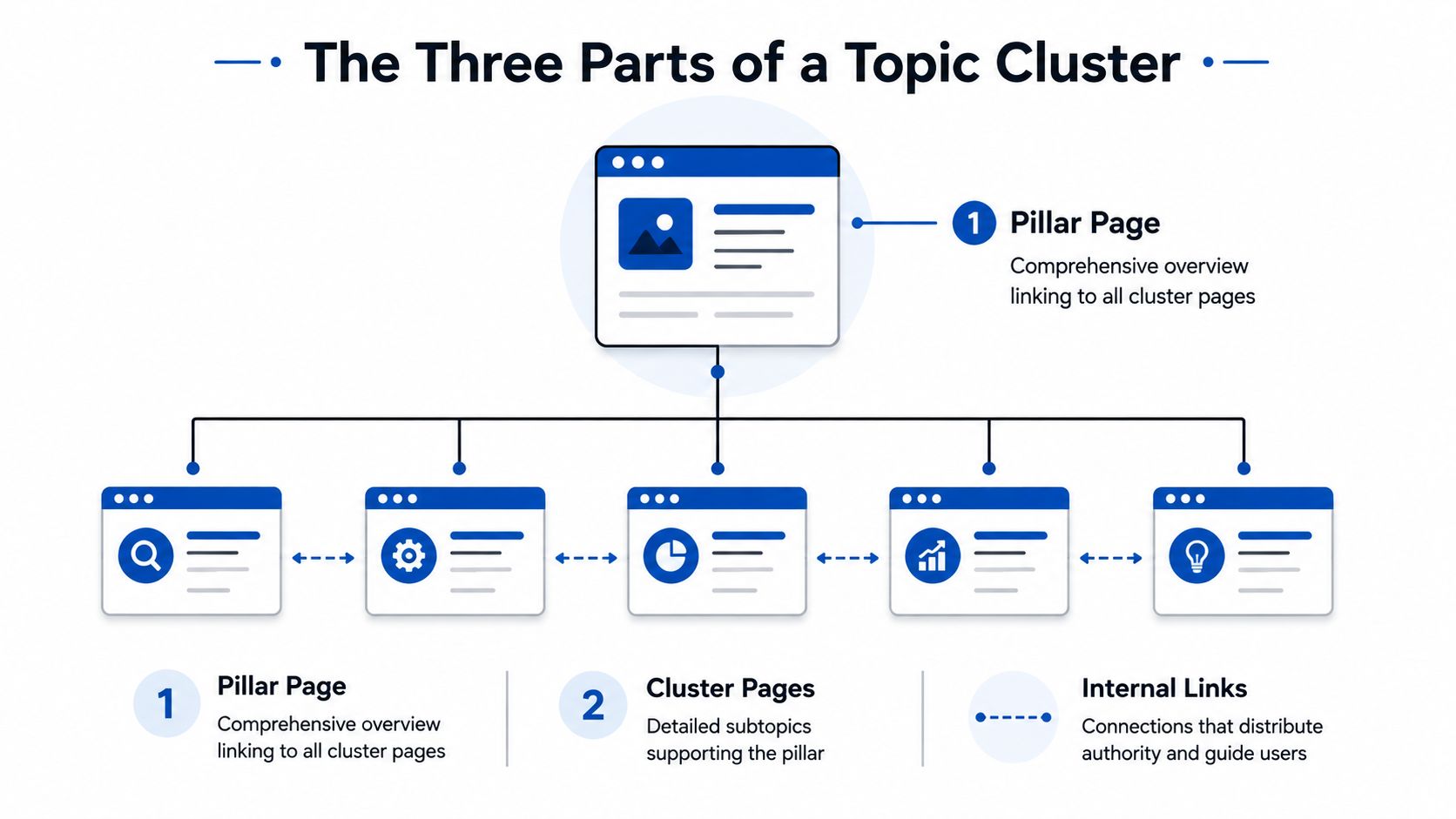
A cluster has three moving parts, and each one carries a different load. The pillar page sets the scope and gives the broad explanation. The cluster pages handle the narrower problems, edge cases, and intent-specific searches. The internal links make the architecture legible to crawlers and help the topic read as one connected system instead of a pile of unrelated URLs.
Start with the pillar page
For a developer tool like API monitoring software, the pillar page might be API Monitoring Guide or API Monitoring Best Practices. Its job is to define the topic clearly and stay at a high level, not to solve every implementation detail on the same page. HubSpot's pillar research treats the pillar as the overview layer, which is the right standard when you are deciding whether a page belongs in the hub or should be split into supporting content HubSpot pillar research.
A good pillar page has enough breadth to orient a buyer or a crawler, but it still leaves room for subpages to do the essential work.
Add cluster pages that target one job each
A cluster page should carry one subtopic, one intent, and one primary query. For the API monitoring example, that could be endpoint health checks, alert configuration, or API latency tracking. Conductor's guidance points to a finite set of supporting pages around a pillar, often 8 to 15 cluster articles per pillar, which is a practical ceiling when you are balancing coverage against maintenance Conductor Academy.
That limit matters in practice. Once a cluster gets too wide, pages start overlapping, writers start repeating themselves, and the internal link graph gets messy. If you are building for a SaaS product, it is usually better to keep each page narrow than to force every adjacent idea into the same article.
Connect them with actual links
Internal links are the part that makes the architecture work. They tell search engines which URL is the hub, which pages are supporting detail, and how the topic should be interpreted. Semrush recommends keyword-rich anchor text, and it also advises placing the primary keyword in the title tag, meta description, URL slug, H1, and first paragraph of the target page Semrush topic clusters.
A rough map on a whiteboard is enough to start, but the structure needs to survive production. Put the pillar in the center, place the subtopics around it, then draw the links back to the hub. If a page does not naturally point back to the pillar, it probably belongs in a different cluster, or it should be removed from the plan. A quick keyword gap analysis can help confirm whether that page fills a real topic gap or just adds another near-duplicate to the queue.
A Repeatable Planning Workflow for Clusters
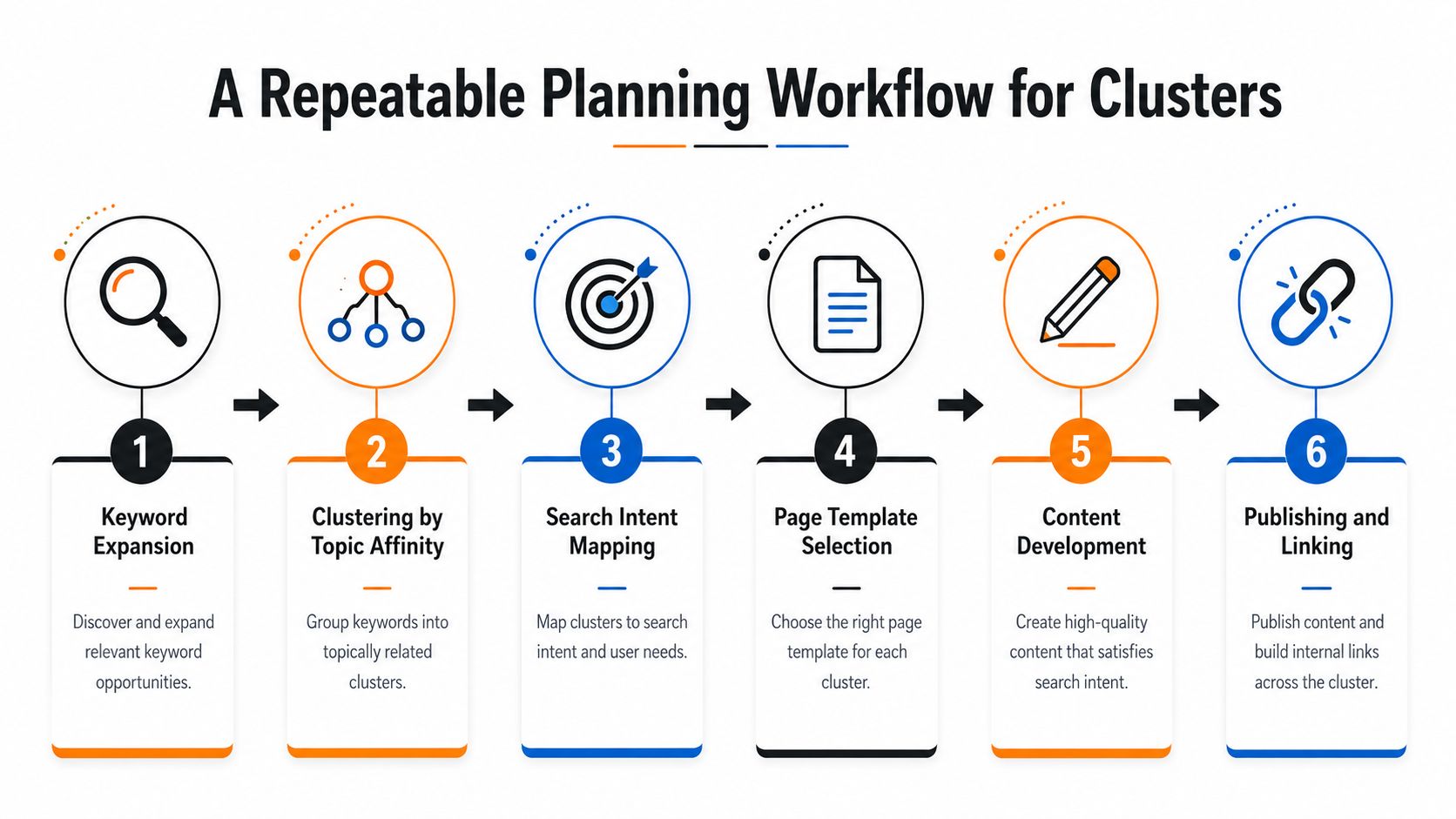
A cluster usually fails long before the first draft ships. The early mistakes are structural, a vague topic, weak demand, or a set of pages that overlap so much they fight each other. I start by validating search demand because everything else depends on whether the topic can support a real cluster.
1. Expand the topic space first
Start with one broad topic, then expand it into candidate subtopics, related questions, product use cases, and adjacent problems your buyers raise. The goal is to map the territory before you assign page types or ask a writer to draft anything. That keeps the cluster grounded in the product and the market, not in a keyword list that looks busy but goes nowhere.
2. Group by topic affinity
Once you have the raw list, group items by meaning instead of shared wording. Pages that sit too close together will cannibalize each other, and pages that are too far apart will make the cluster feel stitched together. A keyword gap analysis helps here because it shows where the topic space is missing coverage and where you are about to create another near-duplicate page.
Thin demand usually means one of two things, either the topic belongs inside a larger page, or it should not be part of the cluster at all.
3. Map intent before page type
A comparison page, a glossary page, a how-to guide, and a use-case page all do different jobs. Page type should follow intent, not the other way around. If the search results are mostly educational, the page belongs in the informational side of the cluster. If the results lean toward evaluation or product fit, the page needs a more commercial angle or it belongs outside the cluster.
4. Choose the template before writing
The template should be decided before anyone starts drafting. Pick the format that fits the job, guide, list, comparison, or product-led walkthrough, and stick to it. That reduces the odds of a page turning into a broad catch-all that tries to answer every related question in one URL.
5. Define the linking graph
The internal linking map belongs in the brief. Every supporting page should point to the pillar, and the pillar should point back to the supporting pages with anchor text that describes the destination clearly. That link structure gives search engines a cleaner signal about which URL is the hub and how the related pages fit together HubSpot pillar research.
6. Set measurement on the cluster, not just the page
Track the cluster as a unit. Individual URLs matter, but they do not tell you whether the architecture is pulling qualified traffic toward the right buying paths. Use cluster-level signals like sessions, average session length, and bounce rate to see whether the topic area is working as a system Topic cluster strategy guide.
Orchory AI Keyword Research Tool fits into this planning layer as a research input, because the cluster still needs validated demand before a prompt or PR gets written. Cleaner research usually leads to cleaner page assignments, and that saves a lot of rework once the build starts.
Scoring Clusters by Pipeline Impact
Most topic cluster advice stops at keyword volume. That is a weak sorting rule for B2B SaaS, because raw search demand does not show which topic drives demos, trials, or expansion. Search Engine Land's guidance is more useful operationally, since it recommends weighting categories by pipeline impact and business value, then scanning competitor blind spots and SERP undercoverage before drafting Search Engine Land topic clusters.
Cluster Prioritization Matrix
| Criterion | Weight | Signal |
|---|---|---|
| Pipeline impact | High | Does the topic connect to a buying stage, product problem, or expansion use case |
| Search demand | Medium | Is there enough validated query volume to justify a page or cluster |
| Intent fit | High | Does the SERP match the page type you want to ship |
| Competitor blind spot | Medium | Are rivals missing the angle or answering it poorly |
| SERP undercoverage | High | Are answers fragmented, outdated, or incomplete |
| Cannibalization risk | High | Would this overlap with an existing page |
Use demand gaps, not just volume
Inflowave defines an underserved topic as one where audience demand outpaces creator supply, which is the signal you want during prioritization Inflowave gap analysis. Search Engine Land also notes that "how do I" and "does X support Y?" patterns in comments often reveal low-competition angles, so one practical way to find useful subtopics is to read the questions people already ask instead of staring at a keyword list all afternoon Search Engine Land topic clusters.
Sort the backlog like product work
If you are choosing between three cluster candidates, score them against business value first, then check whether the search demand is strong enough to justify the page. That order matters because a topic with modest volume but strong buying intent can outperform a higher-volume topic that never reaches a pipeline-relevant audience.
Orchory Free SEO Tools can sit alongside that sort of review when you want a lightweight research pass before committing a build slot. The decision rule matters more than the tool name. A cluster earns its place when the topic is commercially meaningful, search demand exists, and the SERP leaves room for something better.
Turning Clusters into Coding Agent Prompts
Once a cluster is prioritized, the handoff should look like a pull request brief, not a marketing doc. That's the point where a coding agent can do useful work. Orchory's workflow is built around that handoff model, where the output becomes a ready-to-run prompt for tools like Claude Code or Cursor, and nothing hits production until a human reviewer merges the PR.
The prompt needs four fields
A usable prompt should include the page type, target keyword, search intent, and internal link targets with anchor text. If any of those are missing, the agent will improvise, and improv is exactly what you don't want when the page has to fit a cluster architecture.
Here's the shape I use:
- Page type: comparison, use case, glossary, tutorial, or product page.
- Primary keyword: one query the page should own.
- Intent: informational, commercial, or transactional, depending on the SERP.
- Links: exact URLs and anchor text for the pillar and sibling pages.
- Scope: what the page should cover, and what it should leave out.
Keep the prompt narrow
The prompt should describe the job, not the entire content strategy. If the cluster page is about API error monitoring, the agent doesn't need a lecture on brand tone or the history of monitoring software. It needs enough structure to draft the page correctly and enough constraints to avoid overlapping the pillar.
The cleanest PRs come from prompts that specify the page's boundary conditions, not just its topic.
Review like an engineer
Once the PR lands, check three things. First, the page matches the intent. Second, the anchors point to the right URLs. Third, the page doesn't duplicate another cluster URL's job. If all three pass, the merge is a content deployment, not a guessing game.
That workflow keeps production control with your team. The coding agent can draft, but it can't decide architecture. That separation is the main reason this model works for small teams that need SEO throughput without giving up review discipline.
A Sample Topic Cluster for a SaaS Product
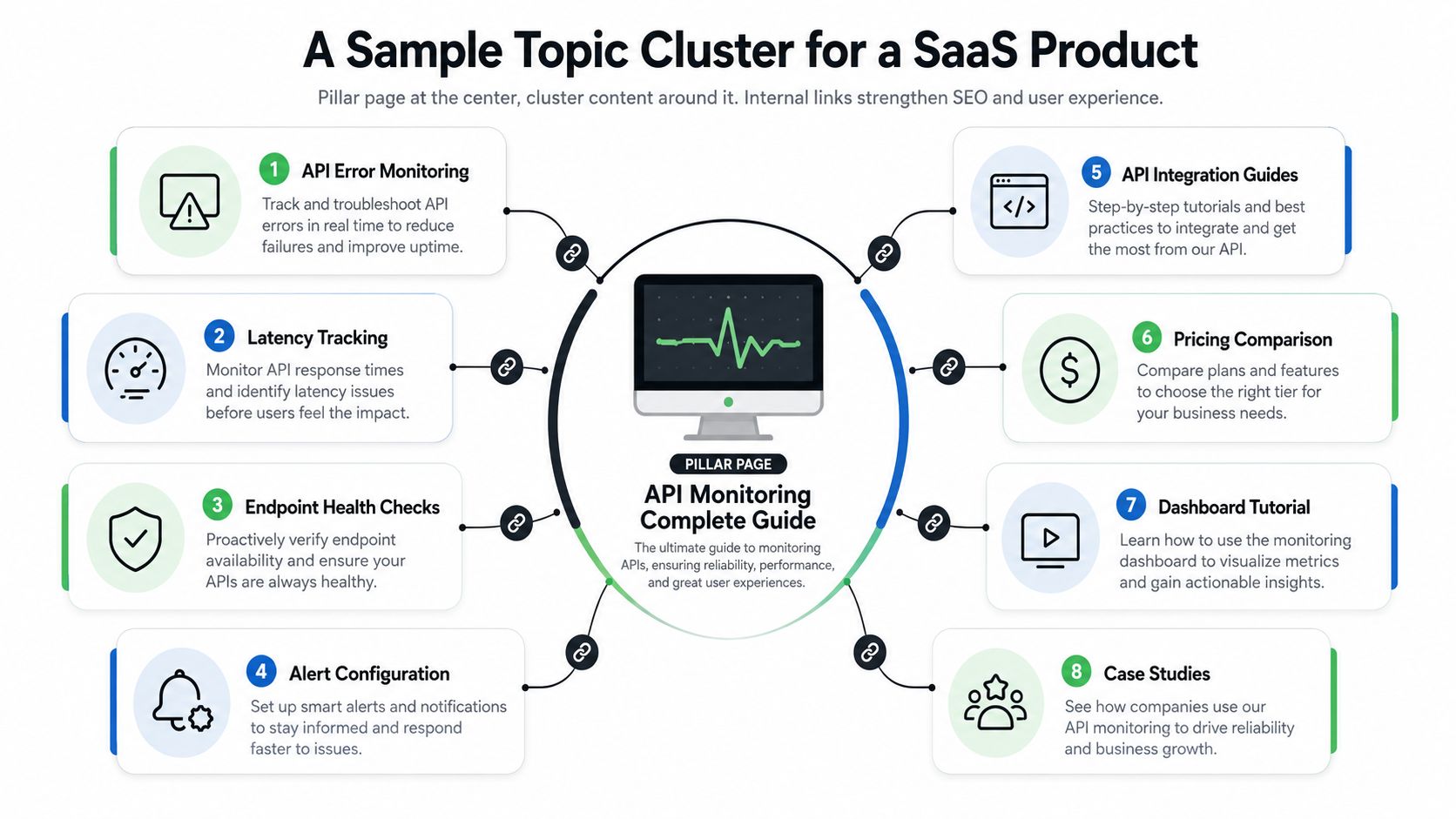
An API monitoring tool is a clean example because the subject has a broad head term, several useful subtopics, and clear commercial intent. The pillar page owns API monitoring, while each cluster page handles one job and keeps the site structure tight.
Pillar page
The pillar should cover the system as a whole, what API monitoring is, why it matters, the core metrics, alerting basics, dashboards, and deployment considerations. It should also link to every supporting page with descriptive anchors so the hierarchy is obvious to both readers and crawlers.
Eight cluster pages
- API Error Monitoring, focused on failure patterns and alerting.
- Latency Tracking, centered on response-time analysis and thresholds.
- Endpoint Health Checks, covering uptime verification and status signals.
- Alert Configuration, explaining routing, escalation, and notification logic.
- API Integration Guides, for setup with common stacks and services.
- Pricing Comparison, for commercial intent and vendor evaluation.
- Dashboard Tutorial, showing how teams read and customize views.
- Case Studies, proving the category in real operating contexts.
Linking and measurement
Each cluster page links back to the pillar. The pillar links out to each page, and sibling pages can link where the relationship is obvious, like error monitoring and alert configuration. That gives search engines a clear map and gives readers a way to move through the topic without landing on unrelated content.
Track the cluster as one unit, not just as separate URLs. HubSpot's topic analytics model points to cluster-level sessions, average session length, and bounce rate as the practical view. That is the set of numbers that shows whether the subject area is gaining traction or just adding pages.
The finished cluster should feel boring in the best way. Every page has a role, every link has a reason, and every keyword maps to a real user job.
Common Mistakes That Kill Cluster Performance
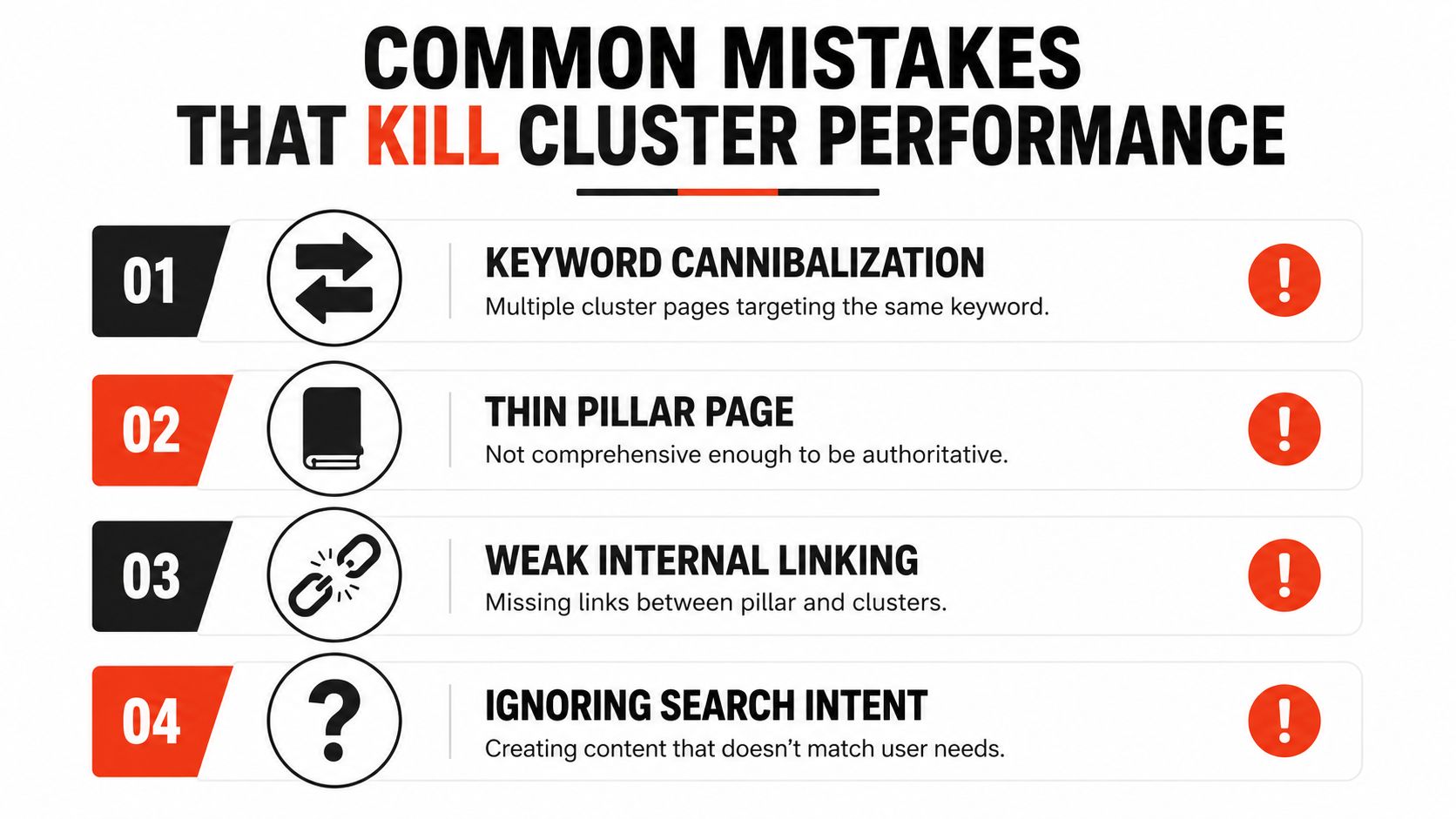
Most cluster failures come from treating the model as a content calendar instead of a system. The architecture gets muddy, the pages overlap, and the site ends up with more URLs but less clarity.
Four failure modes
- Keyword cannibalization, where two pages target the same query and split relevance.
- Thin pillar pages, where the hub is too shallow to act as the authoritative overview.
- Weak internal linking, where the pillar and supporting pages don't reinforce each other.
- Ignoring search intent, where the page format doesn't match the SERP or the user's task.
The fix is usually structural
If two pages overlap, merge or re-scope them. If the pillar is thin, rebuild it before adding more cluster pages. If links are missing, add them in the brief and in the PR. If the intent is wrong, change the page type instead of forcing the copy to compensate.
A useful audit question is simple, does this page strengthen the pillar, or does it compete with it? That one question catches most cannibalization issues before they spread.
When a cluster is healthy, the pillar owns the broad topic, the subpages own distinct jobs, and the links make the hierarchy obvious. When it's unhealthy, the site feels like a pile of adjacent articles that happen to share a subject.
If you want this work turned into a repeatable pipeline, Orchory can take keyword research, cluster theming, and opportunity scoring, then turn the result into prompts your coding agent can ship as reviewed pull requests. That keeps the planning layer inside your control while still moving pages into production fast.
FAQs
What is a topic cluster content strategy?
How many cluster pages should a pillar page have?
How should a SaaS team prioritize which clusters to build first?
What does a coding agent need in a prompt to draft a cluster page correctly?
What are the most common mistakes that kill cluster performance?