Keyword Gap Analysis: From Missing Keywords to Merged PRs
A step-by-step keyword gap analysis workflow for seed-stage teams: pick real SERP rivals, cluster and score terms, then hand off to agent-ready PRs.
You're staring at the same problem a lot of seed-stage teams hit. A competitor keeps shipping pages that pull steady organic traffic, your own blog has a few decent posts but not enough coverage, and you've got a developer plus a coding agent, not an SEO hire. The gap is too wide to “write more content” your way out of, so the question is which pages to build next, in what order, and how to turn that plan into merged PRs.
Keyword gap analysis gives you that path. Done properly, it's not a spreadsheet of missing terms, it's a comparison between your domain and a small set of real search rivals, followed by filtering, clustering, scoring, and handoff into build-ready prompts. Semrush's workflow reflects that shape. It lets you enter your domain plus up to four competitors, shows a Missing tab, and lets you export the result as Excel or CSV for further planning (Semrush keyword gap analysis workflow).
Why Most Keyword Gap Analysis Stops at a CSV
A founder opens a competitor's organic traffic graph, sees page after page that could have been theirs, and then exports a “missing keywords” file. That file feels productive for about ten minutes. Then it sits in a download folder because nobody has turned it into a page queue, a brief, or a PR.
That's where most keyword gap analysis dies. The analysis was treated like a report, not a shipping workflow. A real workflow starts with a small rival set, pulls raw SERP and tool data, normalizes it, scores the opportunities, and ends with prompts a coding agent can execute into reviewed pull requests.
What done looks like
Done means the team can answer three questions without reopening a spreadsheet. Which keywords are worth building for, which page type should cover each cluster, and which PR should land first. If you can't answer those, you don't have an SEO process, you have a list.
Practical rule: if a keyword gap file can't be converted into page briefs in the same week, it isn't operational yet.
The other failure mode is chasing the wrong rival set. A business competitor can look obvious in a pitch deck and still be irrelevant in search. If they don't rank on the queries your buyers use, their keywords will pollute your backlog with attractive looking terms that don't match your SERP reality.
Orchory is built around this handoff. It takes keyword research, clustering, and scoring, then outputs ready-to-run prompts for a coding agent instead of leaving you with a static report. That matters for a small team, because the work only compounds if it becomes pages, not slides.
Gathering the Raw Data Sources You Actually Need
A credible keyword gap pull needs four inputs, and each one catches a different blind spot. Your own Google Search Console export shows what Google already associates with your site. Competitor SERP scrapes show what ranks in the top 10 for your target queries. A paid tool gives you search volume and keyword difficulty, and a short manual list keeps the work anchored to your product language instead of generic SEO noise.
Build one normalized table
Pulling only paid-tool data is lazy because it hides opportunity behind database averages. A keyword can sit at positions 8 to 20 in your own data while competitors sit at the top, and a tool-only export will not show that nuance. GSC alone also undercounts your opportunity, because it only reflects the queries your site already appears for.
A simple schema keeps the work usable across teams:
| Column | Source | Purpose | Example |
|---|---|---|---|
| query | GSC, SERP scrape, manual list | Canonical keyword text | ai keyword research tool |
| domain | SERP scrape, competitor set | Who ranks | competitor.com |
| position | GSC, SERP scrape | Current visibility | 7 |
| URL | GSC, SERP scrape | Page mapping | /blog/keyword-research |
| volume | paid tool | Demand filter | monthly searches |
| KD | paid tool | Difficulty filter | keyword difficulty |
| intent tag | manual review | Content fit | comparison |
| observed SERP features | SERP scrape | Format check | FAQ, snippet |
A practical export from Semrush can cover part of this quickly, since it supports up to four competitors and surfaces a Missing tab exportable as Excel or CSV. For the rest, keep your own records in a single sheet or database table so you can join, filter, and cluster without reformatting, as outlined in the keyword gap analysis workflow.
If you want a fast source for manual seed queries, Orchory AI Keyword Research Tool fits naturally here as one input among others, not as the whole workflow.
Keep the raw table ugly on purpose. Cleanup happens later. Premature formatting breaks joins, and joins are what turn research into something your engineer can ship.
One practical shortcut is to store the raw pulls in CSVs named by source and date, then merge into one normalized table before analysis. That makes refreshes much easier later, because you can swap in a new export without rebuilding the pipeline.
Choosing the Right Rival Set SERP Rivals, Not Just Business Rivals
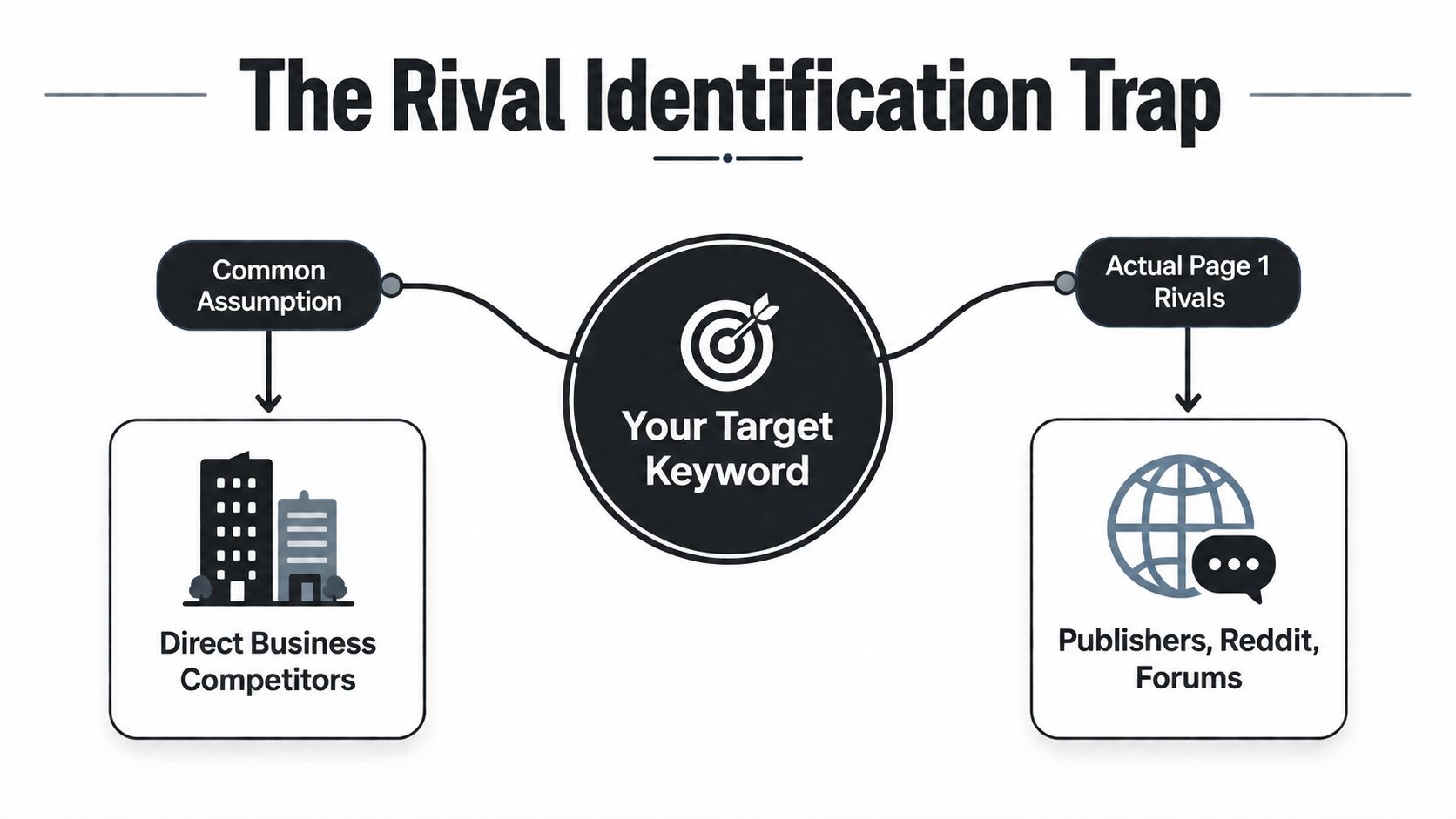
The biggest trap in keyword gap analysis is comparing yourself to the wrong kind of competitor. The companies that sell against you are not always the sites that win page one. For many SaaS queries, the true rivals are publishers, directories, Reddit threads, forums, or affiliate pages that own the intent your buyers are expressing.
Verify the SERP before you trust the gap list
The safest way to pick rivals is to sample 20 to 30 target queries, record who shows up in the top 10, and shortlist only the domains that appear repeatedly. That gives you a rival set that's grounded in search behavior, not org charts. It also lines up with practical workflows that use a small competitor set, typically 2 to 4 domains (AIrops keyword gap analysis workflow).
A business competitor that never appears in those results should not be in the comparison set. If you include them anyway, you'll end up prioritizing keywords that look strategic but don't match what Google is already rewarding. That's how teams waste cycles writing the wrong page format for the wrong query.
A worked example from a SaaS search set
Say you sell developer tooling and want to rank for “code review automation,” “pull request checklist,” and “CI pipeline best practices.” Your business competitors might be other SaaS products. Your SERP rivals might also include GitHub docs, engineering blogs, Stack Overflow threads, and a few technical newsletters.
That changes the content decision immediately. If the page one mix is educational and documentation-heavy, your comparison page won't win just because a competitor sales page does. The gap list is only useful if it reflects the actual page types the SERP prefers.
Practical rule: if a domain doesn't recur in the sampled SERPs, leave it out of the rival set, even if sales says it competes with you.
A free exploratory pass can help. Orchory Free SEO Tools fits naturally as a lightweight place to sanity-check the search surface before you commit to a full workflow. The point isn't tool loyalty. It's making sure the rival set reflects page-one reality.
Normalizing, Deduplicating, and Clustering the Terms
Raw keyword exports are noisy by default. They come with plural variants, branded clutter, awkward capitalization, and duplicate rows from different sources. If you score that mess directly, you'll promote the same topic three times and think you have more opportunity than you do.
Clean the query set before you think about priority
Start by lowercasing all queries, stripping brand noise, and merging close variants that clearly share intent. “keyword gap analysis tool,” “keyword gap analysis tools,” and “keyword gap analysis software” probably belong in one canonical cluster if the SERP supports it. Drop queries below your minimum volume threshold, otherwise you'll spend time on pages nobody searches for.
One practitioner guide recommends keeping a small intent brief with 3 to 5 secondary keywords, a target audience, search intent, content format, key talking points, and 1 to 2 competitor links, while also filtering for a minimum volume threshold around 50 or 100 monthly searches (). That's a good floor for bootstrapped teams, because it stops the queue from filling with speculative long tails.
Use a simple clustering rule
For higher-volume terms, group by shared head term and confirm against the SERP. For lower-volume terms, cluster by observed page one overlap. That keeps the clusters tight without over-engineering the taxonomy.
A simple intent map is enough for handoff:
| Intent | Signals | Typical page type |
|---|---|---|
| informational | how, what, why, guide | blog post, glossary |
| comparison | best, vs, alternatives | comparison page, listicle |
| transactional | pricing, software, tool, demo | landing page, pricing page |
| navigational | brand, login, docs | branded page, support page |
Example cluster output
| Canonical query | Cluster | Intent | Page type |
|---|---|---|---|
| keyword gap analysis | keyword gap analysis | informational | pillar page |
| keyword gap analysis tool | keyword gap analysis | transactional | tool page |
| keyword gap analysis examples | keyword gap analysis | informational | guide |
| keyword gap analysis for SaaS | keyword gap analysis | informational | use case page |
| competitor keyword gap | competitor gap | informational | blog post |
| SEO competitor analysis | competitor gap | informational | guide |
| missing keywords | gap diagnostics | informational | glossary |
| content gap vs keyword gap | gap diagnostics | comparison | comparison page |
| SERP rivals | rival selection | informational | explainer |
| top 10 competitors | rival selection | informational | guide |
| keyword clustering | clustering | informational | tutorial |
| search intent mapping | clustering | informational | guide |
If you want this to plug directly into engineering work, build a page-type column right in the cluster table. Then the handoff layer can join that field without reformatting or guessing.
Scoring and Building a Ranked Page-Opportunity Queue
A clustered list still isn't enough. Two pages can target the same theme and still deserve very different treatment depending on likely impact, difficulty, and fit. The queue has to tell you which page gets built first, which one waits, and which one should be dropped.
Use a formula your team can defend
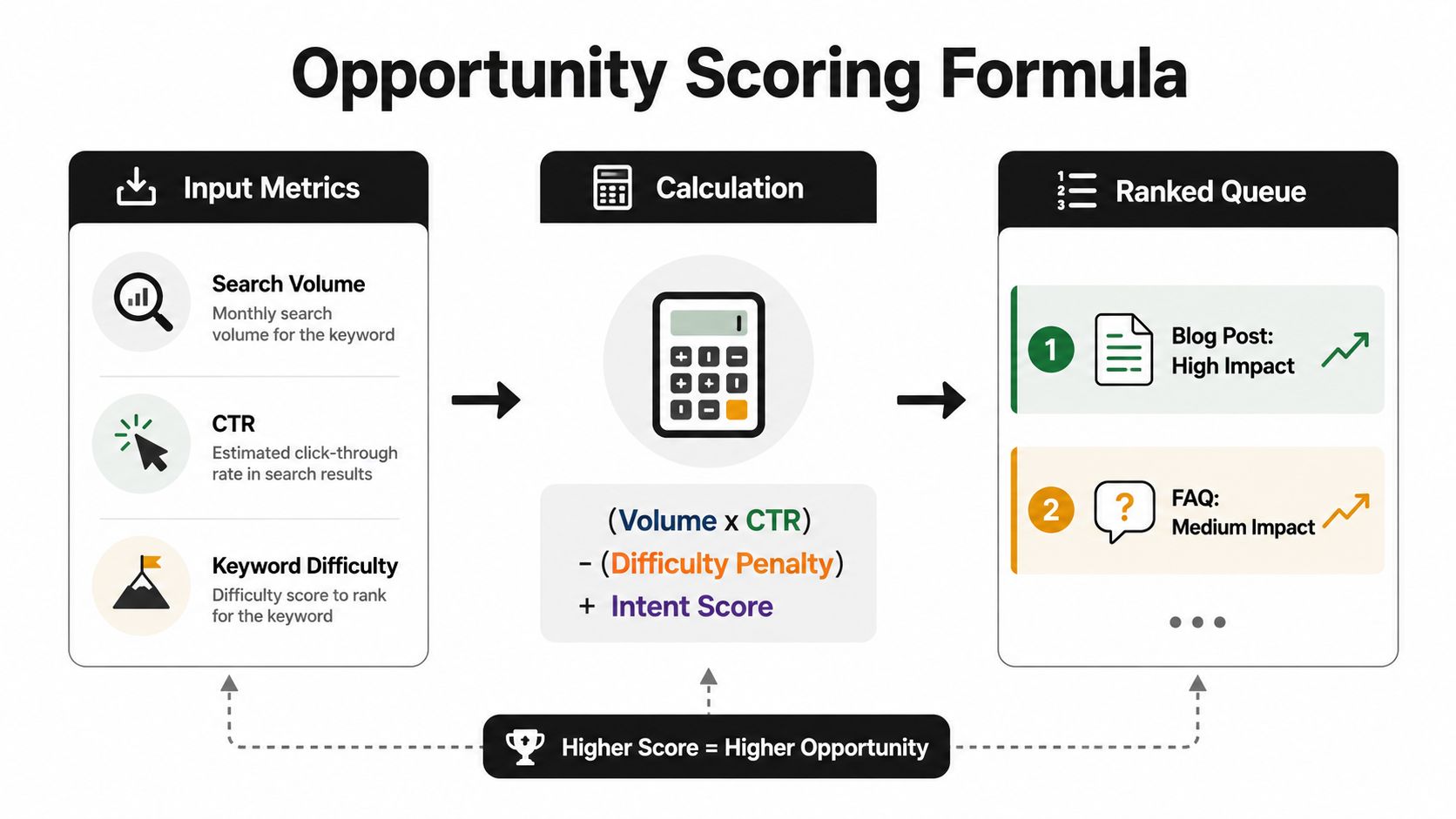
A practical scoring model is a weighted sum of estimated impact, difficulty penalty, intent fit, and a format bonus for page types you can ship.
Opportunity score = (Volume × Target CTR) - Difficulty penalty + Intent score + SERP format bonus
That's simple enough to implement in SQL or Python without a scoring library. The weighted parts matter more than the exact math. If your team can't explain why a page outranked another, the queue won't survive the next planning meeting.
A useful framing from AI-assisted competitive workflows is to score opportunities by business relevance, search volume, difficulty, and intent alignment, then validate the top items with traditional SEO data (Digital Applied AI keyword research guide). The core idea is sound, even if your own weights differ.
A six-item queue
| Rank | Target cluster | Page type | Why it lands here |
|---|---|---|---|
| 1 | keyword gap analysis | pillar page | central topic, broad fit, clear internal linking anchor |
| 2 | keyword gap analysis tool | product page | strong intent match, can be shipped as a focused landing page |
| 3 | competitor gap | blog post | supports discovery intent and links into the pillar |
| 4 | search intent mapping | guide | adjacent topic with shared audience and low content friction |
| 5 | SERP rivals | explainer | helps correct the rival-set mistake before later workflows |
| 6 | content gap vs keyword gap | comparison page | useful, but narrower demand than the core cluster |
The point of the queue is not to sort by volume alone. A high-volume query with the wrong intent fit can sit below a lower-volume term that maps cleanly to a page type you can publish this week. That trade-off is often the difference between a backlog and shipped SEO.
Practical rule: if a page type can't be built without inventing a new content pattern, discount it until the team has capacity to support that format.
For teams that want the queue to be generated in a repeatable way, this is the layer where Orchory fits as a planning system. It outputs ranked opportunities and prompt-ready handoff material, which means the score is not the endpoint, it's the trigger for the build step.
Turning the Queue Into Ready-to-Run Prompts and PRs
A queue only becomes useful when it turns into a prompt your coding agent can execute cleanly. The prompt has to carry the query, secondary terms, intent, page type, required sections, internal links, and acceptance criteria. If it's missing any of those, the agent will improvise, and improvise is another word for rework.
A prompt structure that actually ships
A good handoff prompt is short, structured, and unambiguous.
- Target query: keyword gap analysis tool
- Secondary terms: competitor keyword gap, missing keywords, keyword clustering, search intent
- Search intent: transactional
- Page type: product landing page
- Required sections: problem, workflow, inputs, outputs, review flow
- Internal links to include: pillar page, free tools, pricing or product page
- Acceptance criteria: page matches target intent, includes schema if relevant, slug follows site convention, alt text is written, sitemap entry is added
The engineering checklist matters just as much as the prompt. The agent needs the file path, slug, any schema fields, image alt text, and the sitemap target so the PR is mergeable without cleanup. That's how you keep production control with the team instead of with the agent.
A handoff flow that keeps humans in control
The agent should open the PR, not merge it. A reviewer checks the title, heading structure, internal links, and whether the page matches the SERP format. That review step is where the SEO judgment lives, especially for pages that might straddle informational and comparison intent.
One useful reference for this kind of automation-oriented workflow is SEO Tasks You Can Automate With AI Agents 2026, which fits the same principle, prompt the task, then review the output like any other code change. Keep that loop tight and the team can ship search pages between deploys instead of scheduling separate content projects.
The screenshot below shows the planning side of that pipeline in practice.
If you prefer a visual walkthrough, this short embed shows how the queue can flow into agent work without turning SEO into a separate operating system.
<iframe width="100%" style="aspect-ratio: 16 / 9;" src="https://www.youtube.com/embed/JP34CMl53lY" frameborder="0" allow="autoplay; encrypted-media" allowfullscreen></iframe>Common Pitfalls and a 30-Day Decision Checklist
The recurring mistakes are boring, but they cost the most time. Teams chase high-volume terms without checking SERP format, run the analysis once and forget it, score without a difficulty penalty, or build rival sets from business assumptions instead of page-one reality. Any one of those can make the backlog look impressive while the site stays flat.
A better cadence is a refresh every 90 days after the first publish wave, which gives you enough time to see early ranking movement and also catch new gaps created by competitor launches (MQL Magnet keyword gap analysis workflow). That cadence is practical for seed-stage teams because it lines up with publishing cycles instead of asking for constant re-audits.
The queue should shrink when pages work. If it doesn't, the scoring model or rival set is wrong.
30-day decision checklist
- Rival set verified: sampled real SERPs and removed domains that never recur.
- Raw data normalized: lowercased, deduped, and branded noise stripped.
- Intent tagged: each cluster has a clear page type.
- Queue scored: priorities reflect impact, difficulty, and fit.
- Prompts handed off: coding agent has everything needed to draft the PR.
- PR reviewed and merged: human checked the page before publish.
- GSC monitored: new queries and rankings feed the next refresh.
The point isn't to build a huge SEO system. It's to create one repeatable pipeline that turns search demand into pages, and pages into PRs, without making your team guess. If you want that pipeline to run with less manual setup, visit Orchory and see how it handles keyword research, clustering, scoring, and prompt-ready handoff in one workflow.
FAQs
What's the difference between keyword gap analysis and a regular keyword research pass?
How many competitors should I include in a keyword gap analysis?
How do I know if I've picked the wrong rival set?
What's a reasonable minimum search volume to include in the queue?
How often should a keyword gap analysis be refreshed?
Should a coding agent be allowed to merge its own PRs from these prompts?