
How to Build Topical Authority
Build topical authority by owning one subject, covering the questions searchers ask, publishing cite-ready pages, connecting them, and measuring the topic as a set.
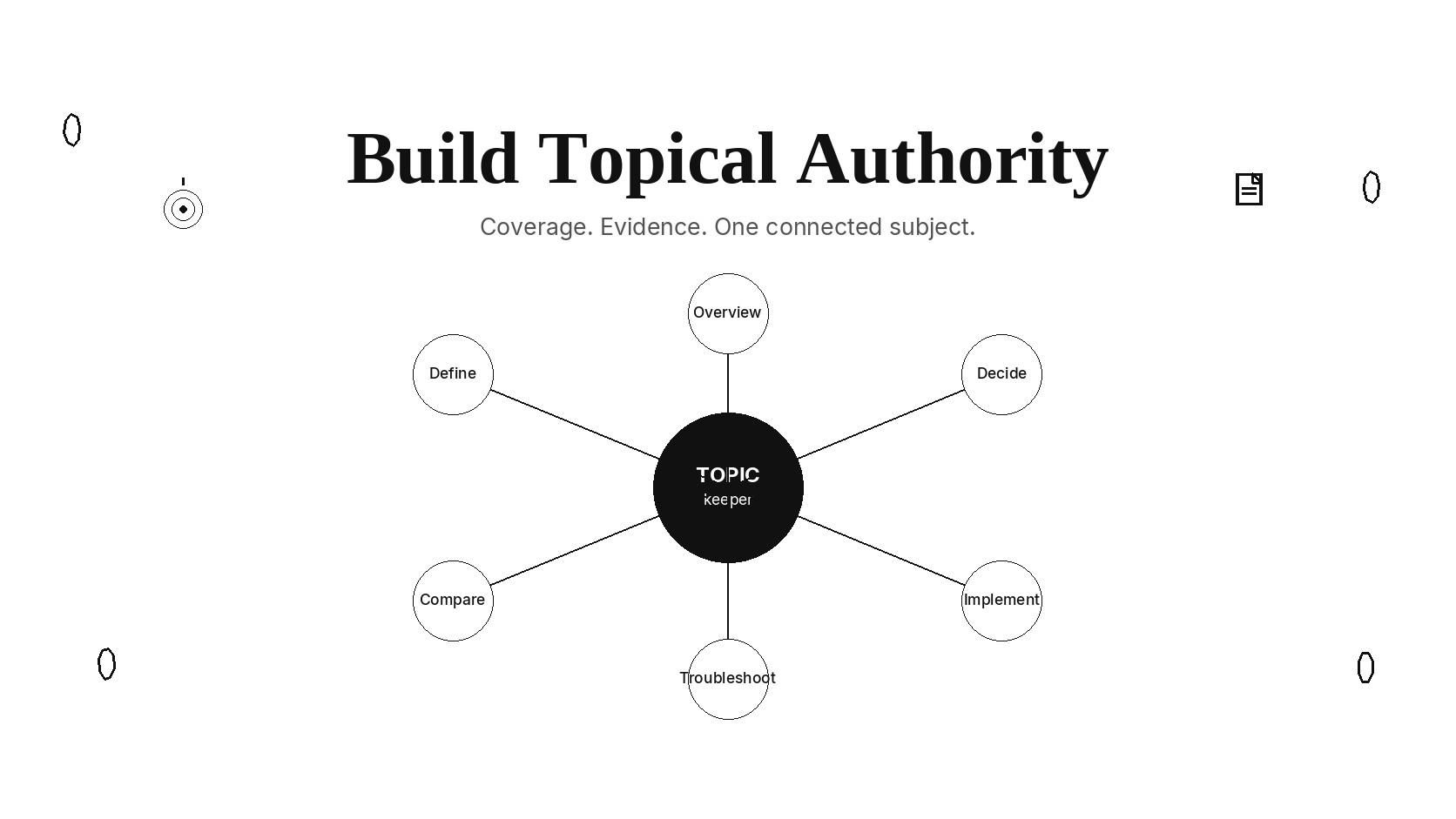
How to build topical authority: pick one subject you can own, cover the questions searchers actually ask, publish cite-ready pages that prove their claims, connect those URLs so the topic reads as one system, and measure the set instead of isolated ranks.
Topical authority (also called topic authority) is not a number in Search Console. Google does not publish a topical-authority score. It is an inference: does this site look like a complete, trustworthy source on this subject, or like a pile of disconnected posts? Google's people-first content guidance asks whether the work shows first-hand expertise and enough depth to satisfy the need. Authority work is how you make that true for a whole topic, not one URL.
What topical authority is (and is not)
Search engines group related queries and decide which sites deserve to appear across that neighborhood. A site that answers the overview, the adjacent questions, the comparisons, and the edge cases, with consistent facts and crawlable links, looks like a source. A site that publishes one generic article and moves on looks like a visitor.
That is different from three things teams often mix up:
| Idea | What it actually is | What it is not |
|---|---|---|
| Topical authority | Inferred coverage and trust on one subject | A published Google score you can export |
| Topic cluster | Site architecture: pillar, supporting pages, links | Proof that the pages are complete or unique |
| Domain Authority | A third-party estimate of relative link strength | A topical signal, or a Google ranking factor |
A smaller site can outrank a stronger domain on a narrow subject it covers more completely. Link equity helps discovery and trust, but it does not replace missing answers. If the SERP for your category is a mix of guides, comparisons, and troubleshooting, one overview page cannot carry the topic.
Practical rule: if you cannot name the subject, the audience, and the questions you refuse to cover, you do not have a topic yet. You have a calendar.
How topical authority differs from topic clusters
A topic cluster is how you arrange URLs. Topical authority is whether that arrangement, plus the pages themselves, convinces a search engine you own the subject. The live playbook for a topic cluster content strategy covers pillar pages, supporting pages, and the links between them. Come back here for the authority job: coverage completeness, evidence, entity consistency, and topic-level measurement.
You can map a clean cluster and still fail the authority test:
- The pillar restates the title and leaves every hard question to "coming soon."
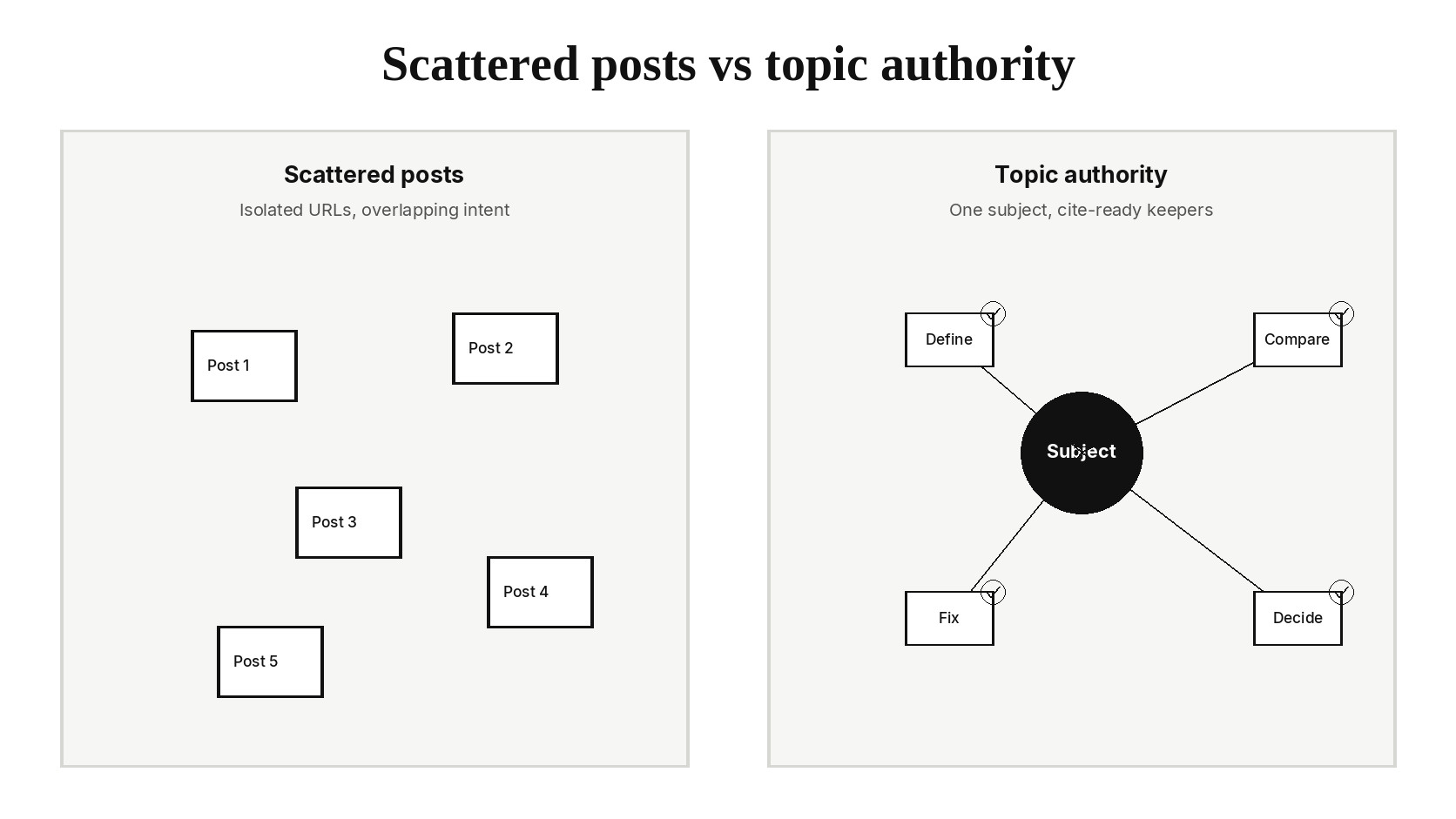
- Supporting pages chase the same intent and split impressions.
- Claims have no named sources, so nothing is safe to quote.
- The graph exists on a whiteboard but not in crawlable HTML.
Architecture is necessary. It is not sufficient. The steps below assume you will use clusters as the filing system and then fill that system with pages worth citing.
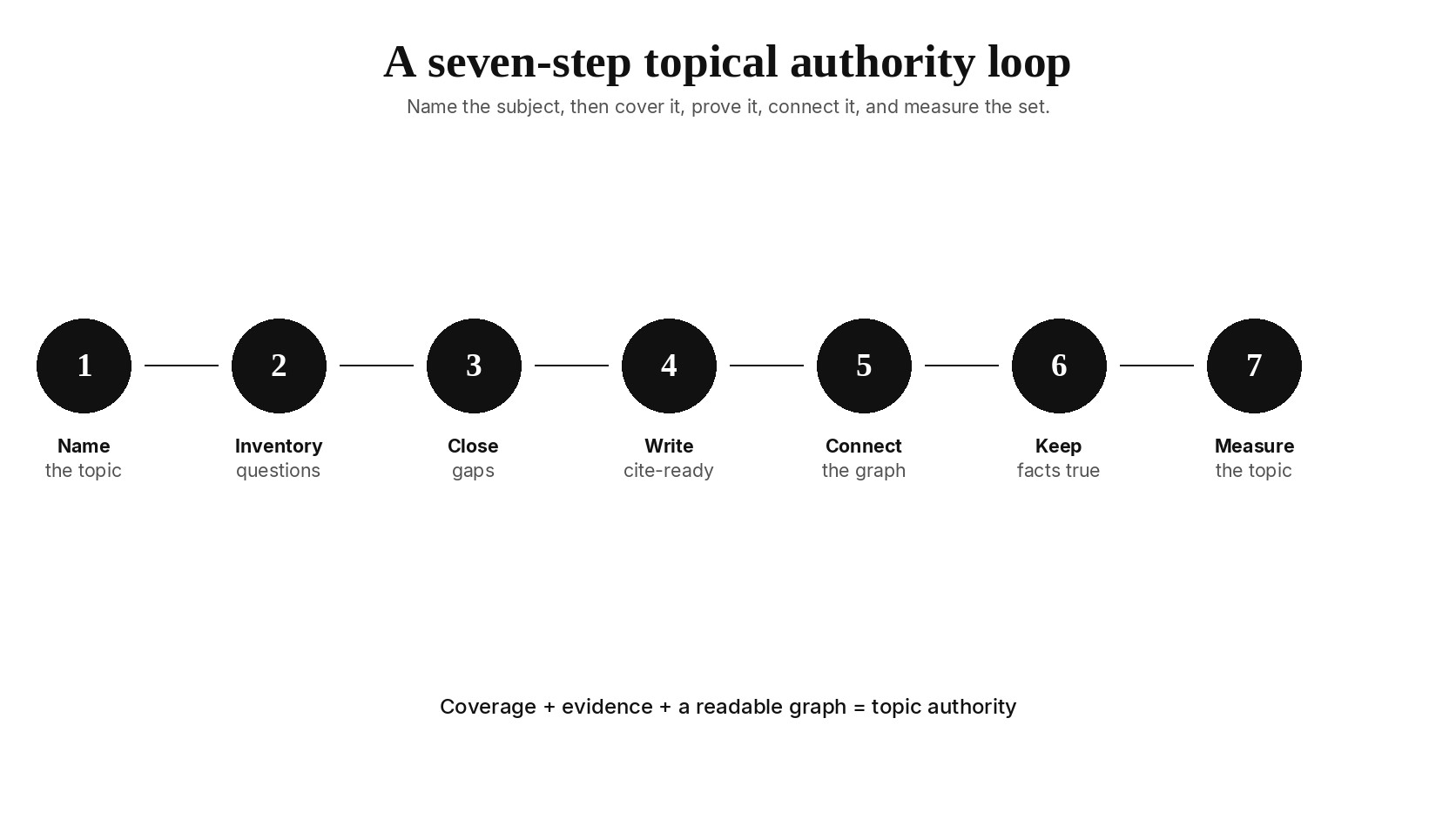
1. Name the topic you can actually own
Authority starts with a boundary, not a keyword list. Write one sentence: who this is for, what subject you will be the source on, and what sits outside the set. "API monitoring for SaaS engineering teams" is a topic. "Everything developers search" is not.
Test the boundary against three constraints:
- Product truth. You can support the claims with what you ship, support, or have measured. Invented coverage is a short-term ranking trick and a long-term trust leak.
- Audience fit. The people who search this subject can become customers, or they are a necessary research audience on the path to those customers.
- Maintenance. You can keep the set accurate. A topic you cannot update will rot, and rotting pages teach crawlers the opposite of authority.
If the first draft of the topic is a whole industry, cut it until a two-person team could finish a first pass. You can widen later. Starting wide produces stubs, and stubs are how topical authority fails in public.
2. Inventory the questions searchers ask
Keyword volume is a weak map of a topic. Searchers ask jobs: define, compare, troubleshoot, implement, decide. Build the inventory from those jobs, then attach queries to them.
Collect candidates from:
- The live SERP for the seed topic: page types, People Also Ask, and related searches.
- Search Console queries that already impress on nearby URLs, including ones you did not intend to rank.
- Sales, support, and onboarding questions that repeat in the product.
- Competitor keepers: which subtopics they cover that you do not. A keyword gap analysis is useful here when you need a structured missing-coverage list, not a longer keyword dump.
Group the raw list by meaning, not shared wording. "What is topical authority" and "topic authority meaning" are one intent. "How to build topical authority" is another. If two items would satisfy the same click, they share a URL later. The keyword research guide is the deeper method for validating demand once the question set exists; this step is about completeness of the subject, not picking a single head term.
3. Close coverage gaps with one URL per intent
Authority dies in two opposite ways: missing answers, and duplicate answers. For each question in the inventory, assign exactly one action.
| Situation | Action | What good looks like |
|---|---|---|
| No page exists and the intent is real | Create one keeper | A distinct URL, title, and H1 that match the job |
| A page exists but cannot satisfy the click | Expand the keeper | Answer first, evidence, and the missing sections |
| Two or more URLs share the intent | Fold into one preferred URL | One keeper, redirects or canonicals, updated links |
| The question is a section, not a page | Keep it on the pillar or a sibling | No new URL, a heading the pillar can link to |
Overlapping intent is the ranking-side view of the same mess. If two keepers already split a query, what cannibalization is in SEO is the decision guide for which URL should receive the links and the impressions. The authority win is identical: one URL per intent so the topic does not compete with itself.
Do not fill gaps with thin variants. A location-token swap or a synonym URL is not coverage. Coverage is a new job the reader could not finish on an existing page.
4. Write cite-ready pages, not stubs
A cite-ready page is one a searcher, a classic result, or an AI answer can lift without guessing. It leads with the recommendation, separates facts from opinion, and names sources next to measurable claims. That is the same bar Google describes for helpful, people-first pages, and it is the material answer systems can quote.
For every keeper in the topic:
- Answer in the first screen. The lead should resolve the query, then the rest of the page earns the click that stayed.
- Match the SERP format. If the results are step-by-step guides, ship steps. If they are comparisons, ship criteria. Format follows intent.
- Prove the claims that can be proved. Link the primary source beside the number or the definition. Unsourced statistics do not build authority; they create a page that looks generated.
- Add the decisions, limits, and failure modes. Expertise shows up where the page says what not to do, not only what to try.
Length is a side effect of finishing the job. A short definition that fully answers one question can be stronger than a long page of filler. A long page that still leaves the decision unmade is still thin.
The guide to getting cited in AI answers is the companion when the goal is extractable passages. The work here is the same pages: they just have to sit inside a complete topic, not as a one-off citation bid.
5. Connect the graph so the topic is readable
Crawlers cannot infer a topic from a folder name. They infer it from crawlable links, descriptive anchors, and which URL the rest of the set recommends. After the keepers exist, the graph is the authority signal you control most directly.
- Every supporting page points to the pillar with an anchor that names the subject, not "overview" or "this guide."
- The pillar points back to each supporting keeper with an anchor that names that keeper's job.
- Sibling pages link when a reader would actually move between them (compare to implement, diagnose to fix).
- Orphans get a path from a page that already earns impressions in the same subject.
A whiteboard map is a draft. The production test is HTML: real <a href> paths a crawler can follow without executing a script. The internal linking strategy guide is the audit-and-fix loop for that graph. If the topic still feels like a pile of posts after you draw the links, the problem is usually missing keepers or overlapping keepers, not a missing widget.
6. Keep the entity and the facts consistent
Search engines build an idea of who you are and what you know from repeated, compatible statements. Authority leaks when the same product, person, or definition changes from URL to URL.
- Name the same thing the same way. Product names, plan names, and the subject itself should not drift between the pillar and a supporting page.
- Repeat the facts that must stay true. Pricing, eligibility, and technical constraints belong in one source of truth and then on every page that mentions them.
- Show who is responsible. A visible author, a review date when the body actually changed, and contactable organization details help a rater or a model decide whether the page has a real source.
- Prefer first-hand proof where you have it. Original measurements, screenshots of your own UI, and limits you have hit in production beat generic summaries of other people's posts.
This is also where off-site corroboration helps: mentions, citations, and links from pages about the same subject. Those are slow to earn and easy to fake badly. Do not chase directories. Publish pages other practitioners would cite, then ask for the citation where a real relationship exists.
7. Measure authority at the topic, not the page
A single URL moving from position 12 to 8 does not tell you whether you own the subject. Measure the set.
In Search Console, build a query group for the topic (a regex or a saved filter of the seed and its adjacent questions). For a 28 to 90 day window, record:
- Cluster impressions and clicks. Is the subject earning more discovery as a whole?
- Query coverage. How many distinct queries inside the subject do you appear for? New coverage is often the first honest signal.
- Intent winners. For each important query, does one preferred URL take the clicks, or do two of yours split them?
- Index status of keepers. A planned page that sits in Discovered, currently not indexed is a coverage hole, not a future asset.
Compare the topic to itself, not to an unrelated site section. If you expanded three supporting pages, do not mix product-app URLs into the same chart. Wait through a recrawl cycle before you treat the group as stable. Day-two judgements create false negatives and more stubs.
For one-off checks of title, canonical, and robots on a suspect URL, the Orchory free SEO tools hub is enough. It does not replace the Search Console export for the topic as a set.
Spend the work on cite-ready pages
Topical authority is not a publishing streak. It is a small set of pages that finish real jobs, prove what they claim, and point at each other so the subject is obvious. The SEO content strategy playbook is the planning layer when you still need a finite roadmap. This page is the quality bar those pages have to clear if the roadmap is supposed to earn the topic.
Orchory is built for that last mile: ranked page opportunities that become structured, cite-ready articles in your site's design. The auto SEO tool workflow is the public description of that loop. If you want a first page on your own domain before you decide, send your site.
Paid plans start at $990/mo when you move from that first page into ongoing production. Cancel anytime if the pipeline does not fit. The topical-authority test for any tool, including this one, is the same: does it add keeper pages worth citing, or another pile of disconnected posts?
