Keyword Research Guide: A Pipeline From Search Demand to Pull Request
A practical keyword research pipeline for bootstrapped SaaS founders: expand, validate, score, and ship pages via coding-agent pull requests.

You've got the product shipped, the homepage rewritten, and a backlog full of things that feel more urgent than SEO. Then a weekly review shows search traffic is flat, the content queue is fuzzy, and nobody on the team can tell which keyword should become a page, which one should be ignored, and which one is already sitting on page two. That's the gap this keyword research guide needs to close for founders who still have to ship product work on the same calendar.
A common error is treating keyword research like a brainstorming session. It isn't. It's a pipeline that starts with measurable demand, filters for real opportunity, and ends with a pull request that your team can review like any other piece of engineering work.
Why This Guide Exists and Who It Is For
A bootstrapped B2B SaaS founder usually does not have a luxury SEO lane. The product backlog is real, the sales inbox is loud, and marketing often means whatever can be shipped by Friday without breaking the app. Keyword research gets pushed into “someday” because it sounds like work for someone with a content team.
That is the wrong mental model. The job is not to collect keywords, it is to turn demand into pages you can publish. Search behavior is fragmented, and the average keyword gets 989 searches per month, while the top 500 most popular search terms account for just 8.4% of total search volume, which is why obvious head terms do not define the whole market. Long-tail keywords still make up most of the usable demand, and seed expansion is how you find it without spending weeks chasing dead ends (Ranktracker).
What You Should Be Able To Do After Reading
You should be able to do five things without a specialist on payroll. First, define keyword research in measurable terms instead of vague brainstorming. Second, run a repeatable weekly pipeline that expands seeds, validates intent, clusters the results, and ranks the queue. Third, defend your scoring logic in a standup without hand-waving. Fourth, hand a coded page brief to an agent and get back a reviewed pull request. Fifth, avoid the traps that eat time, especially cannibalisation, SERP mismatch, and stale Search Console exports.
For teams that want to automate the handoff, Orchory is one way to turn the scored queue into prompts a coding agent can execute.
Practical rule: if a keyword cannot be tied to a page type, a business outcome, and a reviewable implementation path, it is not ready for your roadmap yet.
What Keyword Research Measures
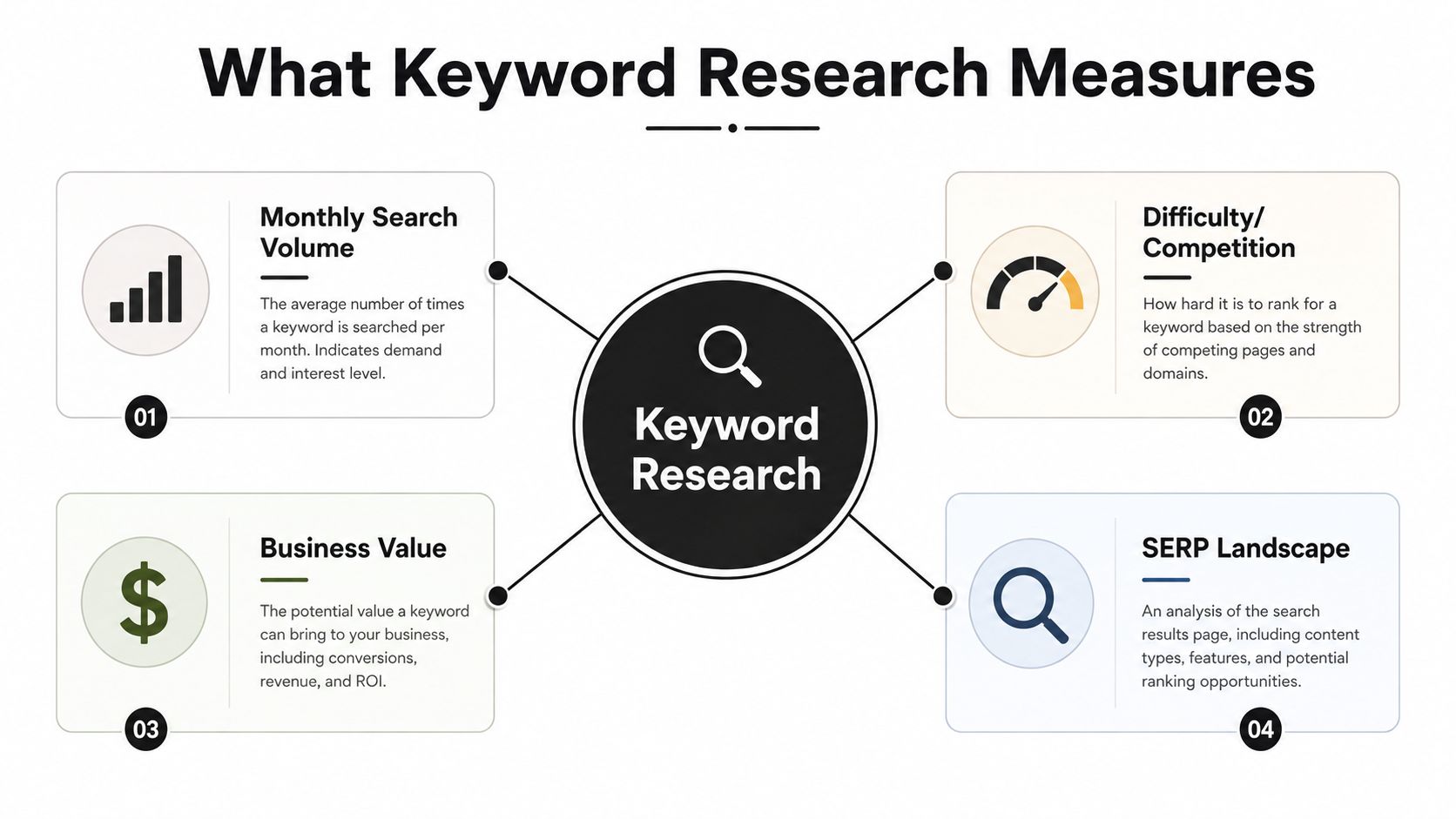
Keyword research is not one metric. It is a set of signals that answer different questions about demand, competition, and page fit. The useful ones are monthly search volume, difficulty or competition, business value, and the SERP features shown for the term. If your current tool only gives you volume, you are looking at demand with half the picture missing.
The Numbers Behind The Signals
The long-tail reality matters because most useful searches are not neat one- or two-word phrases. Long-tail keywords make up most of the workable demand, many search queries contain four words or more, and average keyword phrasing is short. That is why seed expansion is not optional. It is structural.
How To Read Each Signal
Search volume tells you how much demand exists, but it does not tell you whether you can win or whether the page will convert. A high-volume term can still be a poor target if the SERP is dominated by brands you cannot outrank or if the intent is too broad for a focused page. Difficulty or competition gives you a rough read on who else wants the term, but a score alone does not show whether page one is winnable. I treat it as a filter, not a decision.
Business value is your own judgment, because a keyword that looks modest on paper can still map directly to demo requests, product-qualified leads, or a page type that supports revenue. SERP features tell you what Google is already rewarding, and that changes the page format you should build. A query that triggers local packs, shopping blocks, or featured snippets usually needs a different brief than a plain informational result.
A tool like Orchory AI Keyword Research Tool can surface keyword candidates for this kind of review, but the important part is the interpretation. A phrase that looks small can still be valuable if it maps to a product page, a comparison page, or a use-case page that matches how buyers search.
A keyword list is useful only after it is attached to a page type. Otherwise it is just a spreadsheet with opinions.
The End-to-End Keyword Research Pipeline
The harder work is finding the rest of the demand without wasting weeks on dead ends. A pipeline that holds up in a small team is layered, not linear. Start with seed terms, then expand through related terms, modifier variants like best, vs, and how to, competitor gap mining, and Google Search Console query extraction. Each layer catches a different slice of demand, and each one lowers the chance that your strategy is built around only obvious head terms.
Expansion Before Judgment
Use a broad seed list, then widen it deliberately. A technical team can do this in a spreadsheet, in a keyword database, or with a research agent, but the output should be the same, a longer list that reflects how real buyers phrase problems and comparisons. Competitor gap mining is especially useful when you're new to a category, because it shows where another site already earned attention that you did not.
Google Search Console deserves special treatment because it is your own data, not a generic estimate. Regex filters often surface queries that already produce impressions and sit in positions 11 to 20, which are usually the fastest candidates for optimization (ClickRank). Those terms are not glamorous, but they are often the first place to look when you want visible movement without waiting for a brand-new page to age in.
Validation Before Clustering
Once the list is expanded, review the SERP manually. You are checking whether the page one mix matches the intent you want to serve, not whether a keyword tool says the term exists. Search results should tell you whether the query wants a comparison, a glossary entry, a use-case page, or something else.
From there, map each validated keyword to one canonical page. That avoids keyword cannibalisation, where multiple pages on your own site compete for the same term and dilute authority (Hobo). A single page per term also forces clean decisions about scope, slug, and internal linking.
The operational order matters.
- Seed terms from product, support, sales, and competitor language.
- Expansion through modifiers, related terms, and GSC queries.
- Filtering and validation against actual SERPs.
- Intent mapping so each cluster has one page type.
- Clustering and queueing so work can be ranked and shipped.
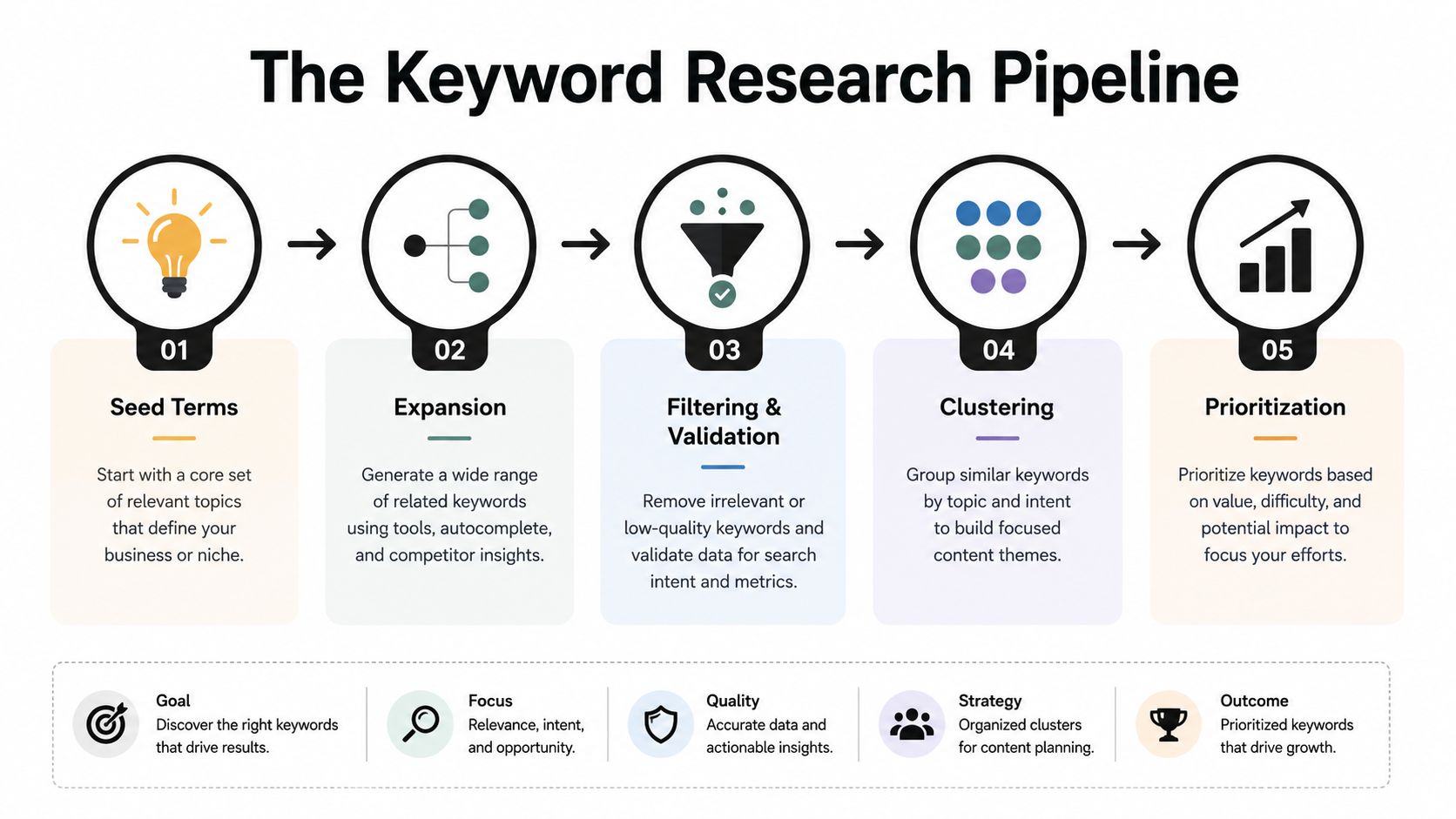
The point of the pipeline is not to build a bigger spreadsheet. It is to turn raw query ideas into pages a team can ship. A useful cluster should end with a page brief, a clear intent label, and a next action that can be handed to a writer, a designer, or a coding agent without another meeting.
That handoff matters because keyword research usually breaks down after clustering. The list looks organized, but nobody has decided what gets published first, what gets merged, and what should be skipped. A working process makes those calls early, then keeps the queue tied to execution. Tools like Orchory's keyword gap analysis workflow fit there as one way to move from discovery into a reviewable build queue.
For a small team, the fastest path is usually seed expansion, SERP validation, page mapping, then shipping. Each step reduces uncertainty. It also gives you a clean audit trail when a page underperforms, because you can see whether the problem was bad demand, weak intent matching, or the wrong page type entirely.
Scoring Keywords Without Falling for Volume
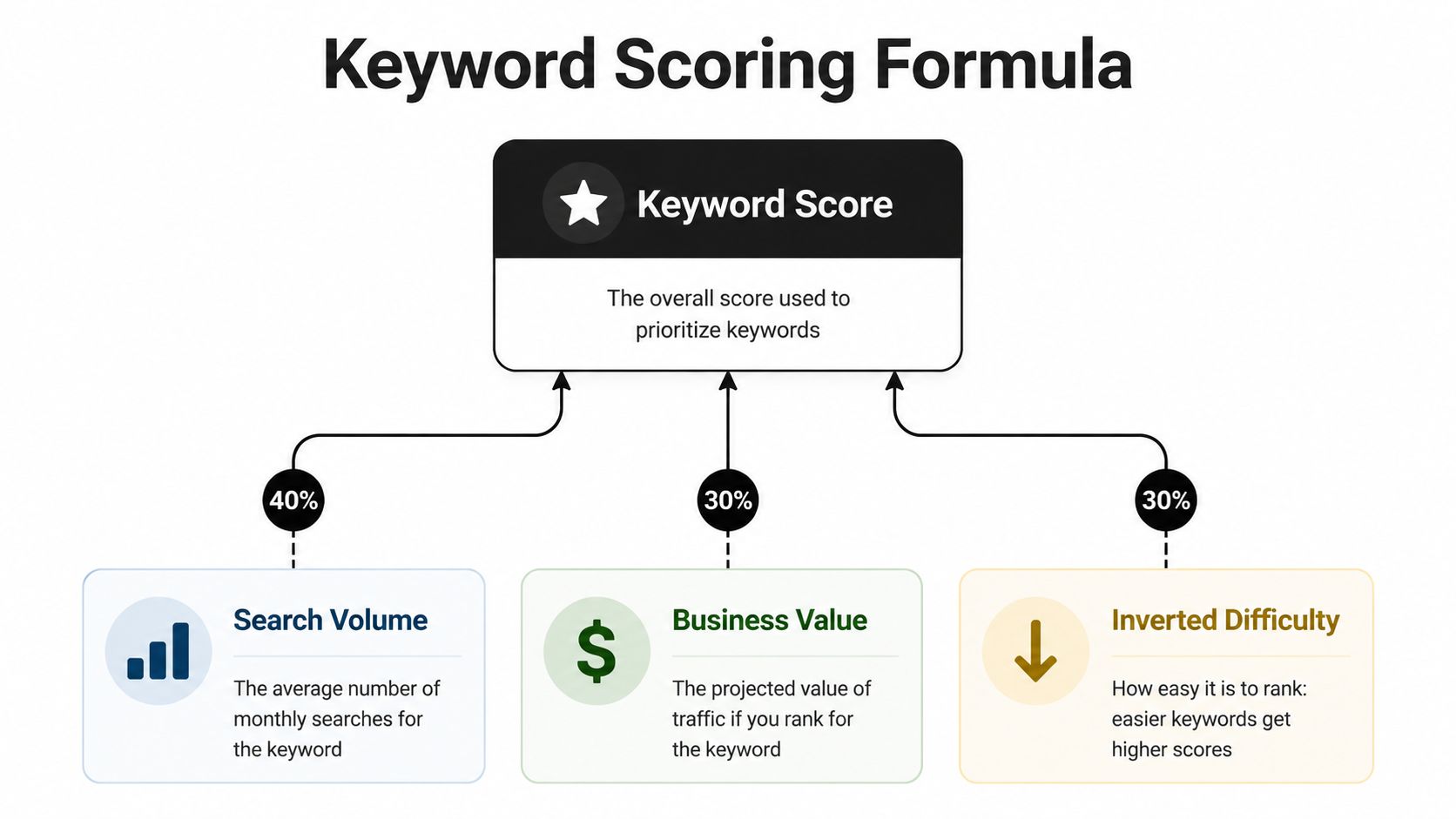
Once the list is validated and clustered, the question changes. It's no longer “what exists?” It's “what gets built first?” That decision should use a weighted score, not a gut feel. A practical starting point is to combine search volume, business value, and inverted difficulty, then adjust by intent fit when a term maps unusually well to a page you can credibly win.
A Score That Favours Shipping
A basic scoring formula can look like this:
- Search volume, 40%
- Business value, 30%
- Inverted difficulty, 30%
That structure isn't magic, it's a way to keep volume from dominating the list. The best early work usually goes to easier opportunities first, and Seobility's guidance in HubSpot's keyword research material explicitly recommends a 90%/10% split early on between easier and difficult keywords (HubSpot). That split gives you faster ranking wins, topical authority, and internal-link equity you can later point at more competitive pages.
Why Difficulty-Aware Priority Wins
You want the queue to reward pages that can ship quickly and produce evidence. Lower-difficulty pages are how small teams build momentum, because a few published wins make the next page easier to justify. They also create internal links that support the harder terms later, which is a lot more realistic than trying to brute-force a head term on day one.
If you need a deeper structure for gap hunting and prioritization logic, I've written the adjacent process in this keyword gap analysis walkthrough. That's the right companion to use once your validated list starts getting large enough that overlap matters.
Orchory Free SEO Tools can sit in the workflow here as a lightweight place to inspect pieces of the process without turning the whole thing into a tooling project.
Practical rule: treat search volume as a tie-breaker, not the main argument. If two keywords are both viable, volume can decide. If one keyword is a poor business fit, volume doesn't rescue it.
From Cluster to Pull Request With a Coding Agent
A cluster only matters when someone can turn it into a page. The handoff should be boring, structured, and reviewable. For a SaaS founder, that means one cluster becomes one canonical page type, one CSV row per opportunity, and one prompt a coding agent can use to open a pull request without touching production directly.
One Cluster, One Page, One Slug
Take a comparison cluster like “tool A vs tool B” or a use-case cluster like “CRM for dentists.” If the page-one mix is commercial and the query is decisive, the right page type is often a comparison or use-case page, not a blog post. The point is to match the page format to the search intent before anyone starts writing.
A useful CSV handoff can be this simple:
| keyword | cluster | intent | page type | priority score | target URL slug |
|---|---|---|---|---|---|
| example keyword | comparison cluster | commercial | comparison | 82 | /compare/tool-a-vs-tool-b |
Keep the schema tight. If you add too many columns, the handoff turns into process theater. If you add too few, the engineering side has to guess what to build.
The Prompt That Becomes A PR
After the CSV is ready, the prompt to a coding agent should include the keyword, the target page type, the desired slug, the internal links to add, and the acceptance criteria for the page. I use the same standard for this as I do for code changes, meaning the PR must be reviewable by a human before merge.
A starter prompt looks like this:
- Create or update the page at the target slug.
- Use the provided cluster as the semantic scope.
- Write the metadata and on-page copy to match the intent.
- Add internal links to the product page and the most relevant supporting resource.
- Return a pull request only, do not deploy.
That's the control point. No page touches production until someone on the team approves the PR. Tools such as Claude Code, Codex, or Cursor can handle the implementation, but they shouldn't own the final decision.
Orchory fits here as one example of a system that produces these prompts from a scored queue, then hands the work off to a coding agent for a reviewed PR. The actual output still needs your team's approval, and that's the part that keeps SEO aligned with the rest of your engineering process.
The demo below shows the workflow shape in practice, and it's worth watching before you wire this into a repo.
<iframe width="100%" style="aspect-ratio: 16 / 9;" src="https://www.youtube.com/embed/6vybXKiYFFU" frameborder="0" allow="autoplay; encrypted-media" allowfullscreen></iframe>See how the prompt handoff fits into the review loop.
For the implementation layer, I also keep a reference to Orchory's AI SEO agent workflow, because the useful part isn't the research alone. It's the clean path from research to pull request.
When a Low-Difficulty Keyword Is Still a Bad Bet
Low difficulty looks attractive because it feels safe. For a startup, though, that score can be misleading if the current SERP is dominated by forums, message boards, UGC, or a mix of pages that don't answer the query well. In that case, the problem isn't competition level, it's that the page type you can credibly ship may not fit what Google is rewarding.
Read The Page One Mix
The question is not “can I outrank someone somewhere?” It's “can I create the right page format for this query, and is the SERP open to it?” If page one is full of forum posts and community threads, that often means intent is fragmented and the market hasn't settled on a clean content format yet. Sometimes that's opportunity. Sometimes it means the query is messy enough that your team will burn time chasing a term that won't convert.
A startup should be honest here. If you can build a comparison, glossary, or use-case page that clearly outclasses what's ranking, the keyword may be worth pursuing. If the best answer would still look weaker than the current SERP mix, pass.
Intent Fit Beats A Shiny Score
The scoring framework has to bend. A low-difficulty keyword with weak intent fit should score below a harder keyword that maps cleanly to a page you can credibly own. That's especially true in categories where forum results and AI summaries already sit in the path between search and click.
If the query wants lived experience, community proof, or a highly specific use case, a generic blog post usually won't win it.
The better question is often not what to target, but which page format should own the query. That framing keeps you from treating every low-difficulty term like easy money. It also saves you from building pages that technically match the keyword but miss the reason someone searched in the first place.
Measuring Results, Refreshing the Queue, and Scaling Safely
After the pull request ships, the work isn't done. Google Search Console needs to feed the next weekly run, because keyword research is a live pipeline, not a static list you export once and forget. If you only append new ideas without re-ranking the whole queue, you'll keep old priorities alive long after the market moved.
What Gets Rechecked Each Week
The most useful loop is simple. Pull performance from Search Console, check which queries gained impressions or moved into page-two territory, and re-score the queue against the latest evidence. That keeps the roadmap tied to what your site is starting to earn, not what looked promising a month ago.
| Stage | Cadence | Tool or agent | Output |
|---|---|---|---|
| Query review | Weekly | Google Search Console | New and moved keywords |
| Queue refresh | Weekly | SEO agent or spreadsheet | Re-ranked opportunities |
| PR generation | Weekly or on demand | Coding agent | Reviewed pull request |
| Market exploration | On demand | Orchory run | New keyword clusters |
The pricing shape matters if you're doing this without a large team. Orchory uses a $990 per month single-plan model with no seats, so the cost structure is predictable when you need to explore a new segment.
The Common Failure Modes
The main ways teams waste this work are predictable. Cannibalisation happens when multiple pages target the same term. One-time Search Console exports go stale fast. Ignoring SERP composition makes you chase terms you can't own. Forgetting to revisit intent becomes more painful as AI answers and forum results change the page-one mix.
The fix is discipline, not more research. Keep one canonical page per term, refresh the queue weekly, and treat the SERP as the source of truth for format decisions. That's how a small team keeps SEO from turning into another abandoned spreadsheet.
If you want a keyword workflow that ends in reviewed pull requests instead of another static list, take a look at Orchory. It's built to turn keyword research, clustering, and scoring into prompts a coding agent can ship, while keeping your team in control of review and merge.
FAQs
What does keyword research actually measure?
How should keywords be scored for prioritization?
Why can a low-difficulty keyword still be a bad bet?
How does a cluster turn into a pull request?
How often should the keyword queue be refreshed?