SEO for SaaS Companies: A Shipping-Focused Playbook
SEO for SaaS companies works when pages ship like product work: queue, template, reviewer, merge. Here's the playbook, from intent mapping to KPIs.

Most advice on SEO for SaaS companies stops at “publish comparison pages” and “write more use-case content.” That's not the hard part. The hard part is shipping pages the way you ship product work, with a queue, a template, a reviewer, and a merge, because a backlog of keyword ideas doesn't rank by itself.
That matters more now because organic search is already a major acquisition layer for SaaS. Industry datasets put organic search at roughly 53% of total SaaS website visits, and one benchmark cohort found the median SaaS company ranking for 32,400 keywords with 881,000 monthly organic visits across 50 companies, which is a strong sign that durable growth comes from clusters, not isolated pages (Digital World Institute). Search-led growth also keeps compounding because the #1 organic result averages a 27.6% click-through rate (Ahrefs).
Why Most SaaS SEO Programs Stall Before They Ship
The usual failure mode is simple. A founder, marketer, or engineer builds a spreadsheet full of keywords, then nobody owns the path from research to a live page. The work stalls between “good idea” and “merged PR,” which is why many SaaS SEO programs look active on paper and invisible in search.
High-performing teams treat SEO like feature delivery, not content brainstorming. They define the page type first, assign an owner, and make the reviewer part of the process. That's the difference between a plan and a shipped asset.
The bottleneck is execution, not ideas
Most SEO teams already have more keyword ideas than they can ship. What they don't have is a pipeline that turns those ideas into reviewed pages with internal links, schema, and a clear intent match. Once that pipeline exists, the page count starts to matter more than the perfect topic list.
Practical rule: if a keyword can't be assigned to a template, a reviewer, and a merge path, it isn't a priority yet.
SEO for SaaS companies starts to resemble build engineering. A weekly run produces a ranked queue, the queue maps to page types, and every page ships as a PR. That keeps production control inside the team instead of inside a content backlog.
AI search changed the output shape
Classic blue-link rankings still matter, but answer engines are changing what visibility looks like. Pages now have to work as retrieval targets as well as click targets, which means clear entity coverage, concise definitions, and explicit use-case framing matter more than fluffy long-form prose. The page that answers cleanly is easier to cite than the page that buries the point.
That's why the process has to be repeatable. You're not just publishing blog posts, you're building a system that can feed Google, AI summaries, and internal docs without rewriting the workflow every time a new surface shows up.
Mapping Search Intent for Product, Marketing, and Docs
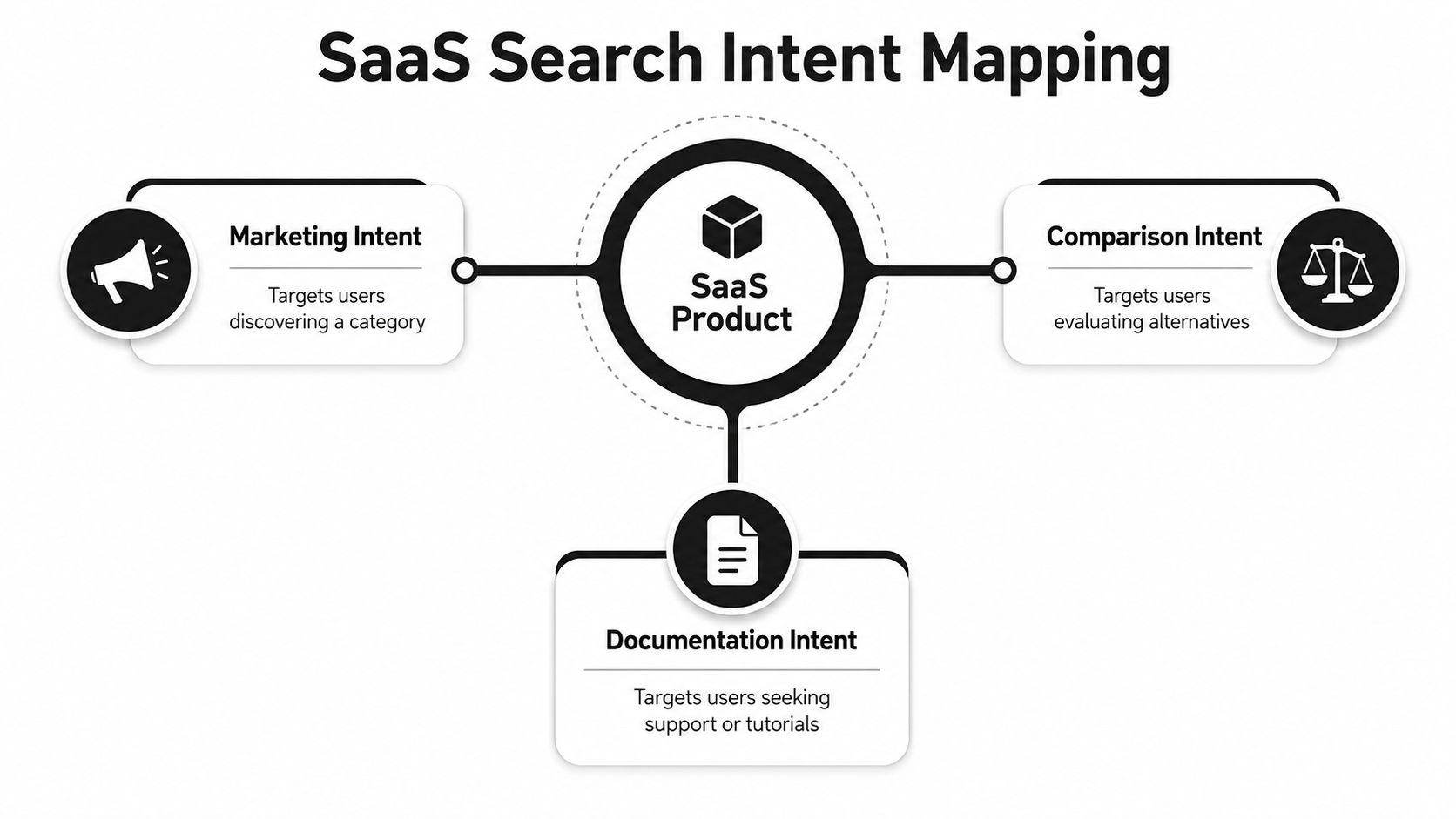
A SaaS keyword is rarely one thing. It can signal a category query, a comparison query, or a support query, and each one belongs on a different page. If you push all three into blog posts, one template ends up doing three jobs badly.
Split the keyword list before you write
Start by classifying the searcher's job. Are they discovering a category, evaluating alternatives, or trying to use the product? That answer decides whether the page belongs in marketing, comparison, or documentation.
A workable scoring rule is blunt. If the SERP is dominated by category pages, the keyword belongs on a marketing page. If the SERP shows side-by-side evaluations, it belongs on a comparison page. If the searcher wants to implement, troubleshoot, or script something, route it to docs.
For a CSV import tool, that split looks like this. “CSV import tool” maps to a marketing page, because the searcher is exploring the category. “CSV import vs custom parser” maps to a comparison page, because the searcher is choosing between approaches. “CSV import API Python” maps to docs, because the searcher wants implementation help.
This is also where a content strategy document should do real work. If a query sits on the edge between a cluster page and a standalone page, a clear SEO content strategy keeps the decision from turning into a meeting instead of a ship date.
Use the page type that already fits the SERP
The job is not to invent a new page for every query. It is to match the page type that already wins the search result, then narrow scope enough to beat the current result on clarity. The search intent map earns its keep there.
Use the same lens on every keyword set. The point is not to chase volume first. The point is to decide whether the searcher needs a category page, a comparison page, or a tutorial page before you write a line.
A useful external tool in that workflow is the Orchory AI Keyword Research Tool, since it is built for keyword expansion and opportunity scoring rather than generic brainstorming.
Choosing the Right Page Types for SaaS Funnel Stages
Most SaaS SEO advice says to build comparison pages, alternatives pages, and use-case pages. That part is correct, but it skips the actual decision rule. If your domain is thin, you don't need a larger content calendar, you need fewer pages with a better shot at ranking and converting.
Prioritize late-stage intent when authority is thin
For early-stage SaaS, broad informational content is often overproduced. It takes time to rank, it attracts loosely qualified visitors, and it usually competes with larger domains that already own the informational SERP. Comparison, alternatives, and use-case pages are usually the smarter first move because they target buyers who are already closer to a decision.
The trade-off is obvious. These pages often have lower search volume than top-of-funnel articles, but they can match demand that already exists in the market. That's why they deserve the first pass when your team can only ship a few pages.
Decision rule: choose the page type that balances buyer intent, ranking feasibility, and cluster effects, not the page type with the biggest keyword count.
Map the page type to the job
| Page Type | Funnel Stage | Typical Volume Band | Min Domain Authority to Rank |
|---|---|---|---|
| Comparison page | Bottom of funnel | Narrow to moderate | Lower than broad informational terms, but still competitive |
| Alternatives page | Bottom of funnel | Narrow | Lower, if the competitor SERP is weak |
| Use-case page | Middle to bottom of funnel | Narrow to moderate | Modest, especially when tied to a specific workflow |
| Glossary page | Top of funnel | Broad | Higher, because generic definitions are crowded |
| Feature page | Bottom of funnel | Narrow | Varies with product maturity |
That table is a prioritization aid, not a guarantee. The primary filter is whether the page can be tied to a cluster, linked from the right places, and reviewed fast enough to keep shipping. A single strong comparison page can justify the surrounding support pages later.
Build the smallest page that can win
A comparison page doesn't need to read like a magazine article. It needs explicit criteria, a fair framing of alternatives, and internal links back into the product and docs ecosystem. The developer workflow comparison with Ahrefs is one example of making the better fit on each side explicit. A use-case page needs one named scenario, one pain point, and one concrete path through the product.
When teams ask what to skip, the answer is usually broad informational content that isn't tied to a product decision. If it doesn't help a buyer choose, configure, or adopt something, it should sit lower in the queue.
Technical SEO That Actually Matters for SaaS Sites
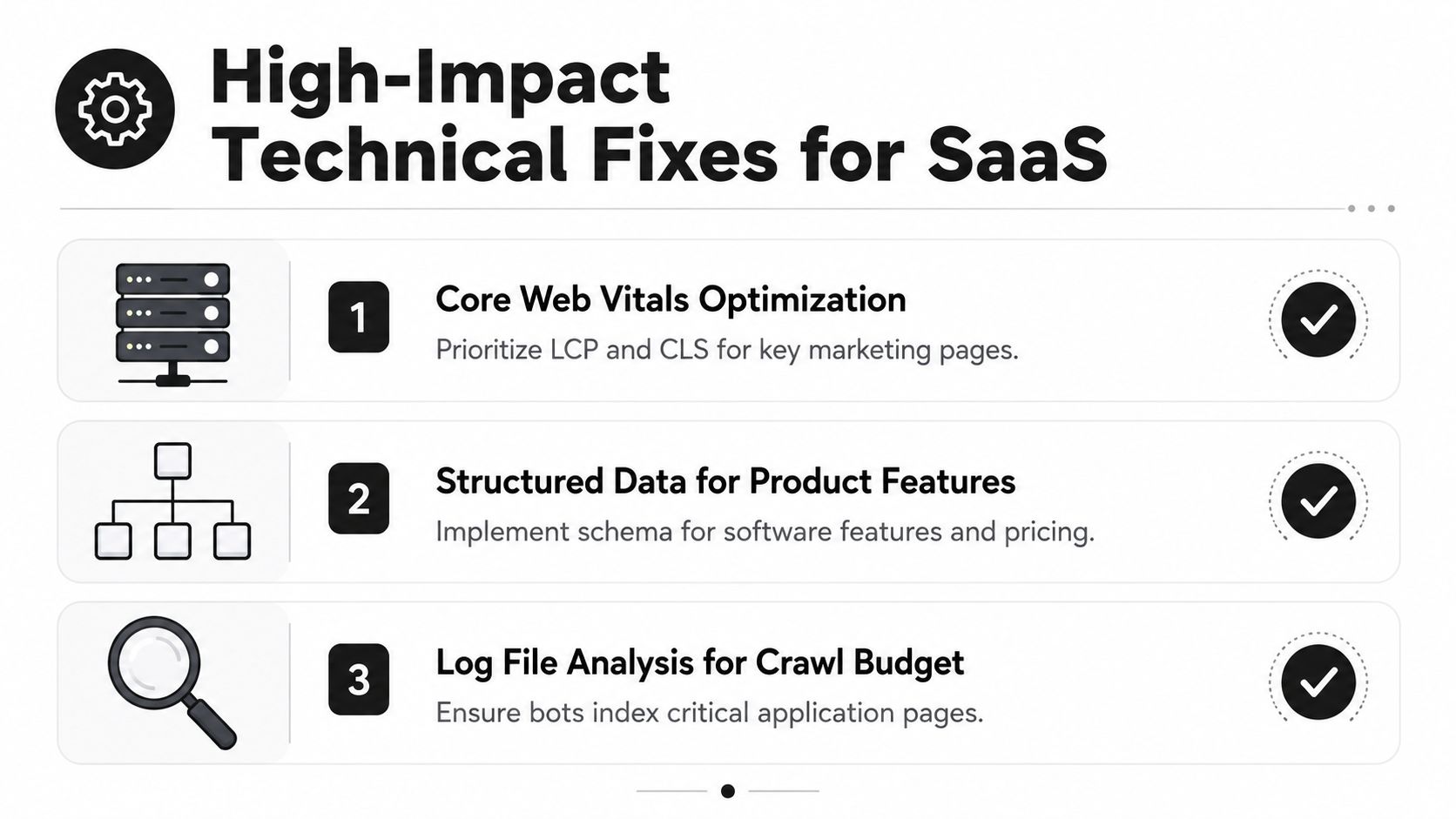
Most technical SEO audits are too long and too abstract for seed-stage teams. For SaaS sites, the work that matters is narrower, especially on pricing, feature, comparison, and docs pages. Those are the pages that influence revenue, so they should load and render like revenue pages, not like afterthoughts.
Fix the pages that influence revenue first
A practical target is Largest Contentful Paint under 2.5 seconds (SEOptimer). For SaaS teams, that means pricing pages, feature pages, comparison pages, and docs should be treated as priority assets in the rendering stack, not just in the content plan. If a buyer hits a slow page right before conversion, the page has already failed its job.
The engineering moves are predictable. Reduce unused JavaScript on marketing routes, use server-side rendering or static generation for revenue-influencing pages, and keep high-intent pages in a shallow internal-link structure. Those changes help crawl efficiency and lower latency at the same time.
Make crawl paths boring
If a page matters, keep it close to the homepage and link to it from the right cluster. Two clicks is a useful rule of thumb for high-intent pages, because the crawl path stays shallow and the user path stays obvious. SaaS sites with scattered navigation often bury pages behind app shell links that search engines don't treat well.
The internal review here should be short and mechanical. Check rendering, check crawl depth, check canonical consistency, and confirm the sitemap includes the page you want indexed. That's enough for most early teams.
For engineers who want a more implementation-focused pass, the internal note at SEO for Developers is the right companion piece. It fits the same principle, focus on the fixes that change indexability and latency, not the long tail of low-impact audit items.
Shipping SEO as PRs With a Coding Agent
A good SaaS SEO week looks a lot like a product sprint. The inputs are keyword clusters, the output is a queue, and the deliverable is a PR that a developer or coding agent can open, review, and merge. That's the model Orchory is built around, since it turns research into a ready-to-run prompt instead of a static report.
A weekly run should end in a mergeable task
Start with research, cluster the terms, and score opportunities by intent and feasibility. Then refresh the queue so the highest-value page type rises to the top. Once you've done that, the output shouldn't be a spreadsheet, it should be a prompt that a coding agent can execute.
A representative week looks like this. Monday is the clustering and scoring pass. Tuesday is template selection and internal-link mapping. Wednesday is the coding-agent prompt. Thursday is review. Friday is merge.
The reviewer should check four things every time, intent match, page template fit, internal links, and schema.
That review step matters because the coding agent shouldn't own production control. It can draft the page, place the content, and structure the PR, but the team still decides what ships. That's the safest way to scale output without handing the site over to a black box.
What the prompt needs to include
A usable prompt doesn't need a long brief. It needs enough structure for a coding agent to create a page that matches the queue item. At minimum, that means the target query, the page type, the intent summary, the primary internal links, and any schema or component constraints.
A workflow like Orchory's fits naturally here. It handles the weekly opportunity queue, clusters the keywords, and outputs prompts that work with agents such as Claude Code, Cursor, or Codex. The site still stays under PR review, which is the part founders and engineers care about most.
The goal is speed without drift. If the page template is standardized, the review becomes about fit and accuracy, not re-litigating structure every week. That's what keeps SEO work from becoming a side project nobody wants to merge.
Measuring SaaS SEO With KPIs Tied to the Pipeline
If the only number you watch is traffic, you'll miss whether the program is compounding. SEO for SaaS companies needs three layers of measurement, pipeline health, search visibility, and business impact. If one layer improves and the others don't, you've got a routing problem, not a success story.
Track the pipeline first
Pipeline health is the earliest signal. Count opportunities queued, pages shipped, and PRs merged each week. Those numbers tell you whether the team is executing the process you designed.
Search visibility comes next. In Google Search Console, watch impressions, click-through rate, and keyword movement in positions 1 to 3, 4 to 10, and 11 to 20. Those buckets show whether the queue is producing pages that can move upward, not just pages that exist.
Use business metrics as the final filter
Business impact should stay tied to organic signups, demo requests, and pipeline attributed to search. If a page ranks but never contributes to a product action, it's not the right page type or the right query. That's why page velocity and keyword coverage matter more than a single traffic spike.
A useful 90-day bar is simple. You want a steady cadence of pages shipped, visible movement in Search Console, and at least one recurring organic path to demos or signups that the team can trace without guesswork. If the queue is moving and the business metrics are flat, re-rank the opportunity list.
Adapting SaaS SEO for AI Search and Answer Engines
The new problem isn't just ranking. It's being retrievable when a user never clicks a classic blue link. Google AI Overviews, ChatGPT, Perplexity, and Gemini make the page format matter in a slightly different way, because the winning page has to be easy to cite and easy to summarize.
Write for retrieval, not just for length
A concise definition near the top of a page now carries more weight than a padded intro. So do explicit criteria on comparison pages and named scenarios on use-case pages. Those are the parts an answer engine can lift cleanly without guessing what the page is about.
The practical edits are small. Add one-sentence definitions to glossary pages, state comparison criteria directly, and use schema markup to disambiguate entities. If a page is about a product feature, say so in plain language and keep the surrounding copy aligned with that entity.
Make new pages reusable across surfaces
A page that can work in both search and AI summaries is usually narrower and cleaner. It answers one question, defines one entity, or compares one set of options. That shape is easier for humans to scan and easier for answer engines to cite.
The contrarian takeaway is straightforward. Broad informational content is often overproduced, while tightly scoped comparison, alternatives, and use-case pages have a better chance of serving both classic SEO and answer surfaces. That doesn't mean blogs are dead. It means the page structure has to do more of the work.
Your First 30 Days of SaaS SEO
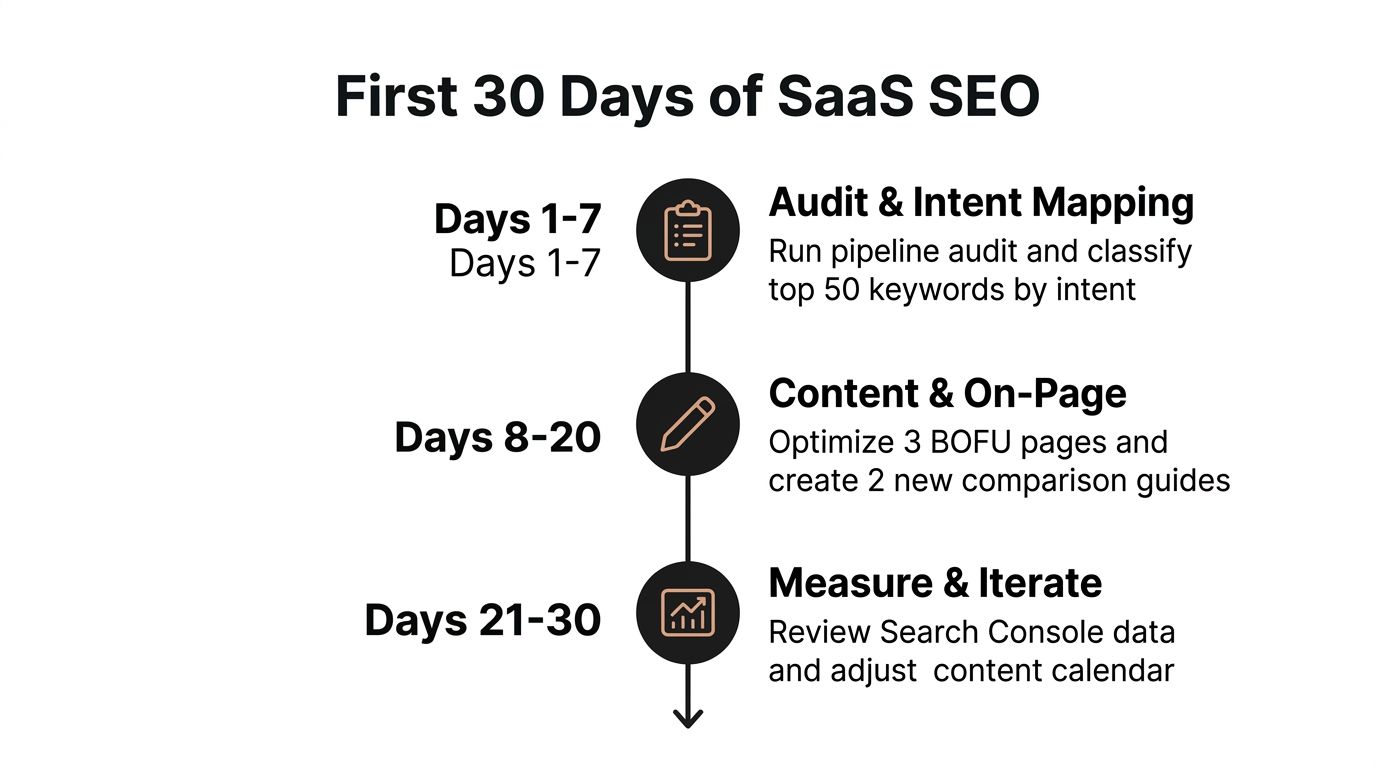
The first month should look like a build cycle, not a content campaign. Days 1 to 7, run the pipeline, classify keywords by intent, and pick three BOFU page types with the best blend of buyer intent and feasible ranking. Days 8 to 14, ship the first PR and review it like any other code change.
Days 1 to 7
Run the keyword pipeline, cluster the terms, and rank the opportunities by intent and feasibility. Don't write yet. The goal is to leave the week with a small list of pages that can ship.
Days 8 to 20
Open the first PR with a coding-agent prompt, then create or optimize the first comparison, alternatives, and use-case pages. Review the page template, internal links, and schema before merge. If a page doesn't match a real SERP pattern, send it back to the queue.
Days 21 to 30
Check Search Console for impressions, clicks, and indexing movement. Review which pages shipped, which queries started moving, and which templates deserve another run. If the process worked, keep the cadence weekly.
<iframe width="100%" style="aspect-ratio: 16 / 9;" src="https://www.youtube.com/embed/kWsA_rkdzuo" frameborder="0" allow="autoplay; encrypted-media" allowfullscreen></iframe>Orchory turns keyword research, clustering, and opportunity scoring into a ranked queue your team can ship. If you want SEO for SaaS companies to behave like product work instead of a content backlog, visit Orchory and see how the pipeline fits your next pull request.
FAQs
Why do most SaaS SEO programs stall before they ship?
Which page types should thin-authority SaaS domains prioritize?
What technical SEO fixes actually matter for SaaS sites?
How should SaaS SEO work actually get shipped?
How does AI search change what a SaaS SEO page needs to look like?