Voice Search Optimization for SaaS Teams: A Shipping Playbook
A shipping playbook for voice search optimization: cluster queries, map page templates, add schema, and ship coding-agent PRs in 90 days.
Your pricing page is live, the docs are polished, and support keeps hearing the same complaint. Customers ask Siri, Gemini Live, or Google Assistant a question that your site should answer, and the assistant either picks a competitor or returns nothing useful. That's when it's clear voice search optimization isn't a copy tweak. It's a shipping problem.
For a two-person SaaS team, the work doesn't start with “write more conversationally.” It starts with a backlog item, a query cluster, a page template, a schema component, and a PR that makes the answer machine-readable. Voice discovery is now spread across major assistants, with U.S. usage measured in tens of millions of users, including about 88.8 million Google Assistant users, 84.2 million Siri users, and 75.6 million Alexa users in 2024, plus independent reporting that says more than 50% of U.S. consumers used an assistant at least monthly and one source estimating 149.8 million U.S. voice users in 2024 (voice search statistics). That's enough demand to justify engineering work, not enough to excuse vague content plans.
Why Voice Search Optimization Is a Shipping Problem
A startup can get away with one strong page and a few internal links in the early days. Voice search breaks that illusion because assistants don't reward “more content,” they reward the most extractable answer in the right structure. A founder who treats this like a content wishlist usually ends up with five FAQ sections, no schema, and no measurable lift.
The real unit of work is a query to PR path
The useful artifact is an opportunity brief, not a brainstorm doc. It should contain the query cluster, the intent, the snippet type you're targeting, and the exact URL or component that will ship the answer. If the brief can't be handed to an engineer or a coding agent, it's still too soft.
Practical rule: if a voice query can't be mapped to one page, one answer block, and one owner, it isn't ready for implementation.
Here's why that matters: voice results are often pulled from a very small set of top pages, and over 80% of Google Assistant answers are reported to come from the top three search results, with 40.7% of all voice answers coming from a featured snippet (voice search marketing statistics). That means the work is not “publish more.” The work is “build a page that can win a compact answer in a narrow retrieval window.”
Treat the site like an answer system
That shifts the backlog from prose to retrieval. Answer blocks, entity coverage, schema, and mobile render order matter more than a nicer tone. If the page loads slowly or buries the answer below decorative hero copy, a crawler and a speech system have to work harder than they should.
The most useful mental model is this: one query cluster, one page, one speakable answer path. Anything else creates ambiguity, and ambiguity costs rankings, snippet eligibility, and internal momentum. If your team already uses clustering, keep it tied to a real build target, not a research spreadsheet. If you need a baseline on that workflow, use the internal clustering guide at what keyword clustering looks like in practice and turn the output into a build queue.
Pulling and Clustering Conversational Queries
Start with real language, not keyword tool guesses. People ask support teams in full sentences, write the same thing into Reddit threads, and use question phrasing in Google Search Console. The job is to pull all of that into one working sheet before anyone writes a page.
Build the source list first
Use these sources in this order:
- Google Search Console, especially queries that already contain question words.
- People Also Ask boxes, because they expose adjacent phrasing.
- Support tickets and sales calls, because they show the exact words buyers use when they're stuck.
- Reddit and niche communities, because they reveal informal language and edge cases.
- Autocomplete and answer tools, only after you've collected real user language.
Then normalize each row into a question stem, such as how, what, can, does, or near me. Tag the speaker, not just the query. A developer asking about a webhook retry policy is not the same as a buyer asking whether the API can handle retries, even if the words overlap.
Score the cluster, not the keyword
Each cluster needs a quick triage pass. I score three things:
- Snippet eligibility, meaning is it a definition, list, comparison, or direct answer.
- Funnel stage, meaning is the query exploratory, evaluative, or ready for action.
- Entity coverage gap, meaning does an existing page already cover the full object or only part of it.
A page about a webhook retry policy can win more than one question if the entity is coherent. If you split that across five posts, you create unnecessary overlap and weaken the answer path. One page should dominate the spoken answer, then support it with secondary sections and internal links.
| Cluster | Question Stem | Intent | Snippet Type | Funnel Stage | Entity Coverage | Priority |
|---|---|---|---|---|---|---|
| Webhook retry policy | How do retries work | Technical | Definition | Evaluation | Partial | High |
| Pricing compare | Which plan fits | Buyer | Comparison | Decision | Partial | High |
| Onboarding setup | Can I import data | Admin | Direct answer | Activation | Missing | Medium |
Ship the export with the first PR
The spreadsheet should end with a real owner and URL. Columns like cluster, intent, template, source FAQ, and owning URL keep the work from drifting into “content later” territory. If engineering can't point to the page that owns the cluster, the cluster is not ready to ship.
Keep the sheet close to the repo. When the PR lands, the source FAQ and target URL should already be known, or the answer will get rewritten three times.
Mapping Voice Intent to Page Templates
Three templates cover most SaaS voice traffic because most spoken questions collapse into a direct ask, a local ask, or a compare-and-choose ask. If you try to force every cluster into a generic blog post, the answer gets muddy and the DOM gets noisy.
Direct answer pages need a tight top block
The Direct Answer template should put a 40 to 60 word answer block above the supporting list or table. The heading asks the question, the first paragraph answers it, and the rest of the page expands the entity. A text-to-speech system should be able to read the answer without tripping over navigation, testimonials, or filler copy.
For DOM order, use:
- H2 question
- Answer block
- Supporting evidence
- Examples or edge cases
That structure works because the answer is visible early and the context stays close to the query. Keep the canonical URL narrow, such as one page per entity or one page per use case. If a cluster is about webhook retry policy, don't bury it inside a broader “developer best practices” article.
Local and comparison intents need different page shapes
The Local/Business template assumes a LocalBusiness object, hours, service area, and a quick answers section for nearby queries. This is the place for location-specific pages, office pages, and regional support pages. It's also where the answer should be explicit about availability, hours, and contact paths.
The Comparison template is different. It should open with a short definition row, then a side-by-side table, then a verdict sentence that can be exposed cleanly. Comparison pages are useful because buyers ask assistants to choose between options, not just define them.
Don't let one page chase three intents. A page that tries to be direct answer, local page, and comparison page usually ends up ranking for none of them.
Map each cluster to exactly one template, then keep the template as an MDX or TSX component so a coding agent can drop it into the CMS without improvising markup. The point is consistency. Speech systems like clear patterns, and developers like components they can reuse without editing every page by hand.
Schema and Technical SEO for Voice Answers
Voice answers need a page that is easy to parse, not just easy to read. That means the answer block, the JSON-LD, and the render order all have to line up. If they don't, the page can look clean to a human and still be awkward for retrieval.
Start with the structured data that matches the page type. FAQPage, Speakable, Organization, and LocalBusiness are the core pieces for voice-oriented pages. Use SpeakableSpecification selectors that point to the exact DOM nodes that hold the answer block, not to an entire article wrapper that contains unrelated copy.
Put the answer where the crawler expects it
The first paragraph should carry the answer block, especially when the target is a featured snippet or voice readout. Keep it short, clean, and directly tied to the question. A 40 to 60 word answer block is much easier to isolate than a long intro that wanders before getting to the point.
The trade-off with nested schema is real. FAQPage inside Product or Article can be fine when the relationship is honest, but over-nesting can make the page harder to reason about during maintenance. If the component tree is already complicated, keep the answer block simple and the schema narrowly scoped.
The speed side matters too. Google's Speech-to-Retrieval work says the system gets answers directly from spoken queries without first converting speech to text, which means precision and structure matter more than literal keyword matching (Speech-to-Retrieval). That makes clean HTML, visible answer blocks, and stable selectors more useful than stuffing every heading with question words.
Validate before the PR lands
Use Rich Results Test and Schema Markup Validator before merge. Then check that the answer block sits above the fold on mobile and that the page's performance doesn't depend on hidden content or late-rendered components. The implementation goal is boring on purpose, the answer should be obvious to a machine and still read naturally to a person.
For a deeper look at snippet shape and extraction, the featured snippet playbook at featured snippet optimization patterns is the right companion piece.
Prompts a Coding Agent Can Ship Today
The fastest way to turn voice search optimization into execution is to treat each page change as a prompt that opens a PR. For a small team, that shifts the work from manual page assembly to review and acceptance. It also makes the rollout repeatable when the next batch of clusters lands.
Use prompts that name files, tests, and acceptance criteria
A coding agent should never get “improve this page for voice.” It needs a route, a cluster JSON object, a template, and a file list. The prompt has to be specific enough that the agent can change the right component without guessing.
- Add FAQ block from cluster: “Given
cluster.jsonforwebhook retry policy, update/app/docs/webhooks/page.mdx, insert a 40 to 60 word answer block under the H2, add three FAQ items sourced from the cluster, and ensure the page still passes lint and MDX build.” - Generate FAQPage JSON-LD: “Create or update
components/schema/faq-page.tsxso the FAQ schema matches the visible Q&A, then validate with Schema Markup Validator and keep the component reusable across routes.” - Refactor existing H2 into answer block: “Move the direct answer into the first paragraph under the H2, add
speakableselectors targeting that paragraph, and keep the surrounding text within the same semantic section.” - Compress hero copy: “Shorten
components/hero.tsxso the answer is visible above the fold on mobile, while preserving the CTA and key entity term.” - Wire structured data into CMS: “Add a schema component to the CMS route model so editors can pick
FAQPage,Organization, orLocalBusinesswithout touching raw JSON-LD.”
Each prompt should name the tests it must pass, usually lint, build, schema validation, and a mobile render check. On a performance-sensitive route, include a first-load target in the acceptance criteria, not just the visual layout.
Measure the right thing for 90 days
Voice-adjacent work is easy to misread if you only watch generic rankings. In Google Search Console, build a query filter for question patterns such as who, what, when, where, why, how, is, can, does, and near me. Segment by device and country, then compare snippet impressions against regular clicks so you can see whether the page is winning answer visibility or just ordinary rank movement.
The 90-day window matters because new templates and schema often need time before the pattern becomes clear. A clean workflow is to watch three boards weekly: cluster rank, snippet impression trend, and voice-to-conversion funnel. If the first board improves but the second doesn't, the page is ranking without being extractable. If the second improves and the third doesn't, the answer is visible but not persuasive.
A voice page that wins impressions but no assisted conversions usually has a structure problem, not a traffic problem.
For teams using Orchory AI Keyword Research Tool, the useful part is the handoff. The output becomes a ranked queue plus prompts a coding agent can turn into PRs without a long SEO brief.
What Actually Changes in 2026 Voice Search
The old checklist still gets repeated because it feels safe. Add long-tail questions, write conversationally, claim your business profile, chase the featured snippet, and call it voice SEO. That playbook is dated because speech-to-retrieval systems aren't looking for literal phrasing first, they're resolving entities, intent, and context, then pulling the best structured answer they can find.
Stop optimizing for the sentence and start optimizing for the entity
Stuffing H2s with every possible question word is weak work now. So is treating Speakable like a ranking factor or assuming one FAQ block will cover every voice variant. Those tactics can help presentation, but they don't fix weak entity coverage.
| Old assumption | 2026 reality | What to do instead |
|---|---|---|
| Long-tail questions alone are enough | Retrieval systems care about entities and context | Build entity coverage pages |
| Speakable drives rankings | Speakable helps surface answer sections | Use it on clean answer blocks |
| One FAQ page covers every voice query | Different intents need different page shapes | Map one cluster to one template |
| A conversational tone is the fix | Structure matters more than tone | Expose Q&A in HTML plus schema |
The better move is to build content that answers the entity completely, then link the narrower questions back to the parent topic. That gives the system a clear source of truth, and it gives users a page that resolves the task they came for. Internal links should point from question pages to the main entity page, not just spread around for pageview padding.
Instrument snippet behavior, not just rankings
Traditional rank tracking won't tell you whether a page got surfaced as a compact answer. You need snippet impressions, query grouping, and assisted conversion tracking to see whether the voice-adjacent page helps buyers move. A page can look underwhelming in a ranking report and still be the answer source that matters.
The practical shift is this. Build the answer container, expose the schema, and measure the retrieval behavior. The prettier your prose gets while the structure stays weak, the more likely you are to confuse human readability with machine retrievability.
Your 90-Day Voice Search Rollout
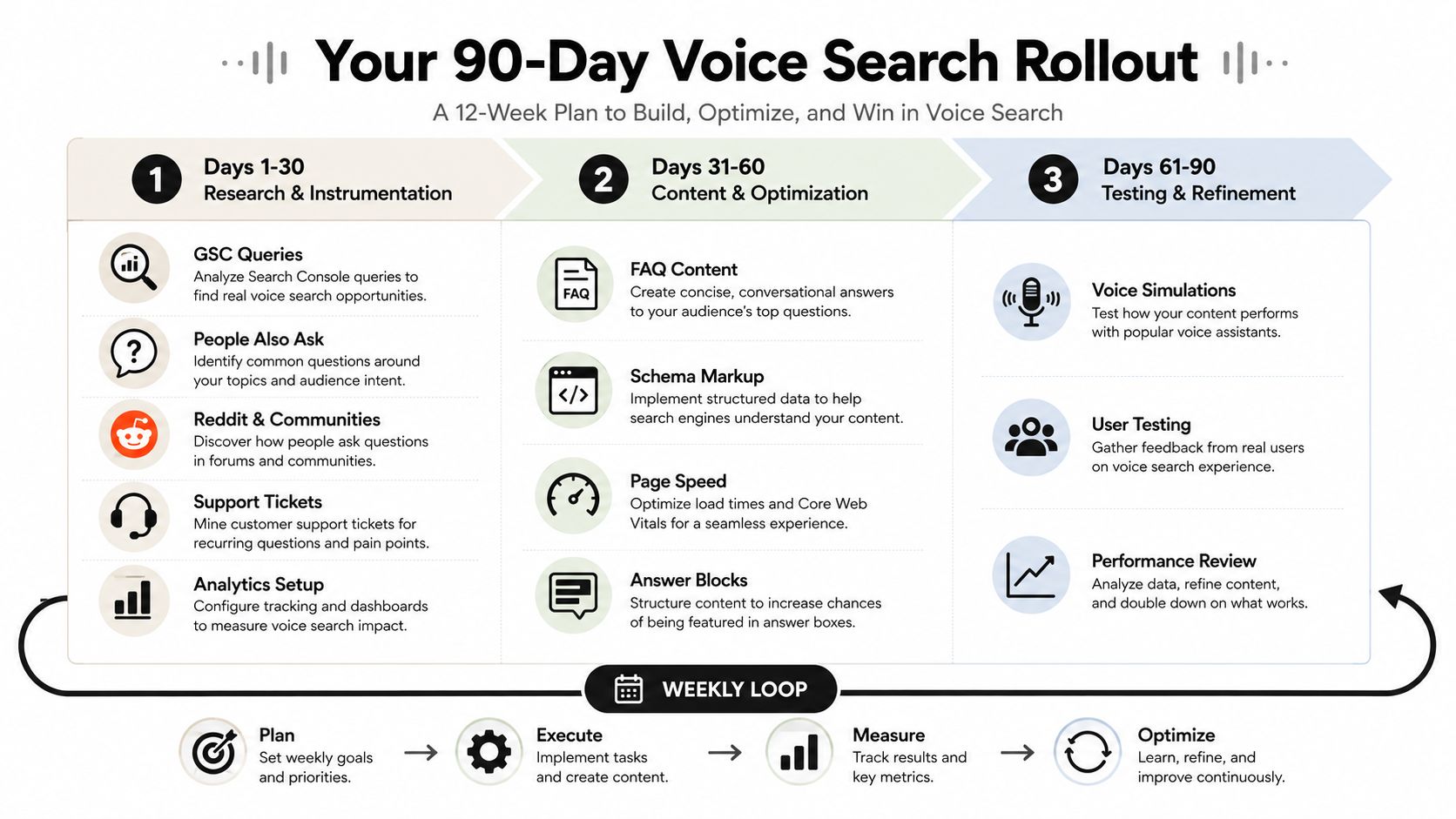
The rollout works best when each month has one job. Month one is research and instrumentation, month two is page shipping, month three is validation and pruning. A small team can sustain that if each week has a named owner and a Definition of Done.
Days 1 to 30 set the queue
Week one pulls queries from GSC, People Also Ask, Reddit, support tickets, and sales calls. Week two clusters them by entity and intent, then tags device and country. Week three stands up the measurement filters in Search Console and analytics. Week four turns the best clusters into a route list with owners and template types.
Days 31 to 60 ship the pages
The repo changes here. Publish the direct-answer pages, add FAQPage and Organization JSON-LD, refactor the top templates so the answer block sits above the fold, and run the coding-agent prompts as PRs. If a page can't be validated with schema tools and mobile rendering checks, it doesn't merge.
Days 61 to 90 cut the noise
By the final month, the team should stop asking whether voice search is “working” and start asking which clusters deserve another pass. Prune pages that didn't earn snippet impressions, double down on the ones that did, and document what gets refreshed each quarter. The goal is a system the next person can run without reconstructing the logic from scratch.
<iframe width="100%" style="aspect-ratio: 16 / 9;" src="https://www.youtube.com/embed/i8gx3qC87Js" frameborder="0" allow="autoplay; encrypted-media" allowfullscreen></iframe>If you want a repeatable way to turn question clusters into page opportunities, Orchory fits that workflow by turning research into prioritized prompts your team can review and ship.
Orchory helps teams turn keyword research into a ranked queue, intent mapping, and coding-agent prompts that become reviewed PRs. If you're building voice-friendly SaaS pages and want the research, clustering, and handoff to live in one workflow, visit Orchory and use it to turn your next query cluster into something the repo can ship.
FAQs
Why is voice search optimization a shipping problem instead of a content problem?
What is the real unit of work for voice search optimization?
How long should a direct answer block be for voice search?
What structured data should voice-oriented pages use?
How long should a voice search rollout take?