How to Grow Organic Traffic for SaaS: Treat SEO Like a Shipping Problem
A practical playbook for early SaaS teams to diagnose, prioritize, and ship SEO pages through the same PR workflow used for product work.
You're probably staring at a backlog that has the right ingredients and the wrong order. A few draft posts exist, the homepage is clean enough, Search Console shows some impressions, and every week someone says SEO is “in progress” while nothing compounds. That's the normal failure mode for early SaaS teams, because traffic growth doesn't start with publishing, it starts with deciding which pages deserve to exist, then shipping them through the same workflow you already use for product work.
Organic search still matters because the channel keeps carrying a huge share of trackable traffic, with BrightEdge's 2024 benchmark putting organic search at 53.3% of all trackable website traffic, compared with roughly 5% from social media and about 15% from paid search (organic traffic benchmark summary). The point isn't that SEO is magical, it's that it's one of the few acquisition channels where the work can keep paying after the PR merges. For bootstrapped teams, that only happens when SEO is treated like a shipping problem, not a content calendar problem.
Why Most SaaS SEO Efforts Stall Before They Start
The first mistake is writing a blog post because the team feels behind, then hoping the post will attract the right people. That usually produces a folder full of generic explainers, a couple of thin comparison pages, and a lot of frustration when traffic doesn't move. The better starting point is to ask which search queries already intersect with your product, your competitors, and your actual buyers.
Organic growth behaves more like product iteration than content publishing. Conductor's benchmark work defined organic search traffic averages from monthly data over the prior 12 months for a dataset covering June 2023 to May 2024, and First Page Sage's published growth rates ranged from 21% for legal services to 108% for biotech, with B2B SaaS at 41%, eCommerce at 38%, and cybersecurity at 36% (industry benchmark dataset). That spread is the practical lesson. A new SaaS site doesn't need to match a mature domain's pace, it needs a plan that matches its current authority, category, and ability to ship.
Treat SEO like backlog selection, not content ideation
Many teams overproduce informational posts because they're easy to assign. They're also easy to ignore in review, easy to delay, and easy to forget after publication. Compare that with a page designed to capture a comparison query, a use case, or an integration question. Those pages map to buying behavior more cleanly, so they're easier to justify in sprint planning and easier to evaluate after launch.
Practical rule: if a page can't be tied to a user query, a buyer stage, and a shipping owner, it's probably not ready for production.
Process matters more than tools. A keyword list alone doesn't create growth. A queue of buildable opportunities, reviewed like product work, does. That's the shift: stop asking, “What should marketing write next?” Ask, “Which search demand can we satisfy with a page our team can ship and maintain?”
Diagnosing Your Current Organic Search Position
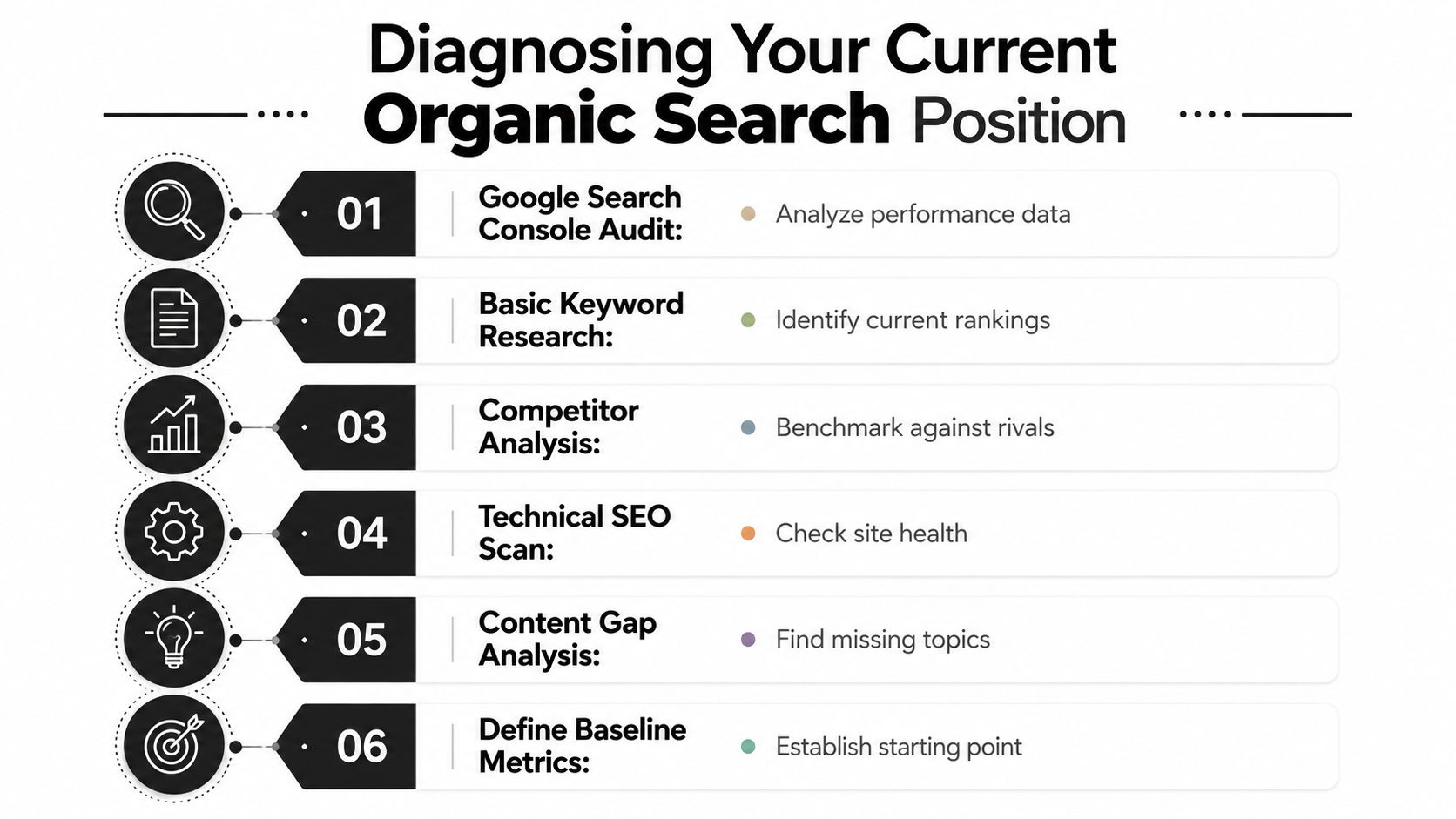
Start with Google Search Console, not with a keyword tool. You need to see what Google already associates with your site before you create more pages. Look at queries, pages, clicks, impressions, and average position, then sort for branded and non-branded terms separately so you don't confuse company awareness with search demand.
The two-hour audit that's actually useful
Do this in order.
- Pull your top queries from Search Console. Group them by intent, not by page title. The question is whether they're informational, comparative, or transactional.
- Check which pages already get impressions but weak clicks. Those are often the fastest wins because the topic is already visible.
- Compare your pages to the current SERP. If the results are mostly listicles, a how-to page may be the wrong format. If the results are product-led, a blog post may be too soft.
- Scan the top competing pages. Note whether they're thin, generic, or obviously stale. That tells you whether you're facing real competition or just inertia.
- Look for underperforming pages. A page with impressions but no traction often needs a title rewrite, tighter intent match, or a different page type.
- Define one baseline metric for each page. Keep it simple, clicks, impressions, and conversions tied to organic landing pages are enough at the start.
If your team uses a structured keyword workflow, Orchory AI Keyword Research Tool fits naturally into this stage because it's built around keyword research rather than a general SEO dashboard. That matters if you're trying to move from raw queries to an actual page queue.
What to watch and what to ignore
Early-stage SaaS teams should care less about vanity rankings and more about whether the site is earning search visibility on queries that can become product-adjacent pages. A handful of impressions on the right query is more useful than a larger pile on a topic nobody converts from. If you can't connect a page to one of your main product paths, it belongs lower in the queue.
Don't audit for completeness. Audit for decisions.
You're looking for pages that deserve a rewrite, a merge, a new internal link, or a replacement page type. Anything else is just documentation.
Prioritizing Keywords and Page Opportunities That Actually Convert
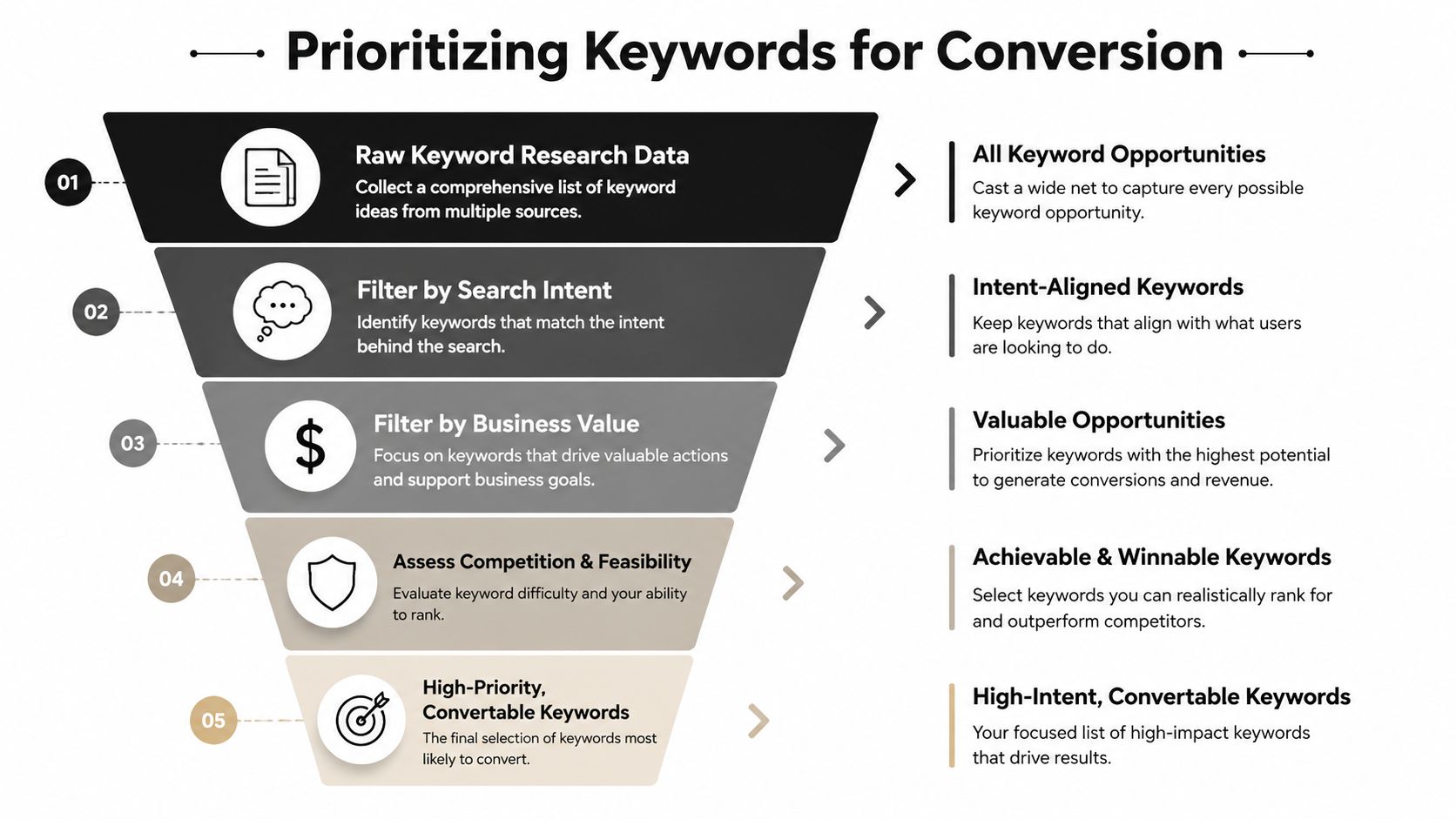
Keyword volume is a weak filter by itself. High-volume queries can be bad bets if they attract the wrong intent, and low-volume queries can be high value if they sit close to purchase or activation. The practical move is to score opportunities by business relevance, search intent, and feasibility together, not in separate spreadsheets.
Filter from raw demand to buildable pages
Start with raw keyword ideas, then cut hard.
- Filter by search intent. If the SERP is mostly educational, don't force a pricing page there. If the SERP is commercial, don't bury the answer in a long essay.
- Filter by business value. A query matters more if it points toward your ICP, your use case, or a core feature.
- Assess competition and feasibility. The benchmark isn't “can we rank someday,” it's “can we build something better than what's there with the team we have.”
- Choose the page type last. The same topic might need a comparison page, integration guide, glossary entry, or use case page depending on the SERP.
- Rank by expected impact. Put the best mix of intent, value, and feasibility at the top, not just the biggest search volume.
In this part of the process, Orchory AI Brand Visibility can be used as a supporting reference point when you want to understand how a brand is showing up around search demand. It's one input, not the output.
Zero-click queries need a different decision
A lot of “increase organic traffic” advice still treats every ranking as a win, but that's not how search behaves. Google has expanded answer-style features, and independent analyses in 2024 found that a majority of searches end without a click in some markets (zero-click discussion). For a SaaS team, that means some queries should be treated as visibility work or assisted-conversion work, not traffic targets.
That doesn't make those topics useless. It means you need a clean standard for deciding whether the query should be targeted with a page, captured through another format, or skipped entirely. If a query rarely produces clicks and doesn't support downstream conversion, it belongs low on the roadmap, even if the search volume looks attractive.
Useful filter: build pages for queries where you can win both relevance and a click, not just impressions.
The output of this step should be a ranked list of pages with a clear reason to exist. If the reason is fuzzy, the page will be fuzzy too.
Building an Execution Plan That Ships Through Pull Requests
Strategy only matters if it lands in a PR. For small SaaS teams, the cleanest workflow is to turn each prioritized opportunity into a brief that a coding agent can execute, then review the result like any other product change. That keeps SEO from becoming a side quest with no owner and no merge path.
What belongs in a real content brief
A useful brief is short but specific. It should include the target query cluster, the user intent, the page type, the competing pages you're trying to beat, the internal links that matter, and the conversion action you want the page to support. If the brief can't answer those basics, the coding agent will fill the gaps with generic filler.
The page types that usually fit SaaS best are comparison pages, integration guides, use case pages, and tightly scoped glossary or problem pages. Those formats map better to how buyers search than broad blog posts do. They also tend to be easier to QA because the expected structure is clearer.
For teams using agents like Claude Code or Cursor, the prompt should include the desired section outline, the product claims that are allowed, and the links that must be included. The agent should not have to guess what the page is for. It should only have to generate the implementation from a clear source brief.
Keep production control in the PR
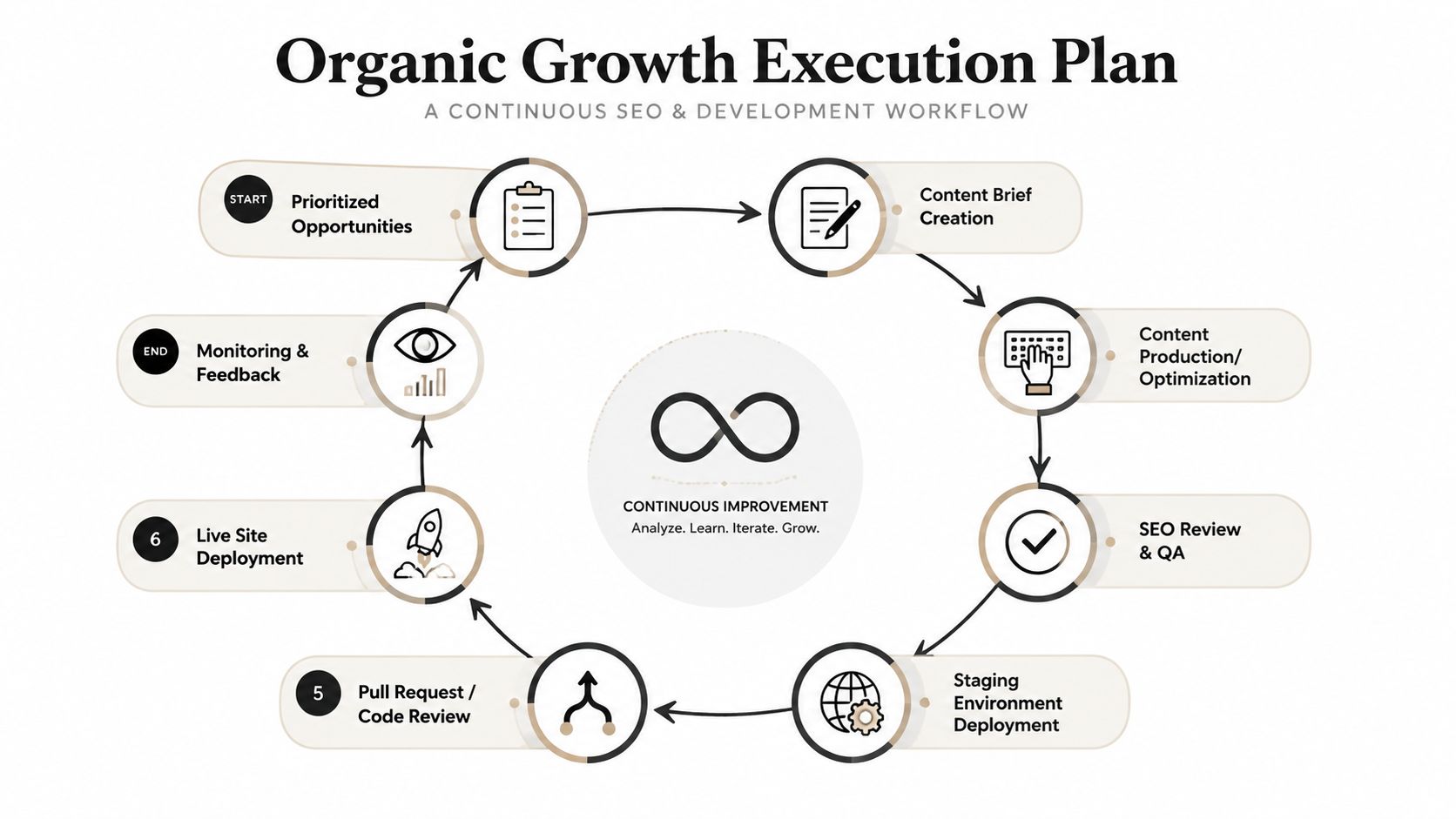
The workflow should look like this.
- Prioritized opportunity becomes a brief.
- Coding agent turns the brief into a draft page or update.
- SEO review checks intent match, headings, links, and snippet fit.
- Staging review checks layout, metadata, and rendering.
- PR review catches product accuracy and implementation issues.
- Merge ships the change, then analytics watches the page.
That is the point where SEO becomes normal engineering work. The team can batch similar pages together, review them together, and avoid one-off publishing sessions that burn time without building a repeatable system.
The video below is useful if your team wants a visual walkthrough of the workflow between planning and execution.
<iframe width="100%" style="aspect-ratio: 16 / 9;" src="https://www.youtube.com/embed/7DRO4rEIHDk" frameborder="0" allow="autoplay; encrypted-media" allowfullscreen></iframe>A concise internal reference can help here too, especially if your team is standardizing how pages are written and reviewed. The internal guide at SEO content strategy fits this kind of production workflow because it can sit beside your PR checklist instead of living in a separate marketing doc.
Measuring Results Without Getting Lost in Analytics
The wrong way to measure SEO is to refresh a dashboard and wait for a line to go up. The right way is to track whether the queue is moving, whether the pages are earning the right kinds of impressions, and whether those pages are tied to business actions. Early-stage teams don't need twenty charts, they need a few signals they can trust.
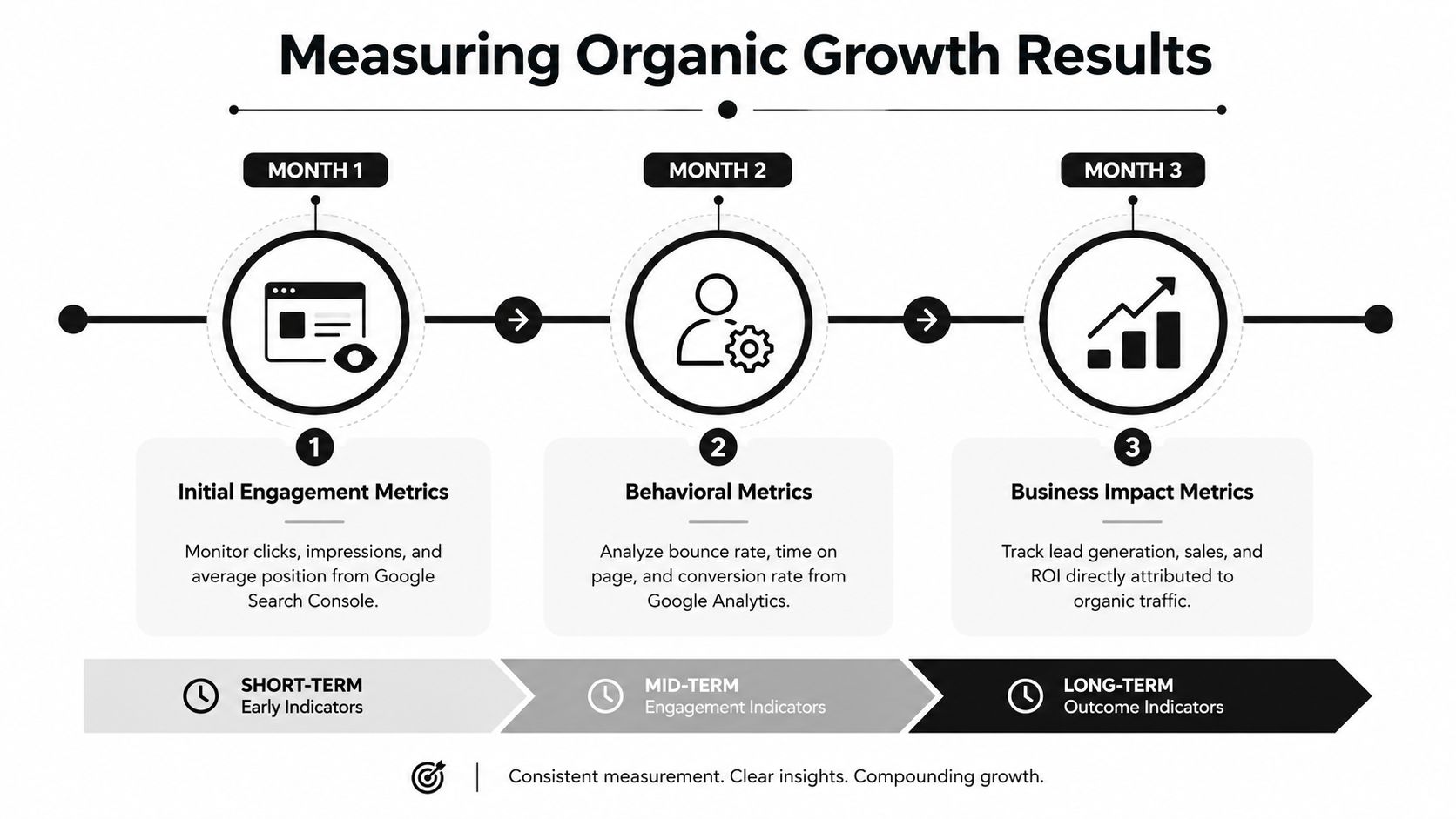
Read the metrics in the right order
In month one, look at clicks, impressions, and average position in Search Console. Those tell you whether Google is testing the page for the right query set. In month two, watch behavior on the page, such as whether visitors stay long enough to consume the offer and move toward the next step.
By month three, tie organic landing pages to leads, trials, demos, or sales, depending on your funnel. That last step matters because traffic without business impact is just busier reporting. If a page gets views but never supports a conversion path, it may be a useful awareness asset, but it's not yet a growth asset.
SaaS organic programs also tend to move unevenly. Published benchmark data suggests new programs often see 0% to 5% monthly growth in months 1 to 3, 10% to 25% in months 4 to 6, and 20% to 40% in months 7 to 12, with many companies reaching 100% to 200% annual growth in year 1 if investment stays consistent. The same benchmark notes that quarterly performance can swing from -30% to +40% after Google core updates (SaaS organic traffic benchmarks). That's why single-month spikes are a bad management signal.
Use trends, not single points
A page can look dead for weeks and then start earning once internal links, title changes, or layout fixes settle in. That's normal. The mistake is changing direction after one weak month and never letting the page collect enough data to show its real curve.
Measure organic work the way you'd measure product adoption, over time, against a baseline you control.
The easiest reporting habit is a weekly review of the opportunity queue and a monthly review of page performance. If a page is ranking on the right query set but not converting, revise the page. If it isn't earning visibility at all, revisit the query, the intent, or the page type.
Operationalizing Growth with Automation and Coding Agents
The sustainable setup is a weekly pipeline that refreshes keyword opportunities, rebuilds the queue, and turns the top items into prompts a coding agent can execute. That removes the repeated manual work from the process and leaves the human team to make judgment calls where judgment matters. A bootstrapped SaaS team can't afford to re-research the same themes every month.
That's the role Orchory is designed to play. It runs keyword expansion, validation, clustering, and scoring, then outputs ready-to-run prompts for coding agents that can open pull requests. The key detail is control, nothing touches the site until a reviewer approves the PR. The guide to AI SEO tools that monitor, write, or execute helps match that model to your actual bottleneck.
Where automation helps and where it doesn't
Automation is useful for research, grouping, scoring, and formatting. It's not enough for positioning decisions, product claims, or final approval. The team still needs to decide whether a page should exist, whether the copy matches the product, and whether the implementation belongs on the live site.
The work pattern should feel familiar to any engineering team.
- Weekly queue refresh. Rebuild the opportunity list from current search demand.
- Prompt generation. Convert the top items into task-ready instructions.
- Agent execution. Let the coding agent draft the page or update.
- PR review. Check accuracy, structure, and SEO basics.
- Merge and monitor. Ship the page, then watch how it performs.
- Repeat. Use the results to feed the next prioritization cycle.
The most useful part of this model is that it scales with the same discipline as product development. You're not hiring for a whole new department just to keep the work moving. You're turning SEO into a repeatable system that fits sprint planning, code review, and release management.
If you want to see how that handoff works in practice, the internal guide on AI SEO agents is the right companion reference. It matches the operating model here, planning first, execution through prompts, and review before anything goes live.
If you're trying to grow organic traffic without hiring a full SEO function, Orchory can keep the research, prioritization, and prompt generation in one workflow. Visit Orchory to see how it turns search demand into reviewed pull requests your team can ship.
FAQs
Why do most SaaS SEO efforts stall before they start?
How should we diagnose our current organic search position?
How do we prioritize keywords that actually convert?
What belongs in a real content brief for a coding agent?
How should we measure SEO results without getting lost in analytics?
Where does automation help in an SEO workflow, and where doesn't it?