The AI SEO Agent Playbook: Turning Keyword Research into Shippable Pull Requests
How AI SEO agents turn keyword research into build-ready prompts your coding agent can ship, reviewed and merged like any other PR.
You've got the usual setup: a small SaaS team, a product backlog that never shrinks, and SEO sitting in the "we know we need it" bucket while shipping keeps winning the calendar. The problem isn't that you don't know keywords matter, it's that the work stops at research decks, while nobody has time to turn those decks into pages, PRs, and published changes.
That's where an AI SEO agent is useful. Not as a chatbot that spits out ideas, but as a system that finds opportunities, ranks them, and hands your team something a coding agent can execute and your reviewer can approve. In practice, that means fewer static reports, more build-ready prompts, and a workflow that fits how developers already ship.
What an AI SEO Agent Actually Does for a SaaS Team
A two-person SaaS team usually doesn't need another dashboard. It needs a way to decide which pages to build, get those pages into a format a developer can ship, and avoid spending a week on keywords that never turn into published work. That's the practical job of an AI SEO agent, especially for bootstrapped and seed-stage teams without an in-house SEO hire.
From research to build instructions
The difference shows up in the output. A classic SEO tool gives you exports, audit flags, and a list of terms. An agent turns research into prioritized build instructions, including intent, page type, and scope. Orchory is built around that planning-and-handoff layer, so a team can move from keyword opportunity to a ready-to-run prompt for a coding agent without inventing the process each time.
Practical rule: if the output still needs a human to figure out what page to build, the tool is helping, but it's not acting as an agent.
That matters because the work doesn't end at finding demand. The agent should cluster related keywords, map the search intent behind each cluster, score the opportunity, and then package the result in a way that Cursor, Claude Code, or another coding agent can use. The team still owns the site, the repo, and the merge. The agent just removes the blank-page step.
For a team that wants to see this kind of handoff in a concrete workflow, the mechanics are worth comparing with Orchory's automation guide. The useful question isn't whether the agent can "do SEO." It's whether it can deliver a ranked queue of page ideas, each tied to a prompt that maps cleanly into the repo workflow your developers already trust.
What to expect from a useful agent
A solid agent should give you three things every week, at minimum.
- A ranked opportunity queue, not a generic list of keywords.
- Search intent mapping, so you know whether a topic deserves a comparison page, use case page, glossary entry, or something else.
- Build-ready prompts, so a coding agent can open a pull request instead of a marketer pasting notes into a doc.
That's the core difference between automation that sounds good in a demo and automation that fits a small SaaS team. If the system stops at analysis, your team still owns the hard part. If it produces something your developers can review, merge, and ship, it starts paying rent.
The Architecture Behind a Production-Ready SEO Agent
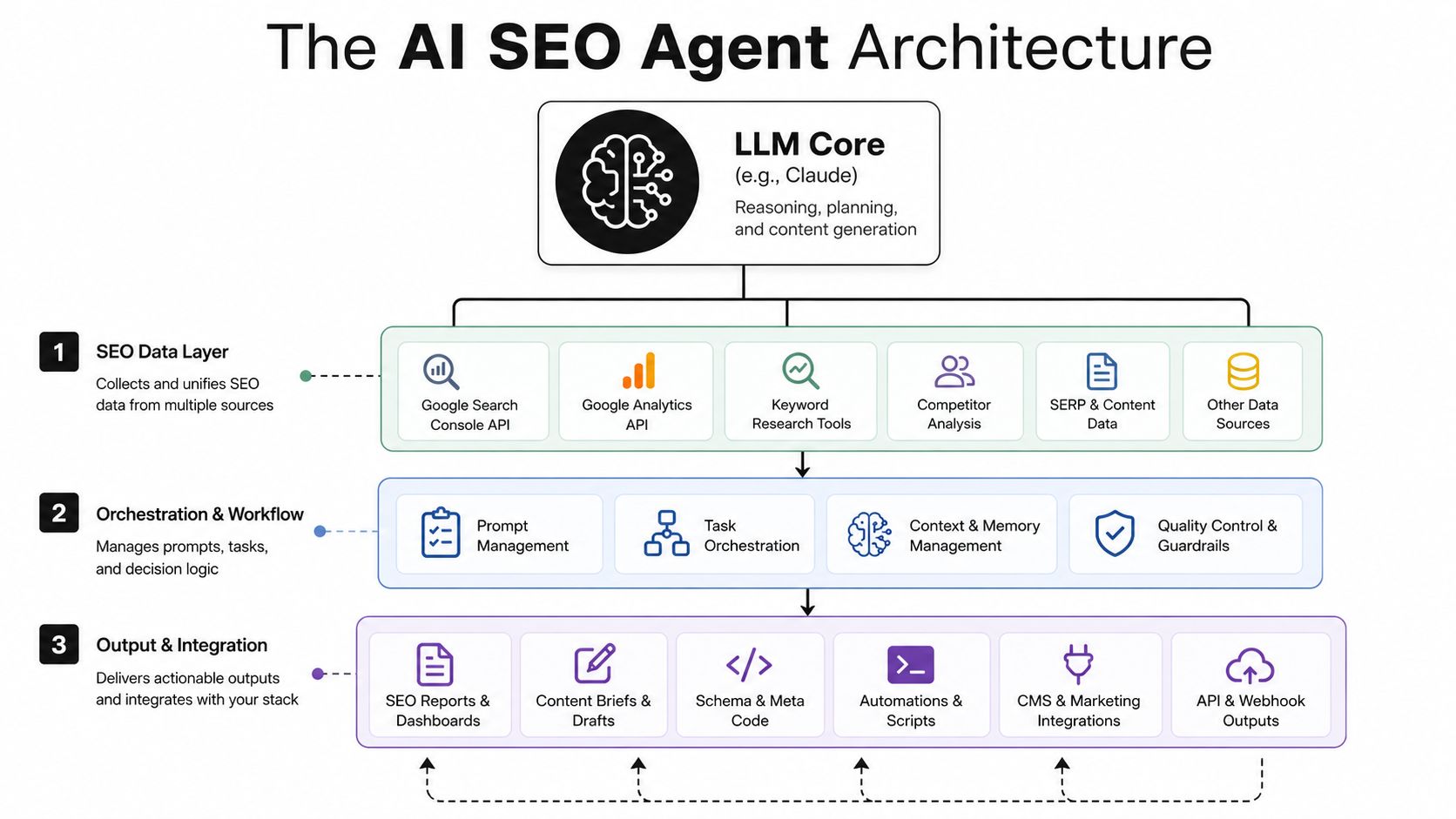
A production-ready AI SEO agent is not a single model with a keyword API attached. It needs separate layers because search research, prioritization, and execution are different jobs. The architecture that holds up in practice is an LLM core, an SEO data layer, an action layer, and a memory layer. That separation is what turns a conversational wrapper into a system that can move from analysis to action, as outlined in the technical breakdown at Slashdev.
The four layers that matter
The LLM core handles reasoning. A model such as Claude or GPT-4 can interpret the data and synthesize the next step, but the model alone is still just a parser and planner. It needs live search inputs and somewhere to send the work.
The SEO data layer pulls from sources like Google Search Console and third-party keyword databases. Without that layer, the agent is guessing from a prompt instead of responding to actual search data. The action layer turns the output into something usable, such as a brief, a CSV, or a structured prompt for a coding agent. The memory layer stores what has been published, which clusters have already been covered, and how pages have performed over time.
A tool that cannot remember what your site already published will keep "discovering" the same opportunity twice.
That memory layer matters more than teams expect. If the agent does not know what is already live, it cannot spot cannibalization risk or avoid recommending duplicate pages. If it does not know what happened after launch, it cannot learn from what worked and what missed. A production agent needs a persistent system around the model, not just a prompt template.
Why this structure changes the weekly workflow
This architecture supports a repeatable weekly loop. Research enters through the data layer, reasoning happens in the model, the output layer formats the recommendation, and memory keeps the same work from being rediscovered next week. That is the difference between a report and a system.
If the agent is built well, your team does not have to ask it what to do with a keyword list. It already knows how to sort the list into opportunities, format the output for your repo, and preserve enough context to keep the next run from starting from scratch. If you are comparing products, Orchory AI Keyword Research Tool fits into that planning layer, with the value coming from how cleanly the output can be handed off to the build workflow.
The Weekly Pipeline from Keywords to Scored Opportunities
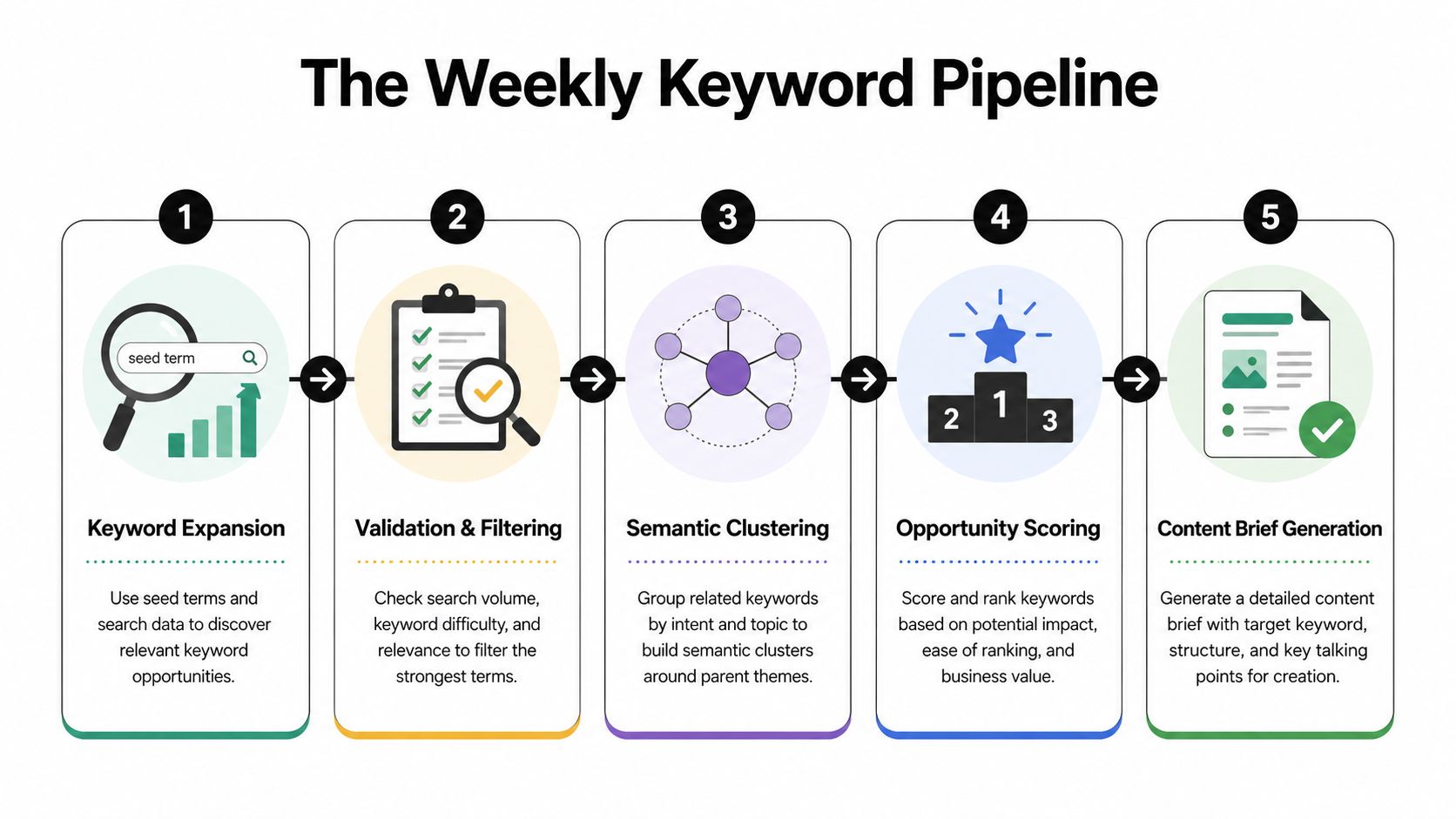
The most reliable SEO workflow I've seen starts with expansion and ends with a queue your team can work through. It doesn't try to be clever first. It tries to be repeatable. The useful pattern is simple: keyword expansion, validation, clustering, scoring, then a refreshed opportunity list that reflects what changed in Search Console.
Start with expansion, then remove noise
The first pass should widen the input set, not narrow it. Seed terms, question formats, and long-tail variants give the agent enough material to cluster around real intent instead of a single phrase. Independent workflow guides describe this as a pipeline that pulls variations, groups them by parent topic, and then scores them by difficulty, traffic potential, and intent, with performance data feeding the queue back in later Ahrefs.
After expansion, the validation step removes terms that look interesting but won't support a page. That means filtering by whether the phrase is likely to support a useful page type and whether the topic has enough intent clarity to justify work. A founder doesn't need 500 loosely related keywords. A founder needs a short list of page opportunities that can earn review time.
Cluster by parent topic, not by surface wording
Semantic clustering is where the agent starts acting like a strategist instead of a sorter. It groups phrases by what the searcher is trying to do, then maps each cluster to a page shape. One cluster might belong on a comparison page, another on a glossary entry, another on a use case page.
The important output is not just the cluster name. It's the page type, the scope, and the intent. If a cluster has mixed intent, the agent should flag it instead of pretending one page solves all of it. That saves developers from building pages that look organized in a spreadsheet but feel wrong in search.
Good filter: if the cluster can't answer a specific user job, it probably shouldn't become a page yet.
Score the queue, then refresh it from performance data
Once the agent has clusters, it can rank them by opportunity. In practice, that ranking should blend difficulty, traffic potential, and business relevance. Then the queue needs to refresh from Search Console so the plan reflects reality, not stale assumptions.
A useful implementation pattern is to watch the top keywords daily and trigger an audit when a page drops materially in position within a week, as described in the Ahrefs workflow above. That's how the agent stays tied to actual movement instead of static planning. The output is usually a CSV export of keywords, clusters, and prioritized opportunities, plus the prompt package that a coding agent can turn into a pull request.
You can see why that matters for a small team. The agent doesn't replace judgment, it compresses the research-to-roadmap phase into something you can revisit weekly without rebuilding the process from scratch. A cataloged option like Orchory Free SEO Tools can sit nearby for lightweight checks, but the value is in the repeatable queue the agent hands back.
<iframe width="100%" style="aspect-ratio: 16 / 9;" src="https://www.youtube.com/embed/FwOTs4UxQS4" frameborder="0" allow="autoplay; encrypted-media" allowfullscreen></iframe>How AI SEO Agents Compare to Traditional Tools and Agencies
A founder usually chooses between three things, software, freelancers, or agencies. An AI SEO agent sits in a different spot. It's closer to an operating layer than a report generator, which changes what it replaces and what it leaves alone.
The real trade-offs
Traditional SEO tools are strong on data access. Ahrefs and Semrush are good examples. They give you keyword, backlink, and competitive research, but the team still has to interpret the outputs and move them into a build process. Agencies can interpret the data for you, but they usually hand over recommendations, decks, or briefs rather than pull requests. A well-designed agent sits in the middle, because it can prioritize work and package it for execution without needing a weekly call to explain the next step. Compare the best AI SEO tools for each workflow by the output your team actually needs.
| Criteria | AI SEO Agent | Traditional SEO Tool | SEO Agency |
|---|---|---|---|
| Main output | Prioritized build instructions, prompts, and queued opportunities | Data exports, dashboards, audits | Recommendations, briefs, slide decks |
| Speed to first useful output | Fast once the workflow is set | Fast for data, slower for action | Slower, because it depends on meetings and turnaround |
| Control over implementation | High, because your team reviews the PR | High, but manual work remains on your side | Lower, because work moves through the agency process |
| Best use case | Turning research into shipped pages | Research and reporting | Strategy support and execution help |
| Typical bottleneck | Prioritization and handoff quality | Manual interpretation | Dependence on external turnaround |
Why the handoff gap matters
Some teams don't fail at getting data. They fail at turning data into something they can ship. An SEO tool can tell you that a topic exists. An agency can tell you that it matters. An agent can hand you the prompt a developer needs to open a pull request.
That doesn't mean the agent replaces every other option. If you need deep backlink research, traditional tools still matter. If you need high-touch strategy, an experienced consultant still has a role. But if the problem is "we know we should publish this page and we never get around to it," the agent is the more direct answer because it collapses research and build prep into one workflow.
What a founder should buy first
If your team has no SEO person, the first purchase should reduce handoffs, not add another place to check metrics. The strongest fit for an early-stage SaaS team is usually the system that gets from keyword to reviewed PR with the fewest extra steps. That's the gap agents target, while tools and agencies fill the research and advisory side.
Wiring the Agent into Your Developer Workflow
The cleanest setup is non-invasive. The agent researches, ranks, and formats the work. Your coding agent opens the pull request. Your team reviews and merges. That separation keeps production control inside the repo, which is exactly where a small SaaS team wants it.
The prompt should look like a build spec
The output from the SEO agent should be structured enough that a coding agent can use it without interpretation. Think in terms of target page type, intent, outline, internal link suggestions, and any content constraints that came out of the research. The prompt should be deterministic enough that Claude Code, Cursor, or a similar tool can act on it.
A practical prompt package usually includes:
- Target query cluster, so the coding agent knows what the page is for.
- Recommended page type, such as comparison, use case, or glossary.
- Content scope, so the draft doesn't balloon into unrelated sections.
- Internal links and schema hints, so the page can ship with the right structure.
- Acceptance criteria, so the reviewer can tell whether the PR matches the brief.
Rule of thumb: if the prompt needs a human to translate it before the coding agent can work, the handoff is too loose.
Keep the repo workflow standard
Once the coding agent has the prompt, it should create changes in the repo and open a pull request. That PR becomes the review boundary. The SEO agent does not need CMS credentials or direct write access to production. It should stay upstream of the site, where it can propose work without changing the live page by itself.
That setup matters because it preserves normal engineering controls. Reviewers can check copy, links, schema, component usage, and whether the page matches the SERP intent the agent identified. Nothing ships until someone approves it. That's the right default for a team that doesn't have the luxury of a separate SEO operations layer.
Why this beats a direct publish model
Direct publishing sounds efficient, but it's risky if the system can't explain every change in a reviewable way. A handoff through pull requests is slower than one-click publish, but it's the safer option for most seed-stage teams because it fits existing quality gates. It also makes iteration easier, since the same workflow can be reused for new pages, rewrites, and updates without changing who owns production.
Where AI SEO Agents Fall Short and How to Compensate
The biggest limitation is not technical, it's strategic. Agents are good at finding and structuring opportunities, but they're still weak at understanding which ones matter most to your business. That gap shows up when a page has great search demand but weak revenue relevance, or when a cluster looks attractive but overlaps with something you already rank for.
Prioritization still needs a human
That's the part most AI SEO content glosses over. Existing coverage is strong on keyword clustering and content gap detection, but weaker on deciding what deserves execution first. A real team still has to weigh revenue potential, topical authority, cannibalization risk, and SERP intent before a page gets built. If you skip that judgment, the agent can produce a tidy queue of the wrong work.
AI search adds another layer of friction. Coverage has increasingly shifted toward AI visibility and changing SERP behavior, but a lot of the tooling conversation still assumes classic keyword workflows. In practice, the agent should inspect current SERP patterns, look at what the top-ranking pages are doing, and shape the page format around what's publishable now, not what worked a year ago Lyzr.
Build fact checking into the workflow
The other failure mode is content accuracy. A practical safeguard is to require sources for every factual claim, then run a fact-checking pass before anything gets published. One guide calls out hallucinated statistics, incorrect dates, and false claims as the core risk, and recommends retrieval with verified sources plus human validation of factual assertions Keytomic.
For a developer-led team, that means the PR review shouldn't just check code and layout. It should also check whether cited facts are traceable, whether the page makes unsupported claims, and whether the content still matches the source material. If your workflow can't enforce that, the agent is generating more cleanup work than it saves.
Don't ignore the search interface shift
AI Overviews changed the job of SEO from ranking only to earning visibility in answer-style interfaces as well. One independent summary tied the shift to 2 billion monthly users globally and noted that AI Overviews appeared in about 25% of Google searches on average, with some commercial verticals as high as 48%. The same source also reports a 34.5% lower CTR for the top organic result when AI Overviews were present, and another dataset showed CTR falling from 1.76% to 0.61%, a 61% decline Digitaloft.
Search strategy now has to account for citations and summaries, not just blue links.
That doesn't mean traditional ranking is dead. It means the agent has to help you plan for pages that can be cited, summarized, and still useful when the click happens. If you keep that in mind, the agent becomes a planning layer that helps you ship the right pages under a changing SERP, rather than a report writer chasing old assumptions.
Buying Criteria and Example Prompts to Get Started
A buyer review usually starts too high, with feature lists and demo polish. For an AI SEO agent, start with the handoff instead. A useful system should show what it needs, what it produces, and how that output moves into your repo. If it cannot do those three things, it is closer to a dashboard than an agent.
What to check before you buy
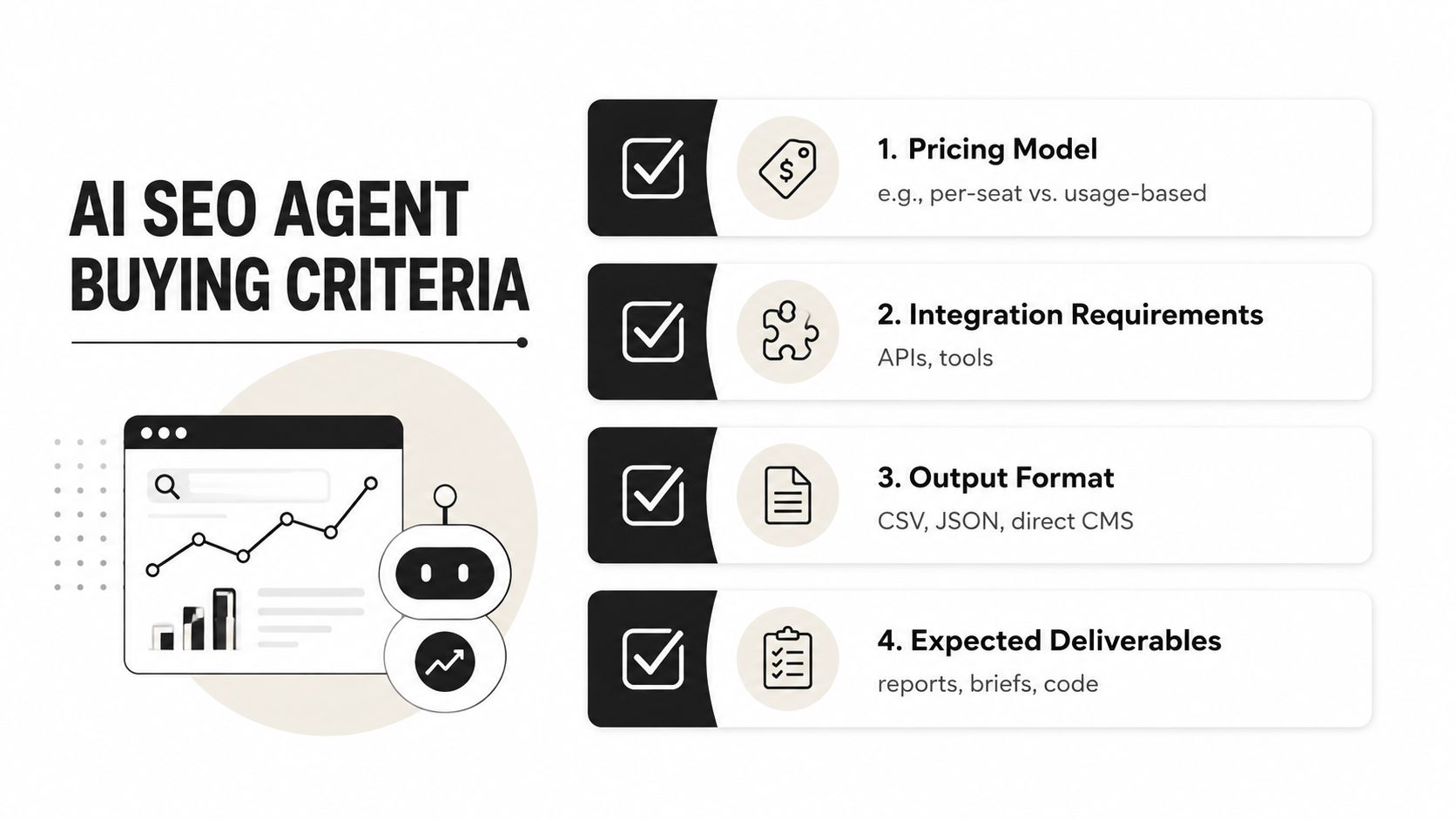
- Pricing model, because you need to know whether the plan charges per seat, per run, or per usage unit.
- Integration requirements, because the agent should work with your existing data sources and coding tools without forcing a full platform switch.
- Output format, because CSV, JSON, or direct prompt output changes how much manual work remains.
- Expected deliverables, because a report is not the same thing as a brief, and a brief is not the same thing as a pull request.
The first week should be easy to judge. You should see a ranked opportunity queue, keyword clusters, intent mapping, and prompts your coding agent can use. If the vendor also supports ad hoc runs for new segments or markets, that helps founders test positioning without rebuilding the workflow. The test is whether the output reduces review work or just adds another layer of interpretation.
Example prompts that should be practical
A comparison page prompt should name the competitor set, call out the differentiators that matter, and define how broad the page should be. A use case page prompt should map the product to a specific workflow and keep the page tied to that job. A glossary prompt should stay on one term so the content does not sprawl into a generic explainer.
You can sanity-check a product like Orchory AI Keyword Research Tool against that standard by asking one question, does it output work your coding agent can ship, or does it leave you with another spreadsheet to interpret? For teams that want a lighter starting point, Orchory free tools can help you test the workflow before you commit to a fuller setup. That is the buying filter.
If you want your SEO work to become reviewed pull requests instead of another pile of notes, start by testing Orchory on your own site structure and keyword set. Visit Orchory to see how it turns keyword research, clustering, and opportunity scoring into prompts your team can review, merge, and ship.
FAQs
What is an AI SEO agent, exactly?
How is an AI SEO agent different from a traditional SEO tool like Ahrefs or Semrush?
Does an AI SEO agent publish pages directly?
What architecture does a production-ready AI SEO agent need?
Can an AI SEO agent replace an SEO agency or consultant?
What should I check before buying an AI SEO agent?