How to Find SERP Feature Opportunities: An Engineering Pipeline
Turn SERP feature research into an engineering pipeline: audit, score, match schema, and ship opportunities as reviewable pull requests.

Your rank tracker has thousands of keywords, but the report still doesn't tell you what to ship next. You can see positions, volumes, and a growing AI Overview column, but the real question remains: which query deserves a page change, a new template, or a pull request this week?
That's the problem with treating SERP feature research as a report. A feature opportunity only becomes useful when it has an owner, an eligible page type, a realistic acquisition path, and a production handoff. The workflow below turns how to find SERP features opportunities into an engineering pipeline, from clean SERP capture to schema validation, prompt generation, publication, and rechecking.
Where to Start When SERP Reports Tell You Nothing
A small SaaS team often reaches the same frustrating point. A rank tracker exports a large keyword file, most commercial queries show the same People Also Ask block, and the new AI Overview column makes historical comparisons harder. Nobody needs another spreadsheet. The team needs a short list of changes someone can implement and review.
Start by separating a SERP feature opportunity from a vanity keyword. A keyword with a feature is only a candidate. The opportunity exists when the feature appears for a relevant query, your site doesn't own it, and the current owner is realistically beatable. A query can have high volume and still be a poor target if Google favors a format your site can't produce or if the visible feature absorbs attention without sending useful clicks.
Run the audit before changing content. Use clean, de-personalized searches in an incognito browser, and capture desktop and mobile results separately. Record the feature type, its position on the page, the current owner, the ranking URL, and the page format Google is rewarding. This prevents a common failure mode, rewriting a page before confirming that the target feature is present for the actual device and market.
Create the first backlog fields
Your first backlog column set can be simple:
- Query class: Definition, comparison, use case, local, product, or process.
- Feature target: Featured snippet, People Also Ask, video, image, local pack, sitelinks, or another visible module.
- Current owner: The domain and URL currently occupying the feature.
- Eligibility: The schema, media asset, crawlability, or template requirement.
- Ship path: Existing-page edit, new page, template change, video task, or technical pull request.
The SERP feature opportunity analysis workflow supports this sequence by separating feature presence mapping, competitive gap identification, and acquisition feasibility. Keep those stages distinct. Presence tells you where to look, ownership tells you whether a gap exists, and feasibility tells you whether the gap belongs in this sprint.
Why SERP Features Now Run the Results Page
A B2B SaaS page can hold a strong organic position and still lose the click. Google may place an answer block, video module, or carousel above it, while related searches and People Also Ask extend the page around it. According to STAT's 2023 analysis, related searches appeared on 83.67% of SERPs, People Also Ask on 78.85%, videos on 52.84%, carousels on 51.65%, and images on 37.81%. These modules are recurring surfaces for valuable queries, not decorative extras.
STAT's 2024 white paper reports that SERP features account for 65% of a SERP's visibility. A ranking report that tracks position alone therefore misses available attention and takeover risk. The page may rank well, yet sit below a format that answers the query before the user reaches the organic listings.
Click behavior makes that gap harder to ignore. SparkToro's 2024 study found that 58.5% of U.S. Google searches and 59.7% of EU Google searches ended without a click to the open web. Reporting based on SparkToro's data put U.S. zero-click searches at 68.01% in the first four months of the year, compared with 60.45% in 2024, an increase of 7.56 percentage points. The SparkToro zero-click search study provides the historical comparison.
Feature work should therefore ship as an engineering queue, not a research slide. Each opportunity needs a target query, page type, schema contract, required asset, and prompt handoff. A featured snippet may map to a structured answer block on an existing page. A video result needs a production task and a video-ready template. This framing exposes the trade-off: visibility can increase while organic clicks stay flat.
| Feature Type | Query Presence Share | Organic CTR Impact |
|---|---|---|
| Related searches | 83.67% | Extends the query journey and exposes adjacent demand |
| People Also Ask | 78.85% | Adds answer visibility while competing with organic results |
| Videos | 52.84% | Provides a visual entry point and can shift attention from blue links |
| Carousels | 51.65% | Occupies prominent page space and changes the visible result mix |
| Images | 37.81% | Creates a visual discovery path for image-led queries |
These presence figures come from STAT's 2023 SERP feature analysis. Use them to monitor feature classes, not promise traffic. Score each opportunity by presence, above-the-fold placement, commercial intent, estimated CTR effect, and whether the team can produce the required format and schema.
Building a Repeatable SERP Feature Audit
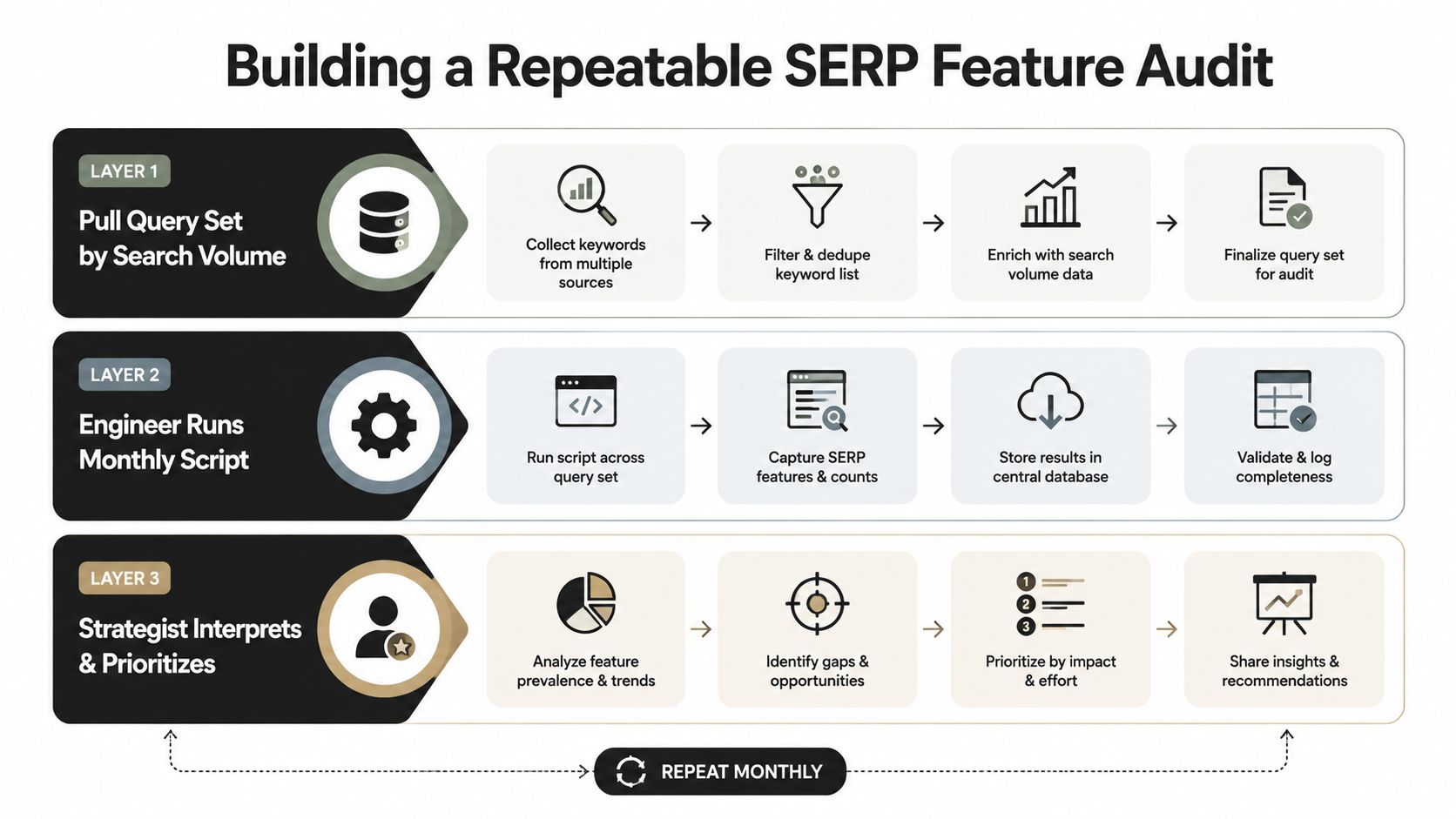
A reusable audit has three layers. The first records what appears. The second identifies who owns it. The third decides whether your team can take it. Run the same process monthly, with the engineer maintaining the extraction and the strategist interpreting the queue.
Layer one maps feature presence
Begin with intent buckets rather than an undifferentiated keyword export. Map each query cluster to the CMS page template that could satisfy it, such as a glossary page for definitions, a comparison page for “best” queries, or a use-case page for workflow searches.
For every query, collect:
- The feature type and approximate page position.
- The desktop or mobile device.
- The current owner and source URL.
- Your ranking URL and position.
- The apparent content format, including list, paragraph, table, video, image, or local listing.
- Any relevant schema or media requirement.
The output should be a row-level dataset, not a screenshot folder. Screenshots help with review, but structured fields let you filter and prioritize.
Layer two finds the competitive gap
Cluster feature owners across the query set. If one competitor owns a feature for many related queries, inspect the page pattern they use. If two competitors alternate ownership, the result may be format-sensitive rather than domain-locked. That's often more actionable than a broad competitor domain comparison.
Take “best SOC 2 compliance software.” The audit row might show a comparison feature, a competitor-owned page, your own comparison page ranking below it, and a content gap around evaluation criteria. That row should move forward only if the page can present a useful comparison and the competing result isn't supported by an authority or format advantage your team can't match.
Layer three applies the feasibility gate
Separate Traffic Value from Acquisition Difficulty. Traffic Value can include search volume, above-the-fold placement, commercial intent, and estimated CTR change. Acquisition Difficulty can include relative authority, your current position, content gaps, schema requirements, and the need to produce original video or imagery.
A useful backlog tier might be:
- Quick win: The target URL exists, the page format matches, the feature is unowned by your site, and the change is mostly structure or markup.
- Long play: The query matters, but the team needs a new page, stronger evidence, original media, or authority development.
- Skip: The feature is present, but the owner is difficult to displace or the format conflicts with the product and CMS.
This keeps the audit tied to work that can ship. A feature row without a feasible implementation is research, not an opportunity.
Scoring Features by Traffic Impact and Takeover Risk
Visibility alone is a weak prioritization rule. A feature can sit above the organic results and still reduce the clicks available to every source. A cross-website study modeled organic CTR across 24 SERP features and found that features can either amplify or attenuate traffic. An academic analysis also reported a positive relationship between the number of positional SERP features tied to a result and CTR, with ρ = 0.22. The academic SERP feature analysis is useful because it shows why feature effects shouldn't be treated as uniform.
Direct answers and featured snippets can decrease CTR while increasing time spent on the results page. Knowledge panels showed no significant effect on either outcome in the separate study described in that research. For a bootstrapped SaaS team, that distinction changes the queue. A winnable featured snippet for a definition may build recognition but produce fewer visits than a commercial comparison module with a clear path to the product page.
Use a score that exposes the trade-off
A practical row score can combine:
- Query value: Relevance to a product, use case, or qualified problem.
- Feature effect: Expected visibility or CTR effect for that feature type.
- Current position: How close your relevant page already is to the result set.
- Ownership strength: The current owner's authority, format quality, and topical fit.
- Implementation cost: Content, schema, media, template, and review work.
- Pixel exposure: How much of the feature appears before a user scrolls, especially on mobile.
AI Overviews deserve a risk field, not automatic enthusiasm. One 2026 industry analysis reported that AI Overviews correlate with a 58% lower average CTR for the top-ranking page, while independent 2026 CTR tables reported first-position CTR falling from 24.9% to 18.6% when AI Overviews are present. Those figures are cited in the SERP feature gap analysis. If an AI Overview offers no link to your site, the opportunity may be brand visibility or citation monitoring rather than a traffic win.
| Feature Type | Avg CTR Lift | Takeover Risk | Recommended Priority |
|---|---|---|---|
| Featured snippet | Varies by query and placement | Moderate for concise, useful answers | Prioritize when the page already ranks and answers directly |
| People Also Ask | Varies by query and answer quality | Moderate | Prioritize for relevant question clusters |
| AI Overview citation | Can suppress clicks when no link is offered | High and format-dependent | Monitor, then prioritize only where the query has strategic value |
| Knowledge panel | No significant effect in the cited analysis | High for non-branded queries | Usually a long play or skip |
| Image or video module | Varies by visual intent and asset quality | Moderate | Prioritize when original assets are easy to produce |
For a broader keyword gap workflow, use Orchory's keyword gap analysis guide as a companion process, but keep the feature score separate from ordinary ranking gaps. The deliverable should be a ranked queue with a reason to act, not a list of every SERP element your tracker can detect.
Finding Opportunities in Mobile and Nontraditional Features
A desktop-only audit misses the page your users see on phones. Run each priority query in both environments and store device as a required field, not an optional note. A mobile result can place images, videos, local results, or People Also Ask blocks in a different order, changing which asset deserves engineering time.
Local intent also appears without an explicit “near me” modifier. A query such as “best CRM for small team Chicago” can require a location page, a local profile review, or both, rather than another generic blog post. Local packs held 4.0% of position-one share in January 2024, 4.6% in January 2025, and 5.7% in January 2026, according to STAT's 2026 SERP feature review. Treat that as a reason to inspect local opportunities where geography is part of the buying decision.
Split the asset tracks
Use separate workstreams for each nontraditional format:
- Images: Produce original screenshots, diagrams, or product visuals. Use descriptive filenames and alt text, and make sure the surrounding copy explains the image.
- Video: Match the video to a specific task or question. Add a transcript and chaptered timestamps when publishing a YouTube asset or embedding video on a page.
- Local: Review the Google Business Profile and location page together. The page should make the service, audience, and location clear.
- Mobile layout: Test the first viewport, expandable answers, tables, media loading, and tap targets on an actual narrow screen.
The mobile and desktop audit shouldn't average these features into one visibility number. A feature that appears only on mobile belongs in a mobile-specific content or product backlog, with its own owner and validation step.
For teams producing instructional media, this is a useful implementation reference:
<iframe width="100%" style="aspect-ratio: 16 / 9;" src="https://www.youtube.com/embed/W4OqODLJfRQ" frameborder="0" allow="autoplay; encrypted-media" allowfullscreen></iframe>Matching Eligibility to Page Type and Schema Contract
A feature target isn't shippable until the page can qualify for it. Google says enhanced-result eligibility requires all required structured data properties for the relevant object, and supported formats include JSON-LD, Microdata, or RDFa. Google also says the page must not be blocked by robots.txt, noindex, or other access controls. See the Google structured data introduction for the eligibility mechanics.
Treat schema as a contract between the opportunity row and the CMS template. A glossary page shouldn't receive Product markup just because a product result appears for the keyword. If the page type can't render the required visible content, create the right template or change the target feature.
Map the opportunity before writing
| SERP Feature | Required Schema | Eligible Page Types | Eligibility Gate |
|---|---|---|---|
| Featured snippet | No guaranteed schema requirement | Glossary, comparison, process, or guide page | Direct answer is useful, concise, crawlable, and easy to extract |
| FAQ-style rich result | FAQPage where supported and appropriate | FAQ or guide template | Required properties are present and visible content matches markup |
| How-to result | HowTo where supported and appropriate | Step-by-step guide template | Steps are explicit and the template can render the required fields |
| Product result | Product with relevant offer details | Product or comparison template | Product information is visible and structured data is valid |
| Video result | VideoObject where applicable | Video landing page or guide with embedded video | Video is accessible, contextualized, and marked up correctly |
| Organization result | Organization where applicable | Company or about page | Entity details are consistent and the page is crawlable |
Google describes featured snippets as special boxes where the descriptive snippet appears before the regular result format. Its featured snippets guidance says systems select pages based on how well they answer the query and how useful the format is for discovery. That supports a straightforward page pattern: answer the definition, comparison point, or process question clearly, then provide supporting depth below.
Before assigning a rewrite, run the current URL through schema validation, confirm crawl access, and inspect whether the CMS can render every required property. The Google structured data policies also prohibit spammy markup and blocked pages, so markup should describe the visible page rather than simulate eligibility.
For practical guidance on shaping answer blocks and page structure, use Orchory's featured snippet optimization guide. The important handoff fields are the target URL, page type, feature, schema contract, visible content change, and validation owner.
Shipping Opportunities Into a Reviewable Content Pipeline
The final output of the audit should look like a production queue. Each row needs enough context for a coding agent or developer to implement the change without reopening the entire research process. If a strategist still has to explain the query, feature, page, and acceptance criteria in a separate meeting, the handoff is incomplete.
A structured prompt can contain:
- Target feature: People Also Ask, featured snippet, video, image, local, or another module.
- Query cluster: The primary query and closely related questions.
- Owning URL: Existing page to modify, or the new URL to create.
- Page type: Glossary, comparison, use case, location, product, or guide.
- Schema changes: Required markup, fields, and validation requirements.
- Content delta: The answer block, table, FAQ, media, or comparison content to add.
- Review checkpoint: Named reviewer, acceptance criteria, and due date.
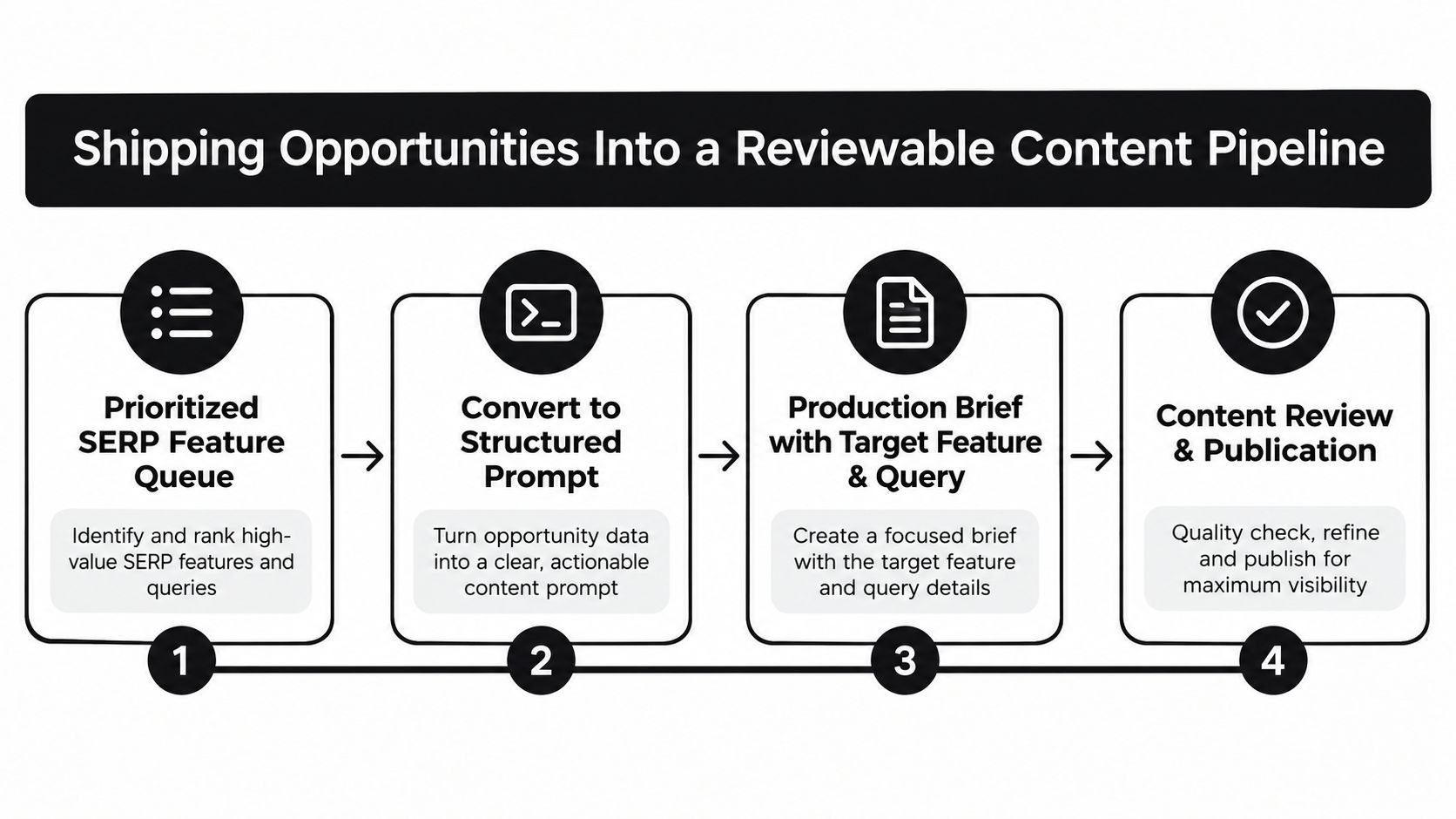
A coding-agent handoff might read:
Task: Add an FAQ section and valid FAQPage markup to
/guides/soc-2-compliance-software. Target the People Also Ask question “What should SOC 2 compliance software include?” Keep the answer aligned with visible page content, validate the structured data, preserve the existing comparison table, and open a pull request for review by Sarah.
The corresponding pull request template should require the target query, feature observed, current owner, changed files, schema test result, mobile check, and screenshots of the rendered page. This makes SEO work reviewable in the same system as product engineering.
Keep the queue self-correcting
At the end of each month, compare what shipped with what was assigned. Record whether the page changed, whether the feature was rechecked after 14 days, and whether position and feature ownership were reviewed after 30 days. Those checkpoints are operating rules for the pipeline, not performance guarantees.
Use a kill criterion when the feature disappears twice in a row. Remove the page from active optimization, document the observed layout change, and redirect effort to a different query or feature. This prevents teams from spending repeated cycles polishing a target Google no longer displays.
Orchory can turn keyword research, clustering, intent mapping, and opportunity scoring into a ranked queue, then output prompts for coding agents that open pull requests while your team keeps review and merge control. Visit Orchory to turn SERP feature research into structured implementation work your developers can ship.
FAQs
What is a SERP feature opportunity, as opposed to just a keyword with a feature?
Why can't position alone tell you whether a page is winning the SERP?
How should a team prioritize which SERP feature opportunities to work on first?
What does a shippable SERP feature opportunity look like in a content pipeline?
How does structured data eligibility affect which SERP features a page can target?