AI Overview Optimization: A SaaS Team's Playbook
AI Overviews cut click rates by up to 58%. Learn how SaaS teams should filter queries, structure pages, and measure citation wins vs. click losses.
A Google AI Overview can cut the traditional organic click rate for the top-ranking page by 58%, with the average position-one clickthrough rate falling from 0.073 to 0.016 when the feature appears, according to Ahrefs' December 2025 update. That changes the question for a SaaS team. You're not trying to optimize every page for a new search feature. You're deciding which queries are valuable enough to justify citation work when the answer may satisfy the searcher before they visit your site.
AI Overview optimization is the execution layer for that decision. It combines query selection, answer-focused page structure, technical accessibility, citation monitoring, and conversion design. The teams that get results won't publish more informational content. They'll filter aggressively, make high-value pages easy to summarize, and measure whether visibility leads to qualified product activity.
Why AI Overview Optimization Matters Now
Google launched AI Overviews in the United States on May 14, 2024, and said the feature would roll out to everyone in the country that week, giving hundreds of millions of users access immediately. Google also stated a goal of reaching more than 1 billion people by the end of 2024, then said on October 28, 2024 that AI Overviews were expanding to more than 100 countries and territories through its global expansion announcement.
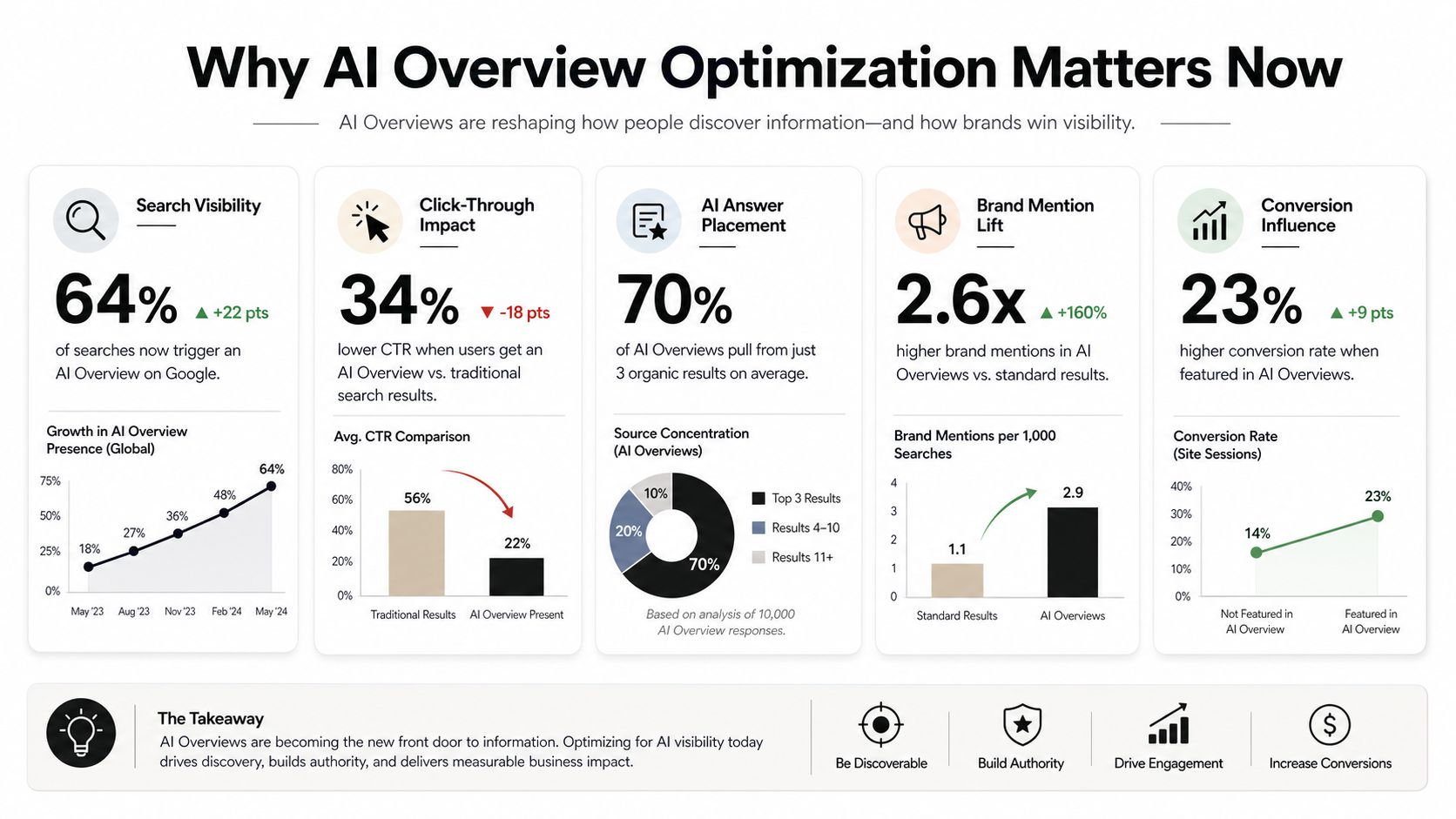
That speed matters for a small SaaS company. A page strategy built around classic rankings can lose relevance even when rankings hold steady, because the search result now distributes attention through an answer layer before the blue links. An independent field-study report described a 38% reduction in outbound organic clicks on queries where AI Overviews appeared, while zero-click searches rose from 54% to 72%. The same update cited research reporting a 39.8% decrease in organic clicks when summaries were shown.
The old ranking model is incomplete
The practical mistake is treating an AI Overview as another ranking position. It isn't. A conventional result asks whether your page can earn a place in a list. An AI Overview asks whether a specific passage, definition, comparison, or supporting fact can be selected and assembled into an answer.
That distinction changes your planning inputs:
- Query economics: Estimate the value of a click before investing in visibility. A broad educational query may expose your brand but produce little product activity.
- Citation fit: Check whether your page contains a direct, self-contained answer that can be extracted without losing meaning.
- Conversion path: Give visitors a reason to continue after the overview has answered the basic question. A calculator, integration guide, comparison, template, or product-specific workflow can create that next step.
- Measurement: Track citations and brand visibility alongside organic clicks. Traffic alone can make a successful visibility project look like a failure when the search surface has changed.
Ahrefs' analysis of 300,000 informational keywords found a 34.5% lower average CTR for the top-ranking page when an AI Overview was present, as documented in Search Engine Journal's coverage. That doesn't mean every page should avoid informational search. It means the keyword needs a business reason beyond its historical traffic estimate.
What SaaS teams should ship
For a seed-stage company, AI Overview optimization should enter the same queue as pricing-page improvements, integration pages, and activation fixes. Start with pages that already rank, receive impressions, or support a commercial workflow. Rewrite the answer section, strengthen the evidence, add useful internal paths, and monitor the query after deployment.
Practical rule: Don't ask, "Can we appear in an AI Overview?" Ask, "If we appear, what business action can the cited page earn?"
How AI Overviews Select and Cite Sources
AI Overviews select usable passages, not only pages holding the top organic position. A page still needs to be discoverable, relevant, and technically accessible. The system also has to identify the page's subject, isolate claims that answer the query, and connect those claims to the searcher's need. Conventional results compete for a slot in a list, while AI Overviews select individual passages to assemble into a generated answer.
A 2026 citation analysis reported that only 38% of cited pages also appeared in the top 10 for the same query. The remaining cited pages came from positions 11 to 100 or beyond, according to DesignRush's report on AI Overview citations. Traditional SEO provides a foundation, not a guaranteed ceiling. A page outside the first page can still earn a citation when its passage addresses the answer more precisely than higher-ranking alternatives.
Build a citable page in four passes
First, define the entity. Start with a plain explanation of the product, concept, or workflow. A developer-tools page should state what the tool does, who uses it, and which problem it addresses before introducing features or opinions.
Second, map sections to questions. Use headings that match buyer language. "What is event-based billing?" gives readers and retrieval systems a clearer boundary than "Billing concepts."
Third, make claims self-contained. Each sentence should retain its subject and action when extracted. "Orchory maps search intent to page opportunities" is easier to reuse than "It handles this automatically," which depends on context from the preceding paragraph.
Fourth, expose evidence in HTML. Keep definitions, comparisons, steps, and supporting facts in crawlable text. An image, PDF, or interaction-dependent interface should not contain the only answer.
Citations are part of the visible interface
Google changed AI Overview source presentation in August 2024, adding a more distinct right-side citation format on desktop. On mobile, users can tap the site icon in the top corner to view source links, according to The Verge's coverage of the citation changes.
That presentation creates two optimization targets: being selected as a source and giving the cited visitor a reason to open the page. A homepage usually wastes that opportunity. A focused comparison, implementation guide, or product-specific explanation provides a logical next click.
Google also said it improved detection for nonsensical queries and limited satire and humor content after early rollout problems, as outlined in its AI Overviews update. Eligibility can improve through clear, extractable content, but no page can force a citation when Google does not generate an overview for the query.
Which Queries Deserve Optimization Effort
Treat query selection as a filter, not a publishing contest. A bootstrapped SaaS team has limited engineering time, so the right target is a query where a citation can support brand discovery, product consideration, or a measurable conversion path.
Seer reported that CTR on AI Overview queries rebounded from 1.3% in December 2025 to 2.4% in February 2026, and that cited overviews performed better than uncited ones, 2.1% versus 0.9%, in its AI Overview CTR update. The figures don't restore the old traffic model, but they do show why citation presence matters. A cited result can perform differently from an uncited result, so your prioritization model should separate the two.
| Query Type | Citation Potential | Business Value | Recommended Action |
|---|---|---|---|
| Product category comparison | High, especially with clear evaluation criteria | High, because the user is weighing solutions | Prioritize pages that compare approaches and connect each criterion to your product's use case |
| Integration or implementation query | High when the answer can be expressed as steps | High, because the search often follows an active project | Build a direct guide with prerequisites, workflow details, and a product-specific next step |
| Problem diagnosis query | Medium to high if the page defines symptoms and fixes | Medium to high, depending on the link to your product | Optimize when your product solves the diagnosed problem and the page can route users to proof |
| Broad educational definition | High for citation visibility | Often low unless the topic sits close to your category | Work selectively, favoring definitions that introduce a buying workflow |
| Generic industry term | Variable | Unclear without a defined conversion path | Deprioritize until you can name the page action and target audience |
| Navigational brand query | Low need for citation optimization | High for brand control | Improve the owned result and product page directly rather than chasing overview inclusion |
Use a simple scoring pass
For each candidate query, score three questions qualitatively:
- Commercial proximity: Does the searcher have a problem your product solves, or are they only learning vocabulary?
- Citation usefulness: Would a source mention place your company in a credible answer, even if the user doesn't click?
- Conversion continuity: Can the cited page offer a tool, example, comparison, integration, or workflow that naturally follows the answer?
Use Orchory AI Keyword Research Tool once during research if you need a dedicated place to examine keyword opportunities. The key output from any tool should be a ranked queue, not an undifferentiated export.
Skip a query when it has weak commercial proximity, no credible citation angle, and no meaningful next action. That decision saves more time than another round of title rewrites.
Content Structures That Earn Citations
A citable page answers the question before it performs the pitch. Models can summarize a focused explanation more reliably than a page that hides its definition beneath a long introduction, brand story, or feature list.
Start with a two-part opening:
- Direct answer: State what the concept is or how the workflow works.
- Scope: Clarify who it serves, what it excludes, or when the recommendation applies.
For example, a weak opening for a developer-focused product might say:
"Modern teams need a smarter way to manage their data workflows."
A stronger version says:
"A data activation platform sends customer events from a central warehouse to sales and marketing tools. It's useful when a SaaS team wants consistent audience definitions without rebuilding the same transformation logic in each destination."
The second passage defines the entity, identifies the user, and explains the use case without requiring surrounding context.
Structure pages around reusable answer blocks
Use one block for one question. A heading such as "How does warehouse-native activation work?" should be followed by a short answer, then supporting detail. Keep the main answer visible in normal HTML, rather than hiding it behind tabs or making it available only through a client-side interaction.
A useful page pattern looks like this:
- Definition: Explain the topic in plain language.
- Decision criteria: Show which factors change the recommendation.
- Comparison: Put alternatives into a table with consistent fields.
- Implementation: Give ordered steps, prerequisites, and failure points.
- Product application: Explain where your product fits without turning every section into a sales pitch.
- Next action: Offer a relevant calculator, template, demo, or related guide.
Tables work well for product comparisons because every row has a clear relationship to the query. Definition lists work for glossaries and technical terms. Numbered steps work for implementation questions. Use structured data where it accurately describes the page, but don't add schema that the visible content doesn't support.
Rewrite buried answers
Before:
"Teams have many options for monitoring customer behavior, and each approach comes with trade-offs that depend on the organization's tooling, maturity, and reporting needs."
After:
"Product analytics tracks user behavior inside an application. Teams use it to measure activation, feature adoption, and retention, while event pipelines move the same behavioral data into other systems."
The revised passage gives the model discrete, answerable facts. It also gives a developer an immediate editing task: identify the first paragraph under each important heading, remove vague framing, and make the subject explicit.
Keep related detail, but move it below the answer. A concise top block doesn't require a shallow page. It gives readers and retrieval systems a clean entry point, then lets technical buyers inspect edge cases, limitations, and implementation notes.
For a complementary treatment of answer formatting, use the featured snippet optimization guide as an internal reference while updating your page templates.
Balancing Citation Wins Against Click Losses
A citation can increase visibility while reducing the chance of an immediate visit. Pew's observed browsing study found that users clicked a traditional result on only 8% of searches with an AI Overview, compared with 15% without one. Only 1% of users clicked a link inside the overview, according to the Pew browsing-study summary.
That trade-off changes how SaaS teams should prioritize queries. An early educational search may produce a citation and little direct traffic. A product-related query can still justify the work because appearing in the answer puts the brand into the buyer's consideration set, even if the immediate click rate is modest.
Choose the right success metric
Report results by query class instead of combining every AI Overview impression into one traffic figure. "What is customer data activation" needs a different success definition from "customer data activation platform comparison." The first may build recognition, while the second has a clearer path to evaluation and conversion. If monitoring is the missing layer, the roundup of AI SEO tools for visibility and execution separates those jobs.
Track:
- Citation presence: Whether the page appears as a cited source for the target query.
- Brand inclusion: Whether the company is named in the answer, even without a link click.
- Organic click behavior: Compare clicks and impressions before and after an overview appears.
- Assisted actions: Check for product-page visits, sign-ups, demo requests, or documentation usage after exposure.
- Page-level conversion quality: A smaller number of visits from a commercial query may be more valuable than broad informational traffic.
CMU and ISB findings cited in the same behavioral data summary indicate that AI Overviews appeared in roughly 41% of observed searches and reduced outbound organic clicks by about 40%. Do not promise stakeholders that citation optimization will restore lost clicks. Set a more defensible expectation: allocate effort more carefully, measure changing search behavior, and protect pages that still have commercial value.
Citation optimization makes the most sense when the answer itself creates demand for the next action.
For low-intent queries, optimize only when the page supports a broader category strategy or a useful brand association. For high-intent queries, defend the click with information an overview cannot provide, such as implementation detail, product evidence, interactive evaluation, or a workflow built for the buyer's stack. The prioritization rule is simple: pursue citations where visibility supports future demand, and require a stronger commercial case when the likely result is exposure without a visit.
Integrating AI Overview Optimization Into Your Pipeline
Make citation potential a field in your opportunity backlog. It should sit beside search intent, page type, business value, existing impressions, and conversion path. If it isn't visible in the queue, it won't survive contact with product launches and engineering work.
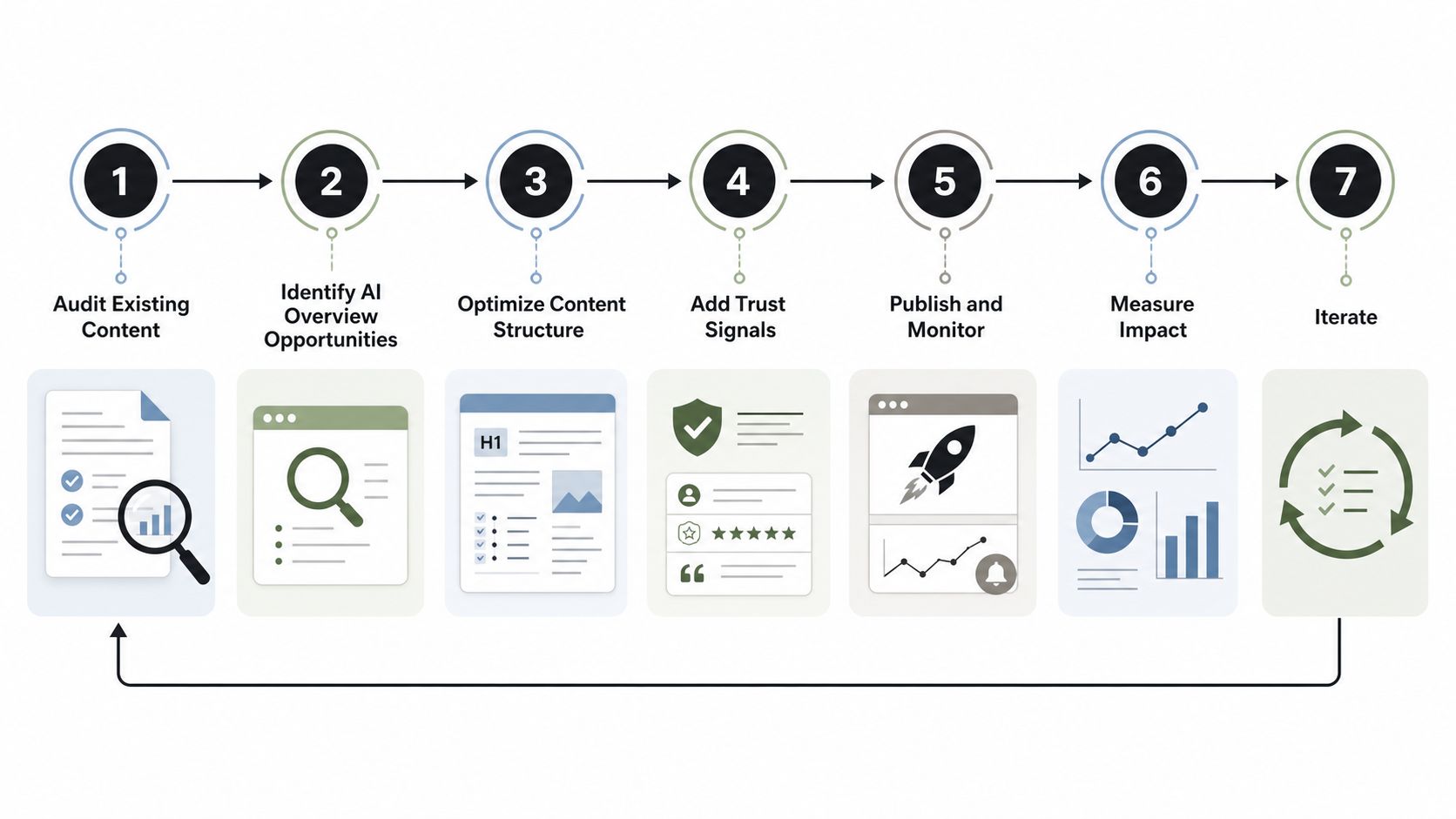
A repeatable workflow can run like this:
- Expand queries: Gather category, problem, comparison, integration, and use-case terms.
- Validate intent: Review the actual result page and classify the searcher's job.
- Check overview presence: Record whether an AI Overview appears and whether competitors are cited.
- Score the opportunity: Rate commercial proximity, citation fit, current page quality, and conversion continuity.
- Write the brief: Specify the direct answer, required sections, evidence, internal links, and page action.
- Ship the change: Assign the page to a developer or coding agent, then review the pull request.
- Measure outcomes: Use Google Search Console data alongside citation observations and product analytics.
The handoff matters. A strategy document that says "improve this page for AI search" leaves the developer to interpret the work. A useful prompt identifies the target query, the current page, the missing answer block, the requested heading structure, the internal destination, and the acceptance criteria for the pull request.
This is the operating model behind AI SEO agent workflows. Orchory runs keyword expansion, validation, clustering, scoring, and queue refresh, then outputs prioritized page opportunities and ready-to-run prompts for coding agents. The team keeps production control through pull-request review, while Google Search Console integration helps connect the plan to observed outcomes.
<iframe width="100%" style="aspect-ratio: 16 / 9;" src="https://www.youtube.com/embed/0jg2g3sNvgw" frameborder="0" allow="autoplay; encrypted-media" allowfullscreen></iframe>Keep quality control in the repository
Create a page template with explicit requirements:
- A direct answer near the top.
- One clear intent per major section.
- HTML definitions, lists, and comparison tables.
- Evidence for factual claims.
- Internal links to the next relevant workflow.
- A conversion action that matches the query.
- Review ownership for technical accuracy and product claims.
Run the queue on a schedule, but don't publish every suggestion. A human should reject opportunities that misrepresent the product, overlap with an existing page, or attract visitors who have no path toward becoming customers.
Common Mistakes and Realistic Expectations
The most expensive mistake is optimizing every informational keyword. A page can earn a citation and still fail to create a qualified visit, so filter by commercial proximity and next action before assigning writing or engineering time.
Another mistake is compressing the page until it becomes useless. Short answer blocks help extraction, but buyers still need limitations, implementation details, examples, and alternatives. Put the concise answer first, then earn trust with depth.
Google also doesn't show an AI Overview for every query. It has improved detection for nonsensical searches and limited satire and humor content, so no structural tactic can guarantee inclusion. Treat citation presence as an observed outcome, not a controllable ranking position.
Finally, don't report citation wins as revenue without a downstream path. Compare query intent, cited visibility, organic behavior, and product actions together. If a page earns visibility but sends no qualified users, change the target query or the page's next step instead of adding more paragraphs.
Orchory helps SaaS teams turn keyword research into a prioritized page queue, intent-aware briefs, and ready-to-run prompts that coding agents can ship as reviewed pull requests. Visit Orchory to build an AI Overview optimization workflow around the queries most likely to support your product, not just the ones with the largest traffic estimates.
FAQs
How much can an AI Overview reduce organic clicks?
Does a page need to rank in the top 10 to be cited in an AI Overview?
Which queries are worth optimizing for AI Overviews?
How should a page be structured to earn an AI Overview citation?
How should SaaS teams measure success from AI Overview optimization?