8 Examples of SEO Keywords for SaaS Teams: From Research to Pull Requests
Eight SEO keyword examples for SaaS teams, mapped through intent, SERP fit, difficulty, and clustering into shippable developer briefs.
Most SaaS teams start keyword research by sorting a spreadsheet from highest volume to lowest. That's backwards. A query such as “project management software” may look attractive, but it doesn't tell you whether the searcher wants a definition, a comparison, a product page, or a workflow for a specific team. A small technical team can spend weeks building the wrong page for a keyword that looked perfect in a tool.
The useful unit isn't the keyword. It's the keyword, intent, business fit, difficulty, and shippable page. The eight examples below move from awareness research to decision-stage strategy. For each one, identify the searcher, inspect the current SERP, choose the page type, define the build, group related queries, and give a developer a brief that can survive review.
Search volume still helps establish demand, but it doesn't set priority by itself. The most valuable opportunity is usually a relevant query with a realistic path to ranking and a page your team can own, build, and maintain.
1. SEO keyword research
“SEO keyword research” attracts marketers and founders building their first search strategy. They want to understand how keywords work, how to find them, and why a broad query may be less useful than a specific product use case. Treat it as a research-stage topic, then connect the research to a page your team can ship.
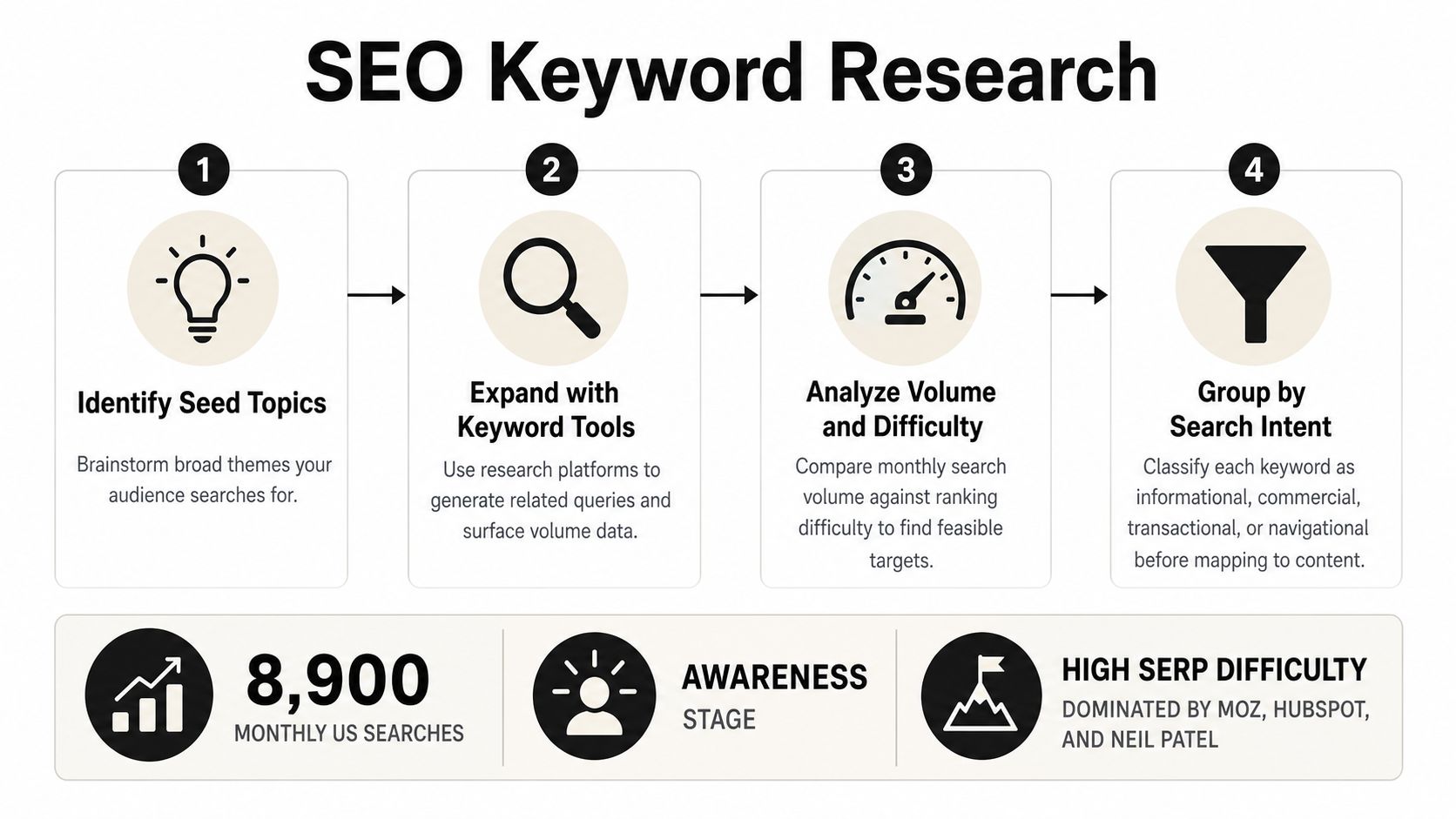
For a SaaS team, this query calls for a hub page rather than a disguised product pitch. Build a foundational guide covering seed terms, long-tail phrases, search intent, volume, difficulty, clustering, and page mapping. The page should move readers from “What should I target?” to “What should I ship next?” Developers can review the proposed page type, data requirements, and internal links before implementation begins.
Build the hub around decisions
Use examples a technical SaaS founder can recognize:
- Short-tail: “API monitoring”
- Long-tail: “API monitoring for small SaaS teams”
- Comparison: “API monitoring alternatives”
- Use case: “monitor third-party API uptime”
- Glossary: “what is synthetic monitoring”
Explain search volume as the average monthly searches for a keyword in a given country. Explain Keyword Difficulty as a 0 to 100 estimate of the challenge involved in reaching the top 10, based on Ahrefs Keywords Explorer. These definitions give the team a shared vocabulary, but difficulty should be weighed against intent, product fit, and the authority required by the current SERP.
A workflow diagram can show how demand, intent, difficulty, and product fit determine priority. Link the hub to narrower guides, comparison pages, and implementation documentation. For a practical tool reference, the Orchory AI Keyword Research Tool fits naturally beside this workflow. Use its output to inform decisions, then have the team validate the cluster and page brief before development.
2. Long-tail keywords
Long-tail keywords are typically three words or more, but word count is only a proxy. The useful signal is specificity. “API monitoring” names a category. “API monitoring for small SaaS teams” identifies an audience, problem, and likely page angle. Semrush's definition describes the practical trade-off: these queries usually attract less demand but express clearer intent.
For a bootstrapped B2B SaaS team, that trade-off changes execution. A narrower query can support a focused guide, comparison, use-case page, or implementation example. It also gives product, content, and engineering a shared brief instead of a vague topic.
Search demand is distributed across many specific queries. Industry analyses report that long-tail searches account for a substantial share of search activity, and that many keywords receive very few monthly searches. Treat those findings as directional, not as a ranking guarantee. A roadmap built only around head terms still ignores a large set of problems potential customers describe precisely.
Choose specificity over cosmetic length
Use examples tied to real product work:
- “SOC 2 evidence collection for startups”
- “status page for internal tools”
- “Stripe webhook monitoring without code”
- “customer feedback portal for product teams”
- “how to track API errors in Next.js”
Each phrase sets constraints for the page. The writer can address the audience and workflow, while the developer can verify integrations, limitations, and implementation details. A generic “software monitoring” article has broader scope but weaker direction.
Before adding a query to the backlog, run four checks:
- Product fit: Does the problem match a capability or documented use case?
- SERP fit: Can the team produce the dominant page type at the required quality, or do mature marketplaces and documentation libraries control the results?
- Cluster fit: Can related phrases share one page without weakening its focus? If not, keep the narrower query separate.
- Action fit: Can the page provide a template, integration example, comparison, or implementation guide?
Record the query, intent, proposed URL, supporting terms, and developer questions in the brief. Have product and engineering review it before writing. Long-tail execution scales when every opportunity becomes a shippable page, not merely another spreadsheet row.
3. Keyword intent analysis
“Keyword intent analysis” attracts people who already understand basic research and are trying to prevent content-to-query mismatches. The query has 4,100 monthly searches in the supplied brief. Its value is less about broad reach and more about helping a team decide what to build before anyone writes copy or opens a pull request.
A simple starting taxonomy is informational, commercial, transactional, and navigational. But labels alone aren't enough. Inspect the current results and ask what page formats dominate. Seography's intent framework provides a practical benchmark: when 8 or more of the top 10 results are educational, classify the query as informational; when 6 or more share the same format, that format is the likely intent match.
Let the SERP choose the page type
Consider two queries for an incident-management SaaS:
- “what is incident management” should probably produce a glossary or foundational guide.
- “best incident management software for small teams” should produce a comparison page.
- “incident management integration with Slack” may need an integration or use-case page.
- “buy incident management software” may be less useful as written if the market searches through product comparisons instead.
The same seed topic can produce different page types. Searchers reveal their expectations through the results they click, so your brief should record the dominant format, recurring subtopics, competing brands, and the action the page should support.
Practical rule: Don't ask a blog post to satisfy a product-page SERP. Change the asset before changing the headline.
Create a small rubric your team can apply consistently. Record the query, likely buyer stage, dominant result format, required proof, internal link destination, and whether the product belongs naturally on the page. A mismatched page usually creates two costs: developers ship an asset that cannot compete, and writers later rewrite it into the format the SERP wanted from the start.
4. Competitor keyword analysis
Competitor keyword analysis is a commercial query for teams that have mapped their own market and want to find coverage gaps. It has 3,400 monthly searches, but the audience is concentrated around a practical decision, which competitors rank for problems that your site hasn't addressed yet?
Start with one direct competitor, not an entire category. Suppose you sell observability software for small SaaS teams and a competitor ranks for “monitor third-party API uptime,” “webhook failure alerts,” and “API health dashboard.” Don't copy those pages automatically. Check whether each query fits your product, whether the competitor's page format matches the SERP, and whether your product can offer a more useful example or implementation path.
Separate gaps from distractions
A competitor report typically produces three kinds of terms:
- Coverage gaps: Relevant queries where your site has no suitable page.
- Weak-fit terms: Queries the competitor ranks for, but your product doesn't solve.
- Authority traps: Relevant terms where the current results require proof, depth, or brand authority your team can't yet provide.
A spreadsheet can be enough for an initial pass. Add columns for query, competitor URL, result format, product fit, existing internal page, likely difficulty, and proposed action. The proposed action should be explicit, such as “create integration page,” “expand existing guide,” “merge with existing cluster,” or “discard.”
Competitor research isn't a license to reproduce a rival's information architecture. It's a way to discover demand your customers may already express. If the competitor ranks with a comparison page, a glossary page is unlikely to satisfy the same query. If the competitor page is thin but ranks because the SERP is weak, a focused page with clear product evidence may be enough.
The final output should be a ranked queue, not a list of competitor URLs. Give every selected term an owner, page type, scope, and review condition before handing it to development.
5. Keyword difficulty score
Keyword difficulty score answers a go-or-no-go question. A SaaS team may have a strong use case and a page idea, but limited authority, limited content capacity, and no reason to assume a difficult SERP will yield quickly. The query has 2,800 monthly searches in the supplied data.
Treat difficulty as an estimate, not an oracle. Ahrefs describes its Keyword Difficulty metric as a 0 to 100 score intended to estimate how hard it may be to rank in the top 10, while its volume figure represents average monthly searches in a selected country. Different tools calculate difficulty differently, so compare the score with the actual SERP.
Make difficulty a planning input
For a new or lightly established SaaS domain, inspect:
- Page strength: Do the ranking URLs have strong backlinks, or are they weak pages from relevant sites?
- Intent match: Are the results serving the query, or are they broad pages ranking by accident?
- Content requirements: Does the SERP favor a concise answer, a deep guide, a comparison, or a functional tool?
- Product evidence: Can your team demonstrate the workflow with screenshots, code, or first-hand examples?
- Internal support: Can existing pages link to the new asset and explain its context?
The supplied keyword experiment shows why phrasing matters. “SEO case studies” and “SEO case study” each had about 320 monthly searches, yet the singular version carried a 51.2 Keyword Difficulty score compared with 37.9 for the plural. The experiment report illustrates a practical lesson, similar demand doesn't guarantee similar competition.
A difficulty score should change the page you build, not just the row color in your spreadsheet.
A difficult term may deserve a supporting glossary, integration, or use-case cluster first. A lower-difficulty term may be worth shipping immediately if it maps cleanly to your product. Record the reason for the decision, then review ranking evidence after publication instead of treating the original score as a permanent verdict.
6. SEO keyword clustering
Keyword clustering solves the production problem that appears after research. A list can contain “customer feedback software,” “customer feedback management,” “feedback portal,” “product feedback tool,” and “feature request tracking.” Those phrases may represent one strong page, several pages, or a dangerous overlap.
Start with the SERP rather than a purely semantic grouping. If the same pages rank for several phrases, that's evidence that one asset can cover the cluster. If different formats or audiences appear, separate the pages even when the words look related.
Turn a messy list into page assignments
For a product-feedback SaaS, a workable structure might look like this:
- Pillar page: customer feedback software
- Use-case page: feature request tracking for SaaS
- Comparison page: customer feedback tools
- Integration page: collect product feedback in Slack
- Glossary page: what is a feedback portal
The cluster isn't finished when similar words sit together. It's finished when each group has a page type, primary query, supporting queries, searcher, internal links, and a reason not to merge with another group.
Ahrefs' matching-terms system makes a useful distinction here. Terms match returns ideas containing all query words in any order, while phrase match requires the words in the entered order, as explained in Ahrefs' matching terms guide. Use both views when harvesting ideas, then validate groups against live results.
For a deeper implementation model, link the finished cluster to topic cluster content strategy. The developer handoff should contain canonical intent, suggested slug, title direction, page modules, structured data requirements where applicable, and links to related pages.
A clean cluster prevents two common failures: multiple pages competing for the same query, and one oversized page trying to answer unrelated buyer questions. The goal isn't maximum coverage per URL. It's clear ownership of each search need.
7. Keyword search volume tools
Search volume is useful for ranking opportunities, but it is a weak approval rule on its own. The term has 4,900 monthly searches, yet that figure is a planning signal rather than a traffic forecast. Volume tools combine modeled or aggregated data, so evaluate whether an estimate supports a specific page decision.
Ahrefs reports that Google Ads Keyword Planner overestimates search volumes 54.28% of the time and is roughly accurate 45.22% of the time, based on the analysis summarized in Ahrefs' SEO statistics. Another cited study examined 72,635 terms and found overestimation for 91.45% of keywords. The practical response is simple: compare sources and review the search results before approving a page.
Evaluate the tool and workflow
A bootstrapped B2B SaaS team should check four dimensions:
- Validation: Can published estimates be compared with Google Search Console data?
- Scope: Does the tool cover your target countries, competitors, and query types?
- Exports: Can the team move keywords, clusters, and notes into its planning system?
- Execution: Does the output specify a page type, primary query, and developer-relevant requirements, or does it end as a report?
Use volume to rank candidates within an execution stage. A high-volume informational query may require a guide, while a lower-volume integration or comparison query may deserve priority because it matches the product and buyer. Review SERP overlap before clustering related queries, then assign one page owner and record the expected trade-off between reach, fit, and build effort.
A solo founder may need a lightweight workflow with Search Console checks. A growth team may need competitor discovery, exports, clustering, and scheduled refreshes. Orchory's AI Keyword Research Tool can support planning and execution, but it should not be treated as a replacement for every volume database. The useful deliverable is an opportunity queue with intent, page type, cluster context, evidence, and a next action ready for developer review.
8. SEO keyword strategy
SEO keyword strategy is where individual queries become a resource allocation decision. The term has 5,600 monthly searches and attracts founders, growth leads, and senior individual contributors deciding whether SEO deserves consistent engineering and content capacity.
For a bootstrapped B2B SaaS team, strategy should begin with constraints. You may have a founder who understands the customer well, a developer who owns the marketing site, and no dedicated SEO editor. That setup favors narrow use cases, integration pages, comparison pages, and glossary content connected to the product. It doesn't favor a large publishing operation with dozens of unrelated articles.
Sequence work by team maturity
A solo founder can start with a small set of product-adjacent pages and one foundational hub. A three-person growth team can add competitor gaps, intent-based briefs, and a regular review cycle. A larger marketing organization can support multiple clusters, original research, editorial review, and broader category coverage.
The sequence stays consistent:
- Define the customer problem and commercial boundary.
- Expand seed terms into specific queries.
- Group queries by SERP overlap and audience.
- Score fit, intent, difficulty, and expected effort.
- Select a page type and owner.
- Write a scoped brief with acceptance criteria.
- Ship, review, merge, and measure.
Volume doesn't tell you which page should be built first. A low-volume integration query may be more valuable than a broad educational term if the product solves the integration directly and the team can publish a technically credible page. Conversely, a high-volume term may be useful as a hub but too broad for an immediate product outcome.
A strategy document should include goals, audience segments, keyword criteria, page types, internal links, developer dependencies, and a review cadence. Orchory can refresh research, cluster and score opportunities, map intent, and produce prompts for coding agents, while your team retains approval and merge control.
8-Point SEO Keyword Comparison
| Topic | Intent & Buyer Stage | Implementation Complexity | Resource Requirements | Expected Outcomes & Key Advantages | Ideal Use Cases |
|---|---|---|---|---|---|
| SEO keyword research (8,900/mo) | Informational, Awareness; learn what keywords are | Low (foundational guide) | Moderate: experienced writer, designer (infographic), promotion for links | High top-of-funnel traffic; establishes authority; long conversion latency | Glossary/hub pages, awareness content that links to execution guides |
| Long-tail keywords (6,200/mo) | Informational → Consideration; understand long-tail value | Medium (examples + data) | Low-Medium: case studies, tool/embed, real search data | More specific traffic with higher conversion efficiency; easier to rank than broad terms | Practitioner guides, lead magnets, bridges to tool evaluation |
| Keyword intent analysis (4,100/mo) | Educational, Consideration to Decision; map content to intent | Medium-High (frameworks + SERP analysis) | High: SEO expertise, live SERP examples, possible tool embeds | Better content-to-intent alignment; shorter conversion window; supports purchases | Content strategy playbooks, decision-stage resources, training materials |
| Competitor keyword analysis (3,400/mo) | Commercial, Consideration to Decision; find competitor gaps | Medium (walkthroughs + tooling) | Medium: access to competitor tools, templates, case studies | Actionable gap discovery; high purchase intent; drives demos/trials | Growth audits, demo-led content, competitive gap templates |
| Keyword difficulty score (2,800/mo) | Technical, Decision; validate target feasibility | Medium (methodology + benchmarks) | Medium-High: tool data or proprietary research, benchmark examples | Enables go/no-go decisions; conversion-ready audience; supports prioritization | Feasibility assessments, prioritization matrices, pre-purchase validation |
| SEO keyword clustering (2,200/mo) | Technical, Decision; organize keywords into clusters | High (semantic methods or manual clustering) | High: tooling/algorithm expertise, templates, worked examples | Prevents cannibalization; improves topical authority; operationalizes content planning | Content architecture, production pipelines, dev-ready briefs |
| Keyword search volume tools (4,900/mo) | Commercial, Decision; compare volume tools | Medium (comparisons + accuracy testing) | High: multiple tool access, GSC data, pricing info | Captures purchase-ready buyers; positions product as complementary to tools | Tool comparison pages, buyer guides, conversion-focused landing pages |
| SEO keyword strategy (5,600/mo) | Educational/Commercial, Consideration to Decision; org-level planning | High (strategic frameworks, maturity models) | High: senior expertise, case studies, downloadable templates | Influences budget/resource allocation; high-impact conversions; enterprise appeal | Executive guides, strategic offers, enterprise positioning |
Turn the Keyword List Into Pull Requests
A keyword list becomes useful when it creates an executable sequence. Start by classifying intent, then inspect the SERP instead of trusting the label in a tool. Record whether the results favor a glossary, guide, comparison, use-case page, integration page, product page, or another format. That observation determines the page brief more reliably than a generic taxonomy.
Next, estimate difficulty and check the ranking pages manually. Look for competitors with strong authority, weak intent matches, missing product evidence, and content formats your team can improve. Treat the score as a feasibility input. It should help you decide whether to build now, create supporting pages first, or defer the opportunity.
Cluster related queries by shared search results and audience, not just similar wording. Give each cluster a primary query, supporting terms, canonical page, page type, internal links, and an owner. This prevents several pages from competing for one search need, while also preventing an oversized article from mixing awareness, comparison, and implementation intent.
Then write a scoped brief. Include the searcher, problem, desired outcome, SERP pattern, title direction, URL, page modules, examples, product proof, links, technical requirements, and acceptance criteria. A developer should be able to review the brief and understand what needs to be built without translating an SEO report into tickets.
Finally, ship the page through a reviewed pull request. Check title accuracy, headings, canonical handling, internal links, rendering, structured data where relevant, performance, and analytics before merge. After publication, use Search Console data to compare the original opportunity assumptions with actual queries and page behavior.
Volume alone doesn't set priority. For a small B2B SaaS team, the best keyword is a relevant, winnable opportunity with a clear page owner and an executable next step. Orchory can refresh research, cluster and score opportunities, map intent, and hand developers ready-to-run prompts, while approval and merge control stay with the team.
Orchory helps turn keyword research into a ranked page-opportunity queue, intent mapping, clusters, and ready-to-run prompts for coding agents that can open pull requests. Visit Orchory to connect examples of SEO keywords to pages your team can review and ship.
FAQs
How many words make a keyword 'long-tail'?
What does a Keyword Difficulty score actually measure?
How should a team decide what page type to build for a keyword?
How accurate are keyword search volume tools?
What's the right sequence for building an SEO keyword strategy on a small team?