Content Planning App: Turning SEO Research Into Pull Requests
A useful content planning app shouldn't stop at topics and calendar dates. It should turn search research into a ranked, reviewable PR.

You have a Notion page full of keyword ideas, a spreadsheet with half-finished briefs, and a backlog that looks organized enough to create false confidence. Then a week passes, and no new page reaches production. Your developer is waiting for clearer requirements, you're waiting for time to write, and your SEO workflow remains a document instead of a pull request.
This is the failure mode this guide covers. A useful content planning app shouldn't stop at topics, labels, and calendar dates. It should turn search research into a ranked handoff that a coding agent can execute, then give your team a reviewable PR and a feedback loop from real search data.
Why Your Content Backlog Is Stuck
A developer opens the next content ticket and asks four questions right away: which query matters, what page type fits it, where should the file live, and what does approval include? If the ticket cannot answer them, the developer starts the research again. The founder waits for a draft, and the backlog gains another status update instead of a page.
The backlog isn't empty. It's unusable.
A planning artifact should give the next contributor enough context to act:
- Page scope: What search need should this URL satisfy?
- Intent: Is the visitor learning, comparing options, or ready to act?
- Structure: Which sections and internal links belong in the draft?
- Repository context: Where should the page live, and which template should it use?
- Review boundary: What exactly will be submitted for approval?
If those decisions are missing, every queue item becomes a new research project. A calendar can show activity while the repository remains unchanged. A pull request creates a concrete handoff, with files to inspect, tests to run, and a defined decision for the reviewer.
Practical rule: If a content task cannot produce a clear branch, file change, or PR description, it is not ready for engineering handoff.
The category now extends beyond publishing schedules. Content planning tools have developed from editorial workflows into systems that connect research, production, review, and publishing, as described in the evolution of content planning tools from publishing workflows to integrated platforms.
For a two-person SaaS team, the working rule is simple: organize ideas only as far as the next person can act on them. A content planning app should preserve the decisions between search research and code, then hand a coding agent enough detail to open a reviewable PR. That structure reduces the cost of clarification without pretending automation replaces editorial judgment. The team still decides whether the page deserves to exist, while the system makes the decision executable.
What a Content Planning App Actually Does
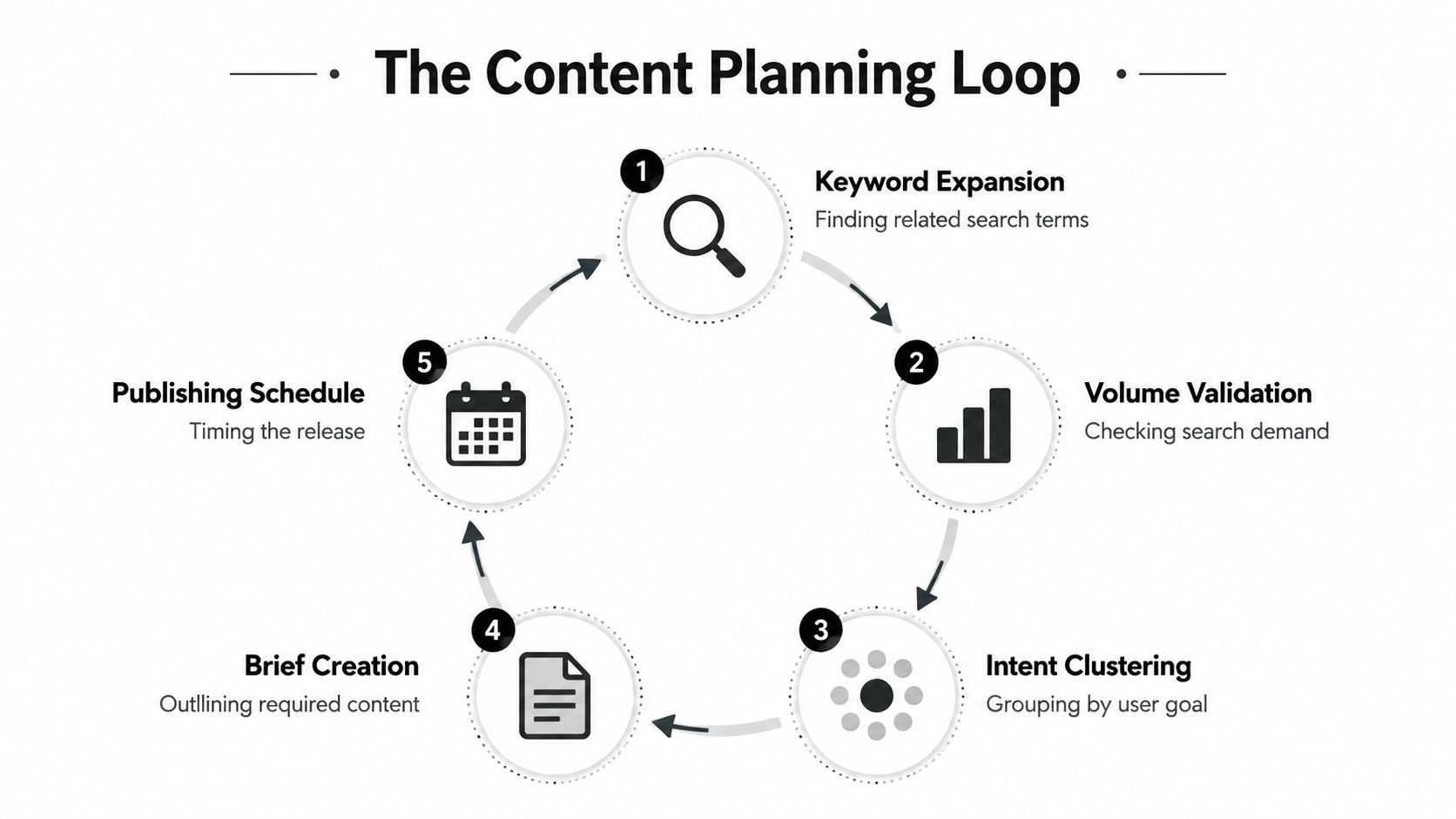
A useful system runs a pipeline. It starts with a broad set of search terms and ends with page-scoped work items that someone can build.
Start with expansion and validation
Keyword expansion finds related language around a topic. If your product serves SaaS marketing operations, the starting phrase might be "content planning app." Expansion can surface adjacent terms such as "content calendar tool" and "editorial workflow software." Those terms aren't automatically separate pages. They're inputs to a decision.
Validation checks whether the terms appear to represent an actual search opportunity for your site. Search Console can expose impressions, clicks, CTR, average position, and query strings by page, country, and device, giving you a view of observed demand rather than only a third-party keyword list. Google defines clicks as visits from a Google result, impressions as appearances in Search, and average position as the topmost position occupied by a link to the property averaged across queries and impressions in its Performance report documentation.
A tool such as the Orchory AI Keyword Research Tool can sit at this research stage, but the output still needs editorial judgment. Research is not the deliverable. A ranked page queue is.
Cluster by the need behind the query
Intent clustering groups terms by the underlying job the searcher wants to complete. Informational, commercial investigation, transactional, and navigational are practical starting buckets, as described in this guide to keyword intent clustering.
In the example above, "content planning app," "content calendar tool," and "editorial workflow software" may belong to one decision-stage cluster if the same page can satisfy the comparison and evaluation need. A separate "how to build a content calendar" query could belong to an informational guide. The point isn't to force every phrase into a page. It's to prevent several pages from competing for the same job.
Score opportunities and create the handoff
Scoring should combine fit, intent, existing visibility, business relevance, and the effort required to build a page. The exact formula depends on your site, but the result should be concrete: a queue item with a target page type, primary cluster, supporting terms, outline, internal-link suggestions, and acceptance criteria.
Google Search Console is particularly useful for near misses. A page with impressions but weak CTR may need a better title and H1 alignment, narrower scope, or a clearer match to the query. Google describes CTR as a measure of how well content matches what users search for in its Search Console performance guidance.
That makes the app a closed loop. It shouldn't be a social scheduler, a generic project board, or a static SEO audit. It should turn evidence into a page queue, then turn each queue item into an executable brief that reaches code review.
The Five Layers Inside a Modern Content Planning App
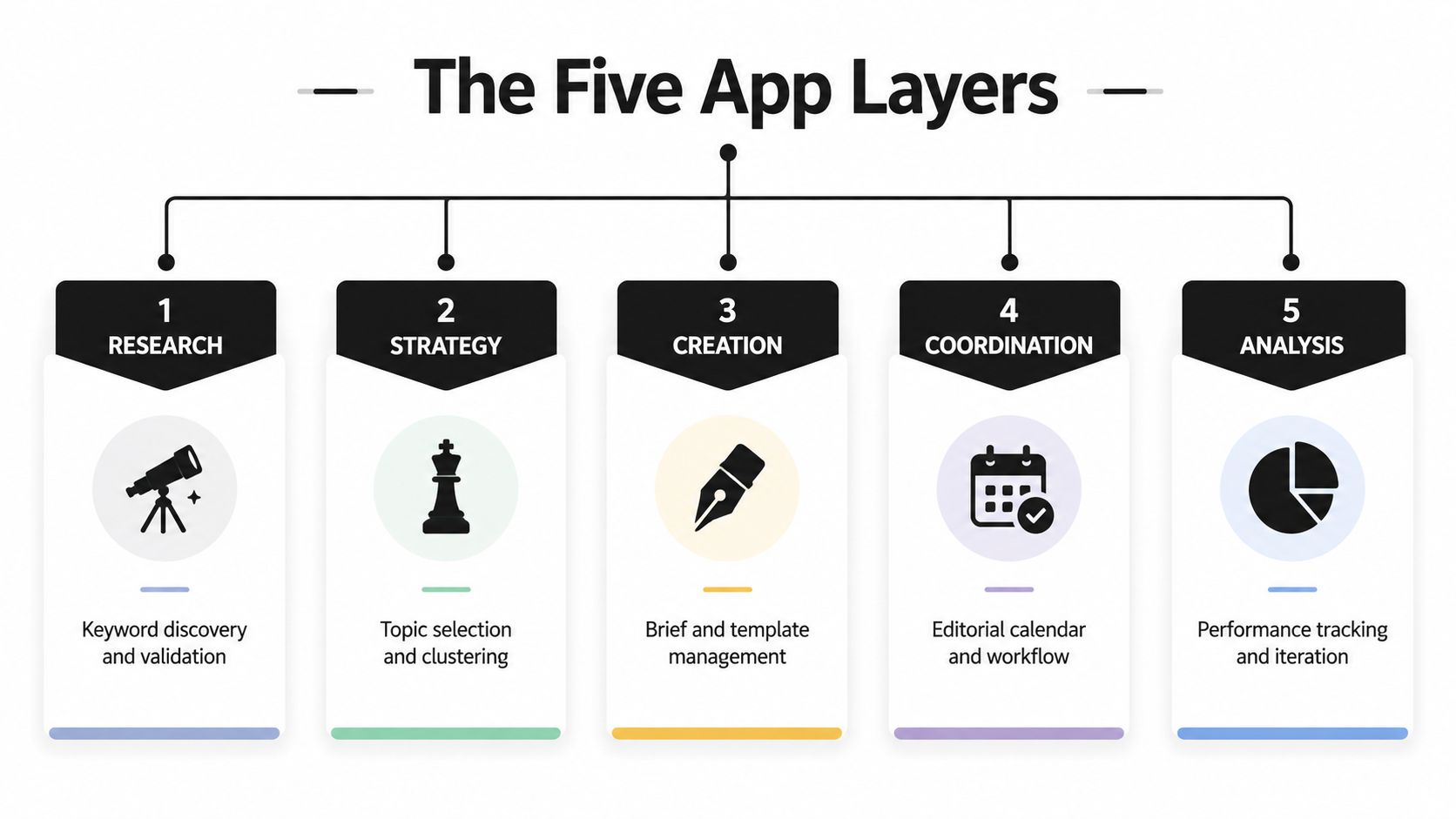
Evaluate products by the work they remove, not by the number of cards on their dashboard. A lean team needs five connected layers, and each layer should either automate a handoff or make the next decision unambiguous.
Research
The research layer expands a seed topic, validates query evidence, and records the source of each opportunity. For a SaaS site, that might mean separating product category terms from implementation questions, competitor comparisons, and use-case language.
You don't need a giant keyword warehouse if nobody acts on it. You need enough context to decide whether a term belongs in an existing URL, a new page, or a later experiment. Search Console's Performance report can break results down by query, page, country, and device, which makes the research layer useful after publication, not just before it. The Orchory Free SEO Tools catalog entry can be evaluated separately from the planning workflow, without treating a tool directory as a production system.
Clustering
Clustering, sometimes called keyword clustering, turns terms into page-level decisions. A group of comparison queries should become one comparison-page queue item, while a group of implementation questions may become a tutorial or documentation series.
The critical field is the page type. "Comparison," "use case," "glossary," and "location" imply different structures, proof requirements, and calls to action. A cluster without a page role is still a keyword list.
For a deeper treatment of this mechanism, see topic cluster content strategy.
Editorial calendar
The calendar layer assigns priority, owner, due date, and publishing sequence. It matters because teams need a visible queue, but dates alone don't create output.
A strong calendar links every date to a ready brief and a repository destination. If a card says only "write content planning article," it belongs in ideation. If it names the cluster, page type, outline, acceptance criteria, and PR owner, it belongs in production.
Collaboration
Collaboration includes comments, reviewers, approvals, and the handoff to version control. For a developer-led team, the natural unit is often a PR rather than a completed task.
The app should make review smaller and faster by defining what changed and why. A reviewer can check search intent, factual scope, internal links, metadata, and rendering without reconstructing the original research from a chat thread.
Integrations
Integrations determine whether the planner becomes another silo. Search Console provides outcome data. A repository and coding agent provide execution. CSV export supports external analysis when your team needs to inspect clusters or build custom reporting.
A practical system can send a ready-to-run prompt to Claude Code, Cursor, or a similar agent, while keeping the repository and merge decision under team control. The integration is successful when the path from opportunity to PR is short enough that developers use it.
Choosing Between Speed and Governance
The right content planning app depends on what fails first in your team. A founder-led company usually loses momentum between idea and implementation. An in-house team may produce pages reliably but struggle with duplicated work, unclear approvals, or inconsistent standards.
Use the same criteria, but assign different weights.
| Evaluation Criteria by Team Profile | Founder (weight) | In-house team (weight) |
|---|---|---|
| Research depth | High, enough to avoid bad bets | High, with repeatable evidence |
| Time-to-first-PR | Highest, the queue must become code quickly | Medium, reviewability matters more |
| Search Console feedback loop | High, to re-rank scarce capacity | High, to govern ongoing priorities |
| Coding-agent integration | Highest, execution depends on it | Medium to high, depending on repository workflow |
| Per-run cost | High, spend must track experiments | Medium, consistency and control may matter more |
A speed-focused founder should ask, "Can this produce a usable prompt today?" A governance-focused team should ask, "Can a reviewer trace this page back to an approved opportunity and verify what changed?" Both should ask whether the system works with their existing coding agent instead of requiring a new production environment.
Three questions that expose weak tools
- What is the output? If the answer is a dashboard, report, or list of recommendations, identify who converts it into a brief and who converts the brief into code.
- Where does feedback enter? The tool should accept page and query performance, not just mark a card as published.
- What can fail safely? A planning system should let a reviewer reject a PR before anything reaches production.
A calendar can be useful for coordination, but it shouldn't receive full credit for execution. If your team already has Notion, Linear, GitHub, and a coding agent, buying another project board may add administration rather than throughput. Compare the AI SEO tool categories by output before adding another layer to the stack.
Two Teams, One Pipeline, Different Outcomes
Consider a two-person founder team with one Next.js site. The founder owns positioning and final review. The developer owns implementation, templates, metadata, and internal links. Their weekly pipeline begins with a ranked queue, selects a small batch, and generates prompts that specify the target route, page type, search intent, outline, and acceptance checks.
The developer runs the prompts through a coding agent, opens PRs, and keeps the site unchanged until review. The founder checks whether the page says something useful for the intended buyer, while the developer checks rendering, links, schema where applicable, and consistency with the existing codebase. Their target is three to five PRs per week, not because that number guarantees traffic, but because it creates a measurable production cadence.
After publication, the team compares the next Search Console run with the assumptions behind the queue. They look for impressions on the intended queries, clicks, CTR, and position by page. Search Console's recent data view can surface performance from the last 24 hours, with only a few hours of delay, according to Google's recent data announcement. That doesn't make ranking changes immediate, but it shortens the time needed to see whether the page is being discovered and whether its search presentation needs work.
The larger team changes the control points
Now take a four-person growth team with one PM gatekeeper. It operates across two product sites and a docs domain, with a target of eight to twelve PRs per week. The same queue needs stronger routing: site, domain, owner, page type, reviewer, and release sequence must be explicit before an agent starts work.
The PM approves clusters and resolves overlap. One person checks search intent and briefs. Developers execute prompts across the repositories. A second reviewer checks brand, product accuracy, and technical behavior. The queue may contain more opportunities, but the gatekeeper prevents parallel work from creating competing pages or inconsistent terminology.
Neither scenario proves that a particular throughput target will produce traffic. Search demand, site authority, competition, quality, and technical health still matter. The operational difference is that both teams can inspect the same pipeline, set a realistic PR target, and use Search Console to re-rank the next run instead of defending an old calendar.
Google's reports can show up to 1,000 top queries, making a recurring review practical when the team focuses on the highest-value slices rather than trying to analyze every possible term. The Search Console Performance report guidance describes those query, page, country, and device breakdowns.
A 14-Day Implementation Checklist
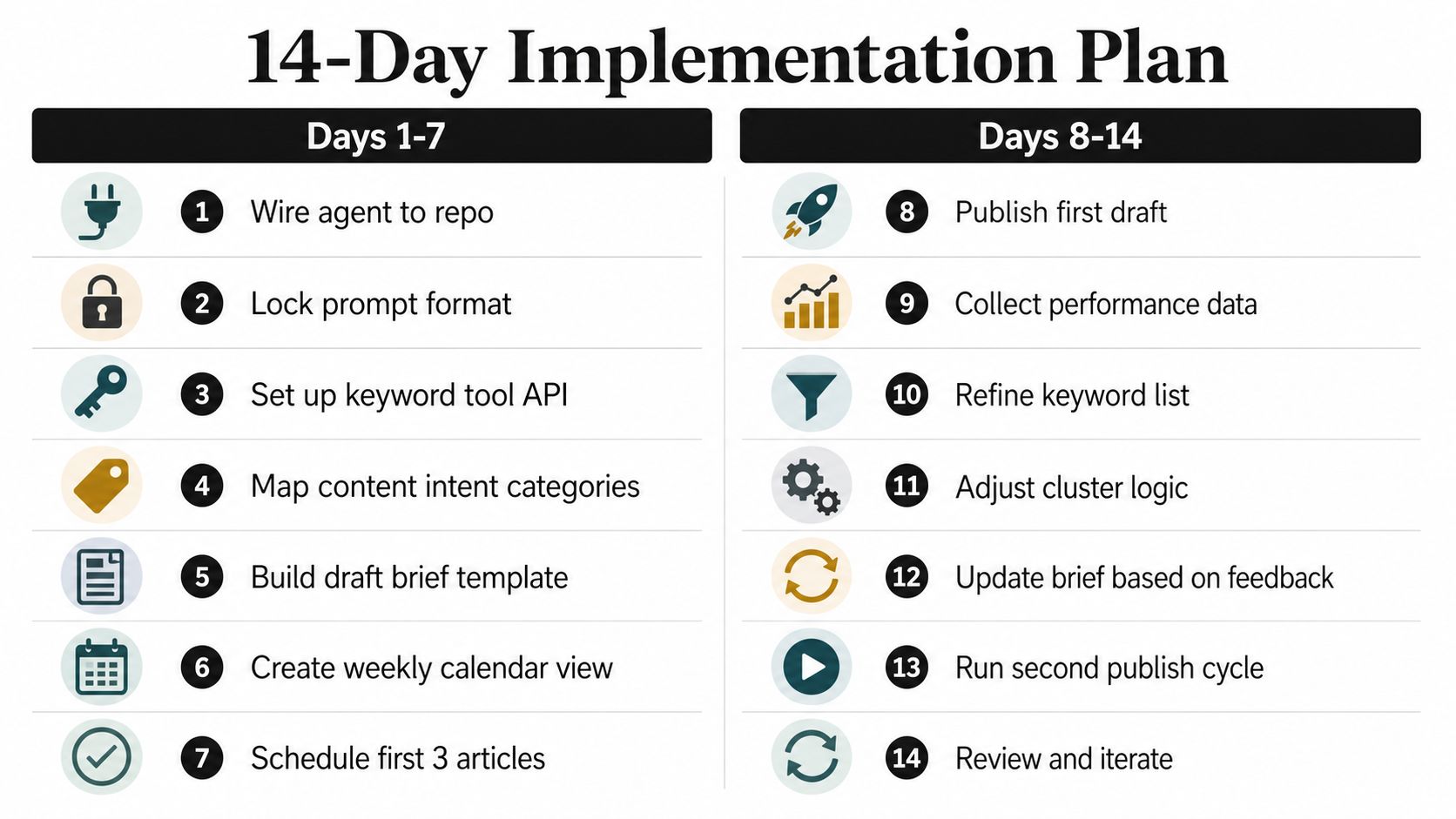
Start with the repository, not a calendar. The first goal is to make one complete path from opportunity to reviewed PR, then improve the path using observed data.
Days 1 through 3
- Wire the agent to the repo: Give the coding agent the repository context, content directory, templates, and test commands it needs.
- Lock the prompt format: Require every task to name the target query cluster, intent, page type, route, outline, internal links, metadata, and acceptance checks.
- Define the review boundary: Make the agent open a PR. Don't allow direct production changes.
- Choose one initial content surface: Start with the blog, docs, or use-case directory. Avoid spreading the first run across unrelated templates.
A concise prompt is better than a long instruction dump. The agent needs decisions, constraints, and a clear definition of done.
Days 4 through 7
Run the first pipeline and inspect the queue before generating drafts. Remove duplicate clusters, reject topics that don't fit the product, and assign each accepted opportunity to a page type.
Then create the first PR. Review the output as software and as search content. Check route behavior, headings, links, claims, canonical handling, mobile rendering, and whether the page satisfies the mapped intent.
Days 8 through 14
Connect Search Console and record the starting query and page signals. Set a weekly review cadence, then run the second cycle against what the first cycle revealed. Refine the keyword list, cluster logic, and brief template instead of treating the original assumptions as permanent.
The content production workflow guide is useful context for formalizing the handoff between planning, drafting, review, and release.
Watch for three failure modes:
- The agent produces drafts but no PRs: The repository instructions or prompt format lacks a concrete execution step.
- The queue fills faster than the team reviews: Reduce scope and prioritize fewer page types.
- Search data never changes the queue: Add a recurring owner and a specific re-ranking rule.
Where Orchory Fits in This Stack
Orchory occupies the handoff layer between SEO research and repository execution. It runs a weekly pipeline covering keyword expansion, validation, intent clustering, opportunity scoring, and queue refresh. Each prioritized opportunity includes a page type and a ready-to-run prompt for a coding agent such as Claude Code, Cursor, Codex, or another tool capable of opening pull requests.

That distinction matters because the alternatives solve different parts of the problem.
| Stack option | What it produces | What your team still owns |
|---|---|---|
| Dashboard-only SEO tool | Recommendations, reports, or keyword views | Briefs, prompts, implementation, and PR creation |
| Freelance or agency model | Research, writing, or managed delivery | Brief cycles, approvals, repository integration, and coordination |
| General CMS calendar | Dates, owners, and publishing status | Keyword research, clustering, technical implementation, and feedback analysis |
| Orchory | Ranked opportunities and execution prompts for coding agents | Agent execution, PR review, merge, and production control |
Orchory doesn't require direct site access or CMS credentials. The team keeps control through pull-request review, while Search Console performance can feed later queue refreshes. It also supports CSV export for keywords, clusters, and opportunities, plus additional on-demand runs through pay-as-you-go credits.
The pricing model is $990 per month for one plan, with no seats or annual lock-in. Those are unit economics to compare against your current cost per page, including research time, developer time, review time, and the opportunity cost of leaving the queue untouched.
A practical fit check
Orchory is a reasonable fit if:
- Your site lives in a repository: Pages can be reviewed and merged through normal development workflow.
- You already use coding agents: The handoff can target Claude Code, Cursor, Codex, or a compatible pull-request workflow.
- Research is the bottleneck: You need expansion, clustering, scoring, and queue refresh rather than another calendar.
- You want controlled execution: Nothing changes on the site until a reviewer approves the PR.
- You can run a weekly operating loop: Someone must inspect the queue, review output, and use performance data to adjust priorities.
If your main need is social scheduling, asset approvals, or a broad marketing calendar, a different layer may fit better. If your actual constraint is turning search opportunities into reviewed code, an executing agent is closer to the missing system than a dashboard.
Orchory turns keyword research and intent clustering into a ranked content queue with prompts that coding agents can use to open pull requests. Visit Orchory to evaluate whether that research-to-PR handoff fits your next SEO cycle.
FAQs
What should a content planning app actually produce, beyond topics and dates?
Why does a content backlog stay stuck even when it looks organized?
What are the five layers inside a modern content planning app?
How should a team choose between speed and governance when picking a tool?
What is a realistic weekly PR target for teams running this kind of pipeline?
Where does Orchory fit in a content planning stack?