SEO Experimentation for Founders and Developers: A PR-Ready Playbook
A practical framework for running controlled SEO experiments (cohorts, single variables, measurement) that founders and developers can ship through a PR.
You've got a product page that deserves organic traffic, a backlog full of SEO suggestions, and no dedicated SEO person to decide what ships first. A founder changes every title, adds internal links across the site, publishes a new content cluster, and waits. Traffic moves, but nobody knows which change caused it. The next decision becomes another guess.
That workflow fails because SEO changes interact with crawling, ranking, search intent, seasonality, and the rest of the site. An audit can identify problems, but it can't tell you whether a specific fix improved clicks for your pages. Early-stage teams need a smaller loop: hypothesis, controlled code change, measurement, decision.
SEO experimentation turns organic search into work your team can ship through a pull request. You'll define a page cohort, change one variable, protect a control group, check Google Search Console, and roll out the result only when the evidence supports it. The process fits a founder and developer workflow because it treats SEO like product development, not a monthly report.
Introduction Why Guessing Fails for Early Stage SEO
A seed-stage SaaS team often starts with a reasonable plan. The founder identifies several high-intent queries, a developer creates landing pages, and someone rewrites the metadata before launch. When the pages underperform, the team changes the copy, headings, internal links, and template at the same time. A later review shows more impressions, fewer clicks, or no meaningful movement. The team still can't isolate the cause.
That uncertainty creates two expensive habits. Some teams keep making broad edits without learning from them. Others stop shipping because SEO feels too slow and too difficult to validate. Neither approach gives developers a reliable way to choose the next change.
Google's own search history makes the operating environment clear. The company says it runs hundreds of thousands of experiments every year to make Search more helpful, and it presents experimentation as one of Search's four foundational themes alongside organizing information, ranking results, and spam detection. Google's documented history goes back to 1997, with explicitly announced algorithm updates appearing from 2002 onward in its public Search history. Search has therefore evolved through continuous testing for decades, not through a fixed list of permanent SEO rules.
That doesn't mean a small SaaS site can reproduce Google's infrastructure. It means your team should stop treating a best-practice checklist as proof. A title recommendation is a hypothesis. A new cluster is a hypothesis. An internal-link change is a hypothesis. The useful question is whether your controlled implementation improved the search outcome for a comparable set of pages.
Practical rule: Don't ask, "What SEO tactic should we try?" Ask, "What single change can we ship, measure, and either roll back or expand?"
A shippable experiment has a clear owner, a defined cohort, a code change, a measurement window, and a decision rule. That structure keeps SEO work small enough for a bootstrapped team to execute and rigorous enough to produce reusable knowledge.
What SEO Experimentation Really Means for Shipping Teams
An SEO change becomes an SEO experiment when you can compare its effect against a credible alternative. The alternative might be an unchanged control group, a previous baseline, or a separate set of comparable URLs. The key is attribution. If you change five things at once, search data may move, but you won't know which change deserves a wider rollout.
Product teams already understand this through A/B testing. In a normal product test, different users may see different experiences at the same time. Organic search works differently because Google decides when pages are crawled, indexed, ranked, and shown. You usually shouldn't create near-duplicate versions of one URL and serve them randomly to searchers. Instead, you assign comparable pages to a control cohort and a variant cohort.
Start with a page type that repeats. For example, a SaaS site might have integration pages, use-case pages, or glossary pages built from the same template. Select pages with similar purpose and existing search behavior. Leave the control pages unchanged. Apply one modification to the variant pages, such as a new title pattern, a revised heading structure, or an added contextual internal link.
The cohort must be deterministic. Store the URL list in the repository or experiment record, define the selection rule, and make sure a future reviewer can reproduce it. "A few pages that looked similar" isn't enough. A deterministic cohort lets you connect a pull request to a specific set of URLs and compare those URLs with pages that experienced the same broader search environment.
Google's history provides a useful analogy. Search itself continuously tests how it organizes information, ranks results, detects spam, and presents answers. Your team can't control Google's experiments, but it can control the change it introduces and the pages exposed to that change.
Separate the change from the result
A page edit is an implementation. An experiment adds a question and a comparison:
- Change: Add a concise product-specific answer near the top of integration pages.
- Cohort: Integration pages with comparable templates and search intent.
- Control: Matching integration pages with no copy change.
- Primary outcome: Organic clicks and CTR in Search Console.
- Decision: Keep, roll back, or expand after the observation window.
Search Console metrics don't tell you why a page moved. They help you evaluate whether the variant performed differently from the baseline. That distinction prevents a common mistake, declaring success because impressions rose while clicks and CTR weakened.
A planning system such as the Orchory AI Keyword Research Tool can sit before the code handoff, where research and opportunity selection happen. The production decision should still pass through your repository, review process, and measurement plan.
Experiment Frameworks and How to Choose Your Test Design
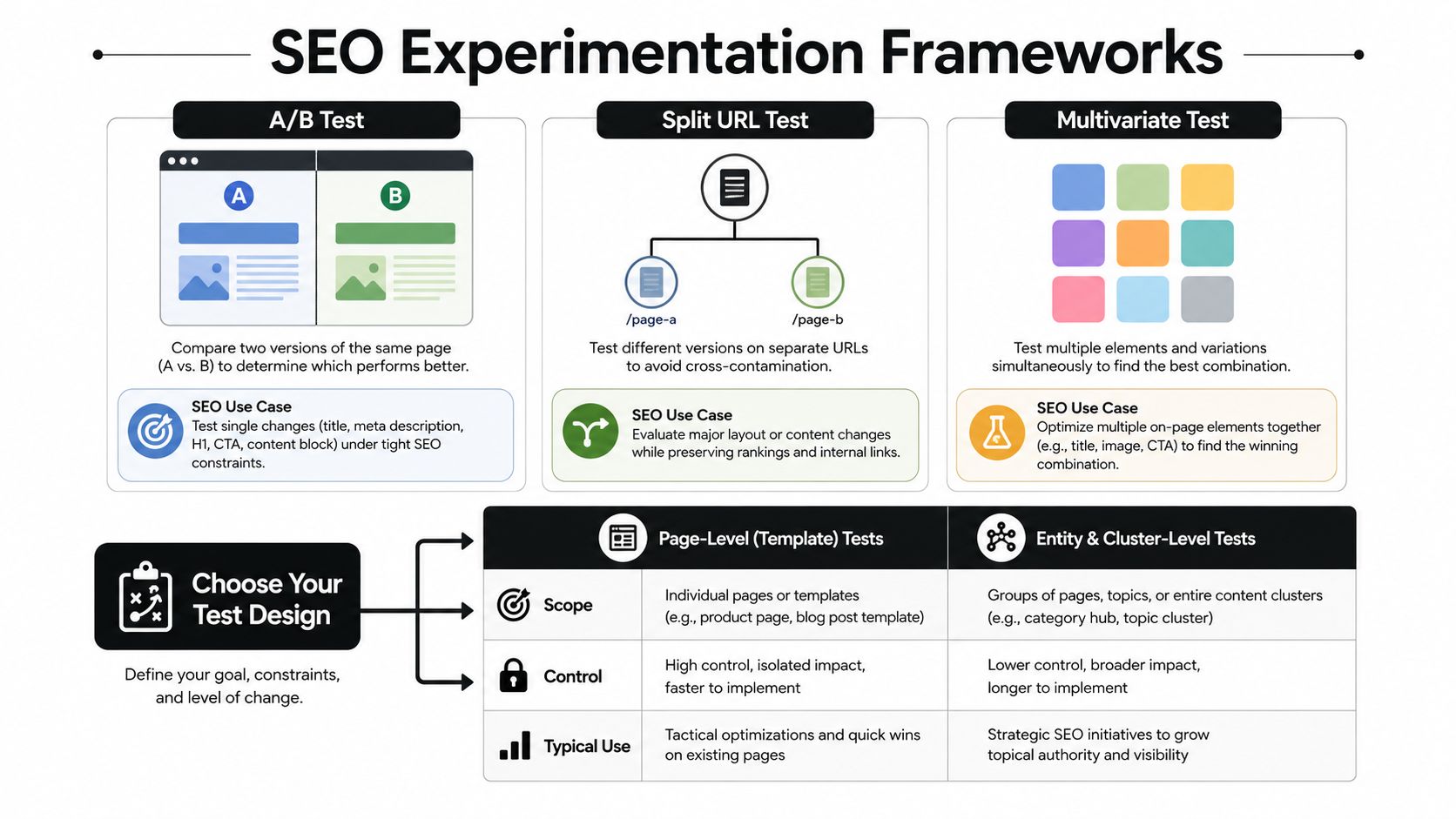
A developer opens a pull request to rewrite titles across every integration page. Before approving it, the team needs a test design that answers one question: did the title pattern cause the change in organic performance? Choose the simplest design that can isolate that variable. More complexity cannot repair weak cohorts or limited search data.
An A/B test applies one version to a variant group while leaving a comparable control group unchanged. It fits repeated templates such as pricing alternatives, integrations, and industry pages. For a PR-ready test, define the cohort in code or a URL manifest, change one element, and record the control before merge. This design usually comes first because the comparison remains direct.
A split-URL test assigns separate URLs to separate versions. Use it when the content or structure must differ substantially. The implementation then needs a plan for indexation, canonicals, redirects, and the URL intended to rank. Decide whether both versions should be available to search engines. Creating duplicate URLs just to avoid organizing a clean cohort adds technical risk without improving the question.
A multivariate test changes several elements across combinations. It can examine interactions between variables, but it requires more pages and stronger data than many early-stage SaaS sites have. Available adoption data reports that A/B tests account for 67.6% of experiments, split-URL tests account for 16.9%, and multivariate tests represent less than 1%, according to Convert's experimentation statistics. For a small shipping team, a controlled single-variable test is usually easier to implement and interpret.
Page-level tests versus cluster-level tests
A page-level test changes a repeated template or page element. A cluster-level test changes how related pages work together, such as their internal links, page types, or information architecture.
| Test unit | Control | Typical use |
|---|---|---|
| Page template | Comparable URLs using the old pattern | Titles, headings, copy blocks, internal links |
| Topic cluster | Comparable clusters or sections with the existing architecture | Pillar pages, child pages, entity coverage, navigation |
Cluster tests address larger strategic questions, though attribution becomes harder. If the same release adds pages, changes links, and revises taxonomy, a traffic shift can have several causes. Keep the first cluster experiment narrow. For example, update the internal-link path across one group of related pages while preserving the existing structure elsewhere. The pull request should list the changed pages, excluded pages, target query cluster, and rollback condition.
Use three criteria to choose the test unit:
- Inventory: Repeated templates support page-level A/B tests. A small, unique site may need a time-based baseline instead.
- Risk: Keep high-value pages in the control group until a smaller batch supports rollout.
- Question: Test a title pattern with page cohorts. Test an information architecture change at the cluster level.
Adoption also shows why tooling should follow the question, not lead it. Reported use of A/B testing or experimentation tools is much higher among large sites than across the wider web. You do not need enterprise tooling to begin, but you do need a clearly stated hypothesis, a single-variable cohort, and a versioned implementation plan.
Orchory Free SEO Tools can support research and planning before the issue becomes a pull request. The test design itself should remain explicit in the issue, URL list, code review, and release notes.
<iframe width="100%" style="aspect-ratio: 16 / 9;" src="https://www.youtube.com/embed/PZoXELCiK28" frameborder="0" allow="autoplay; encrypted-media" allowfullscreen></iframe>How to Measure SEO Experiments Without Fooling Yourself
Search data contains delay and noise. Google may need to recrawl a page, process the change, and adjust its ranking before the effect becomes visible. A page can also gain impressions because it appears for more queries while its CTR declines. Measurement must therefore start before the PR is merged.
Record a stable baseline for the control and variant cohorts. Capture clicks, impressions, CTR, and average position in Search Console. Note the date of the change, the URL list, the target query or cluster, and any other release that could affect those pages. If you can't explain what was different before launch, you won't be able to explain the result afterward.
Google's site testing guidance defines A/B testing as comparing two or more variations while keeping the experiment structurally controlled. Technical SEO practice recommends monitoring clicks, impressions, CTR, and average position over a 4 to 6 week window after Google has had time to recrawl and re-rank the affected URLs. Treat that window as a planning guardrail, not a promise that every test will produce a clean answer.
Build guardrails against false wins
A false win often looks convincing at first. The variant gets more clicks for a short period, the team rolls it out, and the apparent improvement disappears. Several failure modes recur:
- Short windows: Early movement may reflect normal SERP volatility rather than the change.
- Algorithm updates: A broad search change can affect both cohorts and distort a before-and-after comparison.
- Unverified Googlebot exposure: If the variant wasn't crawled or indexed as expected, the test didn't expose Google to the intended change.
- Underpowered cohorts: A small set of pages with limited impressions may not produce a dependable signal.
Write the stopping rule before launch. For example: "Evaluate after the planned observation window, check crawl and indexation first, and roll out only if the variant improves the primary metric without a material deterioration in the supporting metrics." Avoid changing the rule after seeing the graph.
Measurement rule: Indexation confirms that Google can process the page. It doesn't confirm that the page captures more organic demand.
Use the control group to separate site-wide movement from the variant effect. If both groups move together, the cause may be seasonality, an algorithm change, or a broader release. If only the variant changes after Google processes the new version, the hypothesis becomes more credible, though it still deserves cautious interpretation.
For a practical framework around prioritizing growth opportunities before testing, use this guide to finding a growth factor once, then keep the experiment record focused on the selected hypothesis.
Tooling and Workflows That Keep Experiments Shippable
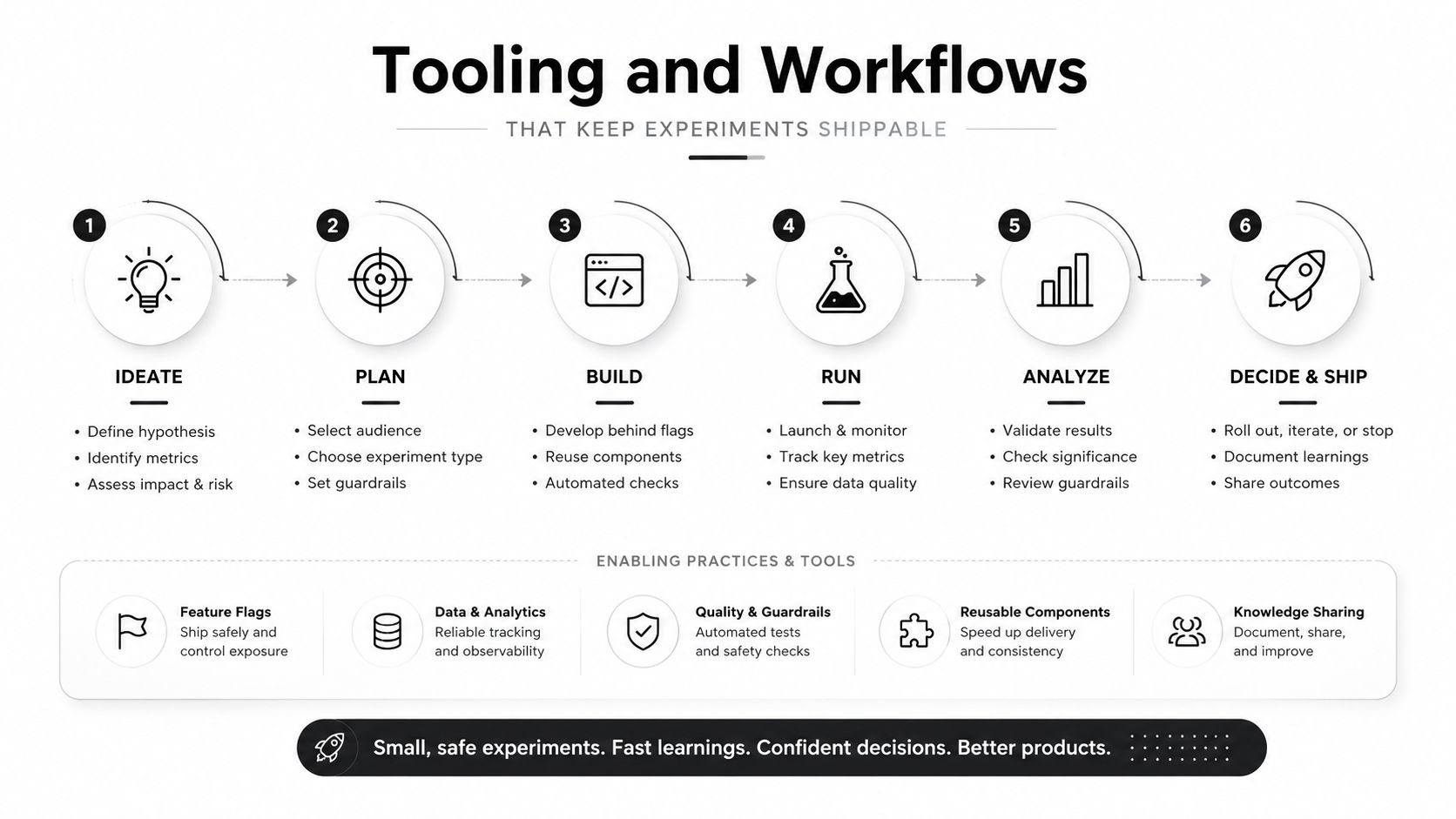
A founder changes a template, a developer opens a pull request, and a keyword export becomes production content. A shippable SEO workflow prevents that handoff from skipping intent review, cohort design, or rollback planning. Keep discovery, planning, implementation, review, and measurement as separate stages.
Start by checking the live Google SERP for the target query before assigning a page type. Its result format indicates whether the dominant intent is educational, commercial, navigational, comparison-based, or another category. Validate intent from the results themselves, not only from the wording of the keyword. Use the search intent and topic clustering guide for that research step.
Make clustering reproducible
A SERP-overlap workflow collects the top 10 ranking URLs for each keyword, counts shared URLs between keyword pairs, divides the shared count by 10, and uses a 40% threshold, or 4 or more shared URLs, as a grouping signal. The method appears in this keyword clustering workflow. Treat the threshold as a starting rule. Review each resulting group against the live SERP and the page model your product can support.
Clean the export before defining a cohort:
- Remove noise: Separate branded queries, parameters, location modifiers, and year tags unless they represent distinct intent.
- Normalize terms: Combine singular and plural variants when they describe the same intent.
- Preserve value: Remove negligible or commercially irrelevant terms, while keeping distinct product use cases separate.
- Create hierarchy: Place broad thematic pillars above narrower child clusters.
Turn the selected hypothesis into a PR-ready prompt. Include the URL cohort, control URLs, one variable, expected template output, acceptance checks, and rollback instructions. A coding agent can draft the implementation, while the developer reviews the diff and confirms that only the intended pages changed. An AI SEO agent workflow can support this planning and handoff layer without receiving production authority.
Separate coverage from performance
Index coverage is an early health check. In a 16-month experiment, about 71% of new AI-generated pages were indexed within the first 36 days, according to Search Engine Land's coverage of the experiment. Use that benchmark to plan observation lag, not to declare success. A page can enter the index without earning stable impressions or clicks.
Use a staged rollout:
- Ship a small controlled batch.
- Confirm that the intended pages are crawlable and indexable.
- Wait for Search Console data to accumulate.
- Compare the variant with its control.
- Expand only after reviewing the primary and supporting metrics.
Keep the experiment record tied to the selected hypothesis. The repository, code review, and rollback path should remain the source of truth for production changes.
Common SEO Experiment Types With Real World Examples
A founder's first SEO experiment should be small enough to reverse and specific enough to review in a pull request. Repeated page types work well because the team can define comparable cohorts, isolate one code or content change, and apply it consistently.
Title and snippet test: A SaaS team sees impressions for several integration pages, but their CTR is weak. The hypothesis is that clearer, product-specific titles will better match the searcher's task. The variant changes only the title pattern. The control keeps its current titles. The team measures clicks and CTR, then checks impressions and average position to separate a snippet effect from a ranking change.
Internal-link test: Glossary pages rank for related concepts but sit several clicks from product pages that convert visitors. The team adds one contextual link from selected glossary pages to a relevant use-case page, while leaving the control cohort unchanged. The question is whether this relationship improves qualified visibility for the target pages. "Add more links" is too broad to produce a useful PR or a clear result.
Template and content-structure test: A product-led SaaS site has repeated use-case pages with inconsistent openings. The variant adds a concise explanation of the intended audience, a clear use case, and a link to the relevant workflow. The control retains the existing structure. Developers can ship this as one template change, then verify recrawling before assessing search performance. Early indexation only confirms that Google found the pages, not that the change worked.
Cluster or architecture test: A team has several pages covering overlapping terms for one workflow. Before changing URLs, it inspects the live SERP to see whether Google favors one broad page or several specialized pages. Search intent needs live validation because the results reveal which content format currently earns visibility. The team might compare two internal-link structures or two controlled page groupings, rather than rewrite the site in one release.
A useful experiment brief can translate each example into a PR-ready prompt: identify the cohort, name the single variable, list the files or templates affected, and define the rollback. That keeps research, clustering, and implementation connected without turning the test into a reporting exercise.
Example decision: If the variant is indexed but clicks remain flat, do not call it a win. Choose whether the next test should address SERP presentation, page scope, or internal discovery.
Simple designs produce clearer learning. A title test answers one focused question. A cluster rewrite that changes URLs, headings, links, and navigation creates movement without showing which change mattered. Ship the smallest implementation that can disprove the hypothesis.
Your Practical Playbook to Run Your First SEO Experiment
Choose a repeated page type with a clear business purpose, then write the experiment record before opening a PR. Keep the document short enough that a developer can review it during normal sprint work.
Hypothesis: State the change and expected outcome. "Adding a product-specific benefit to integration-page titles will improve organic CTR for the variant cohort."
Cohorts: List the variant URLs and control URLs. Explain why they're comparable, and freeze the lists for the test.
Single variable: Define exactly what changes. Don't combine title edits with copy rewrites, internal links, or template changes.
Duration: Plan for a 4 to 6 week observation window after Google has had time to recrawl and re-rank, following the controlled-testing guidance cited earlier.
Success criteria: Name the primary metric, such as clicks or CTR, then list supporting metrics including impressions and average position. Add a rollback condition for crawl, indexation, or material performance problems.
Before merging, verify the live SERP intent, clean the cluster of branded and irrelevant variants, confirm that the control pages remain unchanged, and check that Googlebot can reach the intended pages. After launch, separate index coverage from performance, record unrelated releases and search changes, and make the rollout decision from the predefined rule.
Orchory can support the planning and handoff layer by turning keyword research, clustering, opportunity scoring, and search intent mapping into ranked opportunities and prompts for coding agents. Queue one test, attach the cohort and acceptance checks, and let your team keep control through PR review and merge.
Orchory helps founders and developers turn SEO opportunities into ranked, PR-ready work instead of leaving them in a report. Visit Orchory to plan a controlled experiment, hand it to your coding workflow, and ship the first test with a clear measurement plan.
FAQs
What makes an SEO change an actual SEO experiment?
Should I use an A/B test, a split-URL test, or a multivariate test?
How long should I wait before measuring the result of an SEO experiment?
What causes a false win in an SEO experiment?
Does getting a page indexed mean the SEO experiment worked?