Competitive Positioning as an SEO Build Constraint for B2B SaaS
Why competitive positioning must precede SEO for B2B SaaS founders, and how to turn a position into a shippable content queue.

Popular advice says to "differentiate your brand" first and worry about SEO later. For a small B2B SaaS company, that sequence is backwards. Competitive positioning is a build constraint. It determines which search topics deserve a page, which competitors you can realistically challenge, and which content should wait.
A founder who targets "project management software" because it has obvious demand may spend months producing pages that compete directly with Monday.com and Asana. A founder who defines a narrower positioning strategy can turn that decision into a practical queue: comparison pages, use-case pages, integration pages, and technical guides that all reinforce the same reason to choose the product.
SEO adds another complication. Ranking alone doesn't guarantee traffic. One SISTRIX study summarized by Business Journal Daily found that position 1 click-through rate varies from 13.7% on commercial searches with Google Shopping to 46.9% when sitelinks appear. Your job isn't to collect rankings. It's to win the right searches with pages that make your position obvious. That's the core discipline behind B2B SaaS SEO.
Why Most SaaS Founders Get Positioning Wrong
Most founders treat positioning as homepage copy. They write a tagline, add three feature bullets, and move on to keyword research. That makes positioning a branding exercise instead of an operating decision.
The cost appears in the content queue. If your product serves async-first engineering teams, a broad plan built around "project management software" pulls you toward a category battle you may not be equipped to win. A sharper position points toward topics such as async sprint planning, remote engineering standups, or project management for distributed development teams. Those pages attract a narrower audience, but they also give your product a coherent search identity.
Competitive positioning became a formal strategy concept in the 1970s and 1980s, as strategy scholars shifted toward measurable analysis of market share, relative position, cost, differentiation, and industry attractiveness. Michael Porter's 1979 Harvard Business Review article on competitive forces, followed by his 1980 book, helped make positioning central to strategy. The historical development is documented in Pankaj Ghemawat's historical perspective on competition and business strategy.
Practical rule: If a page doesn't support who you serve, what you replace, or why you win, it probably doesn't belong in the first version of your SEO roadmap.
Positioning is an architecture decision
Your position affects the structure of the site:
- Topic clusters: Group pages around the problems your target segment searches.
- Internal links: Link supporting guides to a focused pillar page, not to unrelated product features.
- Comparison targets: Compare against tools buyers consider, including manual workflows and the status quo.
- Content priority: Build pages where your differentiation can be demonstrated, not merely mentioned.
A developer-focused CI/CD product shouldn't create an editorial calendar that alternates between generic DevOps definitions and broad software engineering topics. If its wedge is faster builds for monorepos, the architecture should connect monorepo CI, build caching, dependency graphs, affected-project detection, and competitor comparisons.
The failure mode is easy to recognize. A team publishes for months, sees impressions spread across unrelated queries, and concludes that SEO "isn't working." Often the problem isn't production. The team never decided which market position its pages were supposed to defend.
The Three Pillars of Competitive Positioning
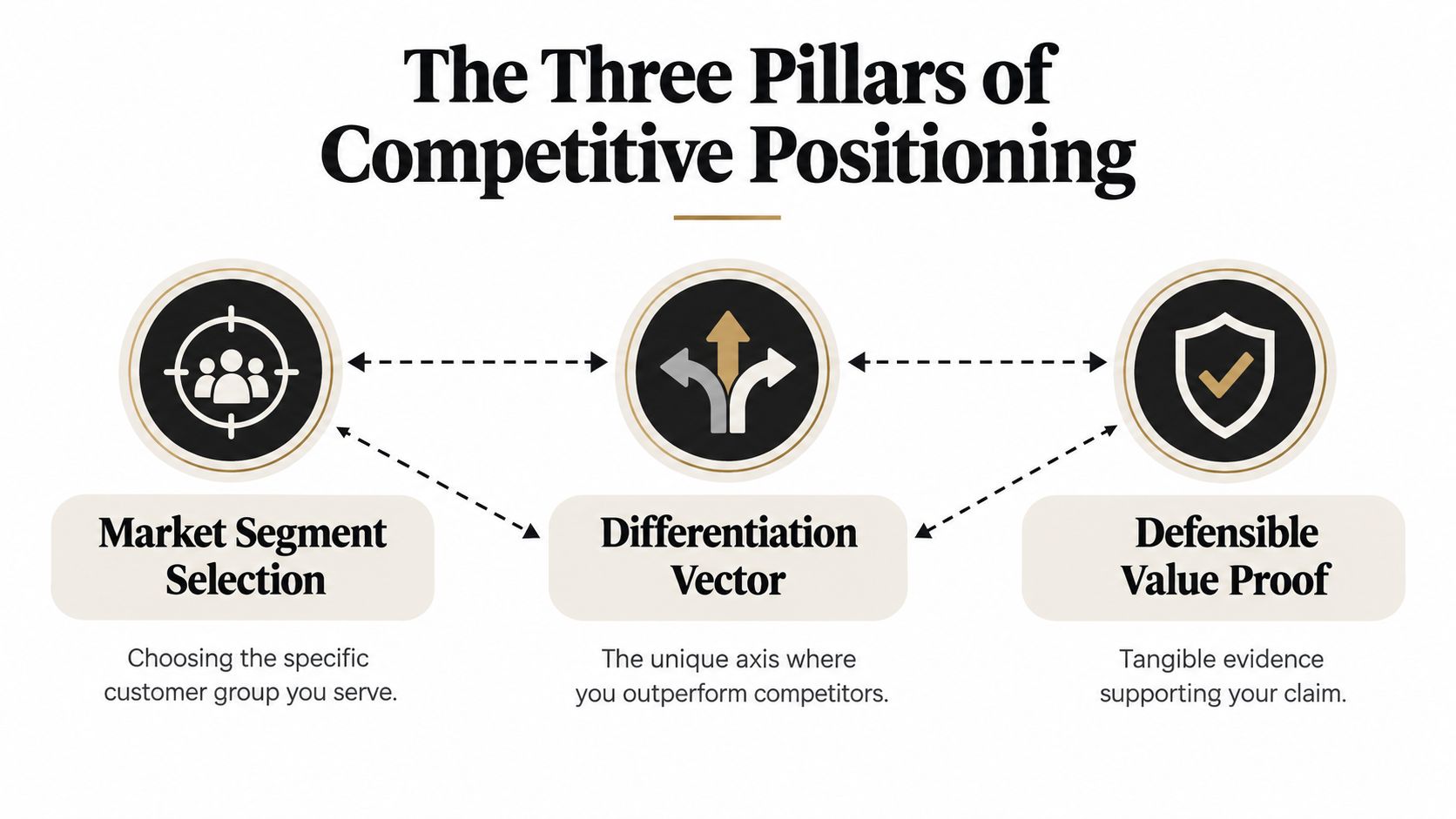
A useful position has three connected parts: market segment selection, differentiation vector, and defensible value proof. Remove one, and the SEO strategy becomes either too broad, too vague, or impossible to substantiate.
Market segment selection
Start with the customer group that has the strongest reason to care. A developer-focused CI/CD tool might choose mid-market DevOps teams instead of enterprise procurement departments or hobbyist developers. That decision changes the keyword universe, the language on the page, the integrations you prioritize, and the competitors you name.
Don't describe the segment only by company size. Add the workflow, technical environment, and trigger that create urgency. "Teams maintaining monorepos with slow CI feedback" is more useful than "modern engineering teams" because it gives you observable search patterns and page subjects.
Differentiation vector
The differentiation vector is the axis where the product wins. For this CI/CD example, that axis could be build speed for monorepo architectures. The claim isn't "we have powerful automation." It is a specific comparison: this product is designed around a problem that generic CI tools handle less directly.
That wedge produces long-tail opportunities. You can build pages about CI for monorepos, build performance diagnostics, selective test execution, and comparisons with GitHub Actions or CircleCI for the relevant workflow. Each page should explain the same advantage from a different search intent.
Defensible value proof
Proof turns a positioning statement into a content asset. A claim such as "40% faster builds for repos over 500k lines" may support a comparison page, a technical case study, and structured product evidence, but only if the company can substantiate it. Since the verified data here doesn't establish that claim for any real product, it should be treated as a hypothetical example, not published as a fact.
A technical founder can keep this pillar honest by connecting every differentiation claim to an artifact:
- Benchmark methodology and test conditions
- Customer evidence
- Product documentation
- Reproducible implementation details
- Clear limitations and qualifying conditions
Orchory fits naturally into this kind of workflow as a planning and handoff product, but the positioning claim still has to come from your product evidence, not from the tool generating the page.
The three pillars interact. Segment choice tells you whose problem matters, differentiation tells you which problem to own, and proof tells you whether you can earn trust for that claim in search and in sales.
Building a Positioning Map for Your Market
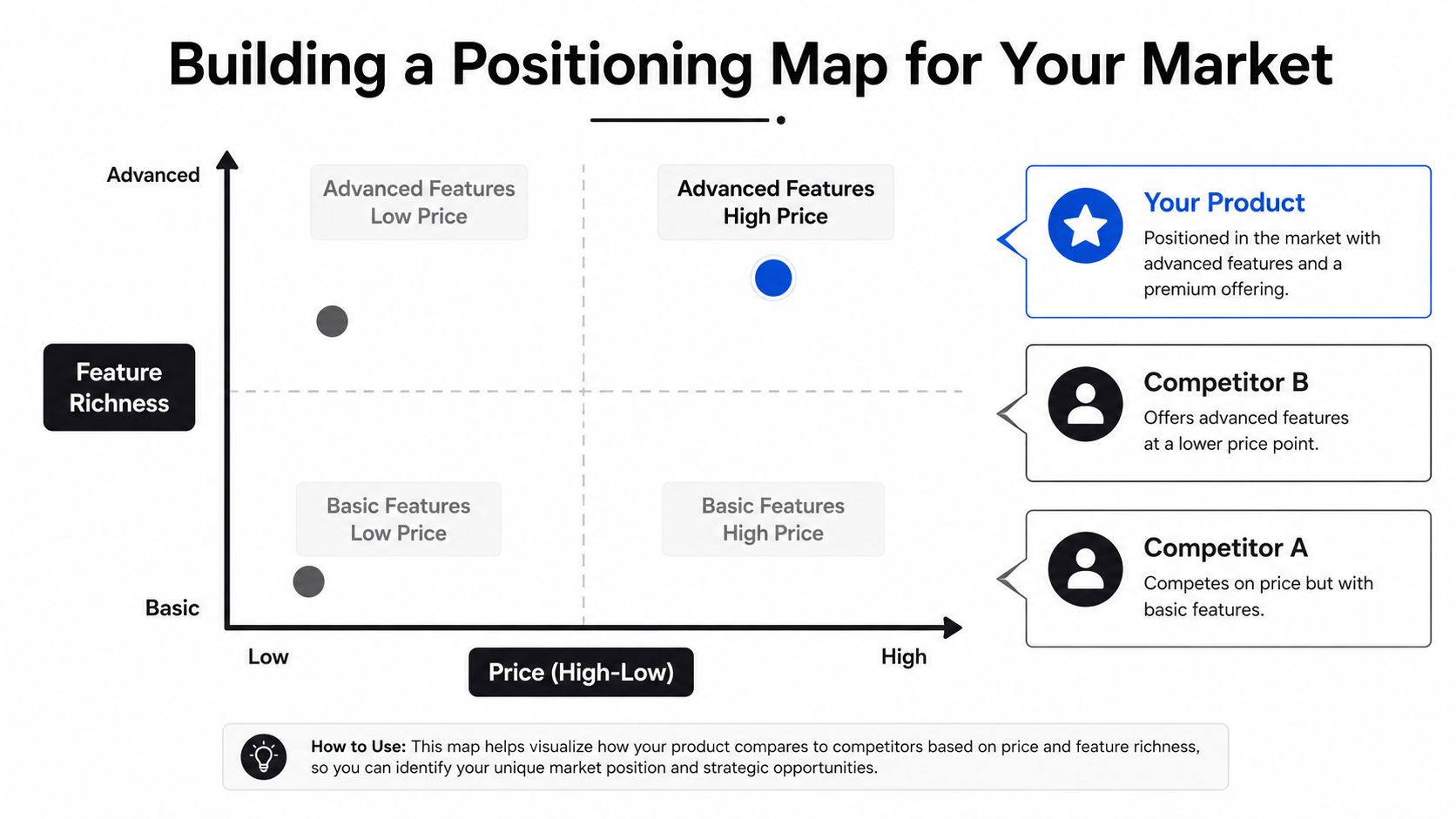
A positioning map is useful only when its axes reflect how buyers compare products. Don't begin with "cheap versus expensive" because those dimensions are easy to draw. Begin with the evaluation criteria that appear in reviews, sales calls, procurement questions, and comparison searches.
Use B2B project management SaaS as the working scenario.
Step one, choose buyer-relevant axes
Start with two dimensions. For a project management product, one axis might be workflow complexity, from simple task tracking to advanced dependencies and portfolio operations. The other might be collaboration depth, from individual use to cross-functional coordination.
The supplied visualization uses price and feature richness, which can work as a first-pass map. It shouldn't be your final strategic answer unless buyers use those dimensions when choosing a product.
Step two, plot real alternatives
Plot the competitors buyers mention, not every company that appears in a software directory. Use G2 reviews, feature matrices, pricing tiers, sales notes, and customer interviews. Include the status quo, such as spreadsheets or a homegrown workflow, because "do nothing" is a genuine alternative in B2B purchasing.
You don't need false precision. The purpose is to expose patterns:
- Crowded quadrant: Several products make similar claims to the same buyer.
- Weakly supported quadrant: Products appear to occupy the space, but their proof is thin.
- Unserved quadrant: Buyers describe a need that no competitor addresses clearly.
- Misleading whitespace: A visually empty area with little searchable demand.
Step three, connect whitespace to search
A gap on the map isn't automatically an opportunity. Cross-reference it with keyword intent and SERP composition. If your proposed position produces only vague informational searches, it may support awareness content but not near-term pipeline.
Competitive SEO becomes more actionable when you use a shared keyword universe segmented by intent, location, device, and page type. Track average position, the share of keywords in positions 1-3 and 4-10, and competitor overlap over time, as recommended in this SEO position benchmark framework.
The output should be a page queue. A clear whitespace might produce a category page, a use-case page, a competitor comparison, and several supporting guides. If you can't translate the map into URLs and search intents, the map is only a workshop artifact.
How Positioning Shapes Your SEO Strategy
Most founders start with a keyword export and hope a strategy emerges. That approach gives every phrase equal political weight. Positioning should eliminate most of the universe before anyone writes a brief.
Take a product positioned for async-first remote engineering teams. A raw research set might include broad project management, team collaboration, task tracking, sprint planning, remote work, and productivity terms. The filter asks four questions:
- Does the query come from the target team?
- Does it describe the workflow the product handles?
- Can the page demonstrate the product's differentiation?
- Is the SERP aligned with the page type you can ship?
A query that fails two of those tests goes into a later research bucket. It doesn't deserve immediate production just because its wording includes "project management."
Build the matrix before the calendar
Use a matrix that separates alignment from popularity. Monthly search volume and keyword difficulty are inputs, not decisions. A low-volume comparison query can matter more than a broad educational term if it reflects an active evaluation and gives your product room to prove its wedge.
| Topic Cluster | Positioning Alignment (1-5) | Monthly Search Volume | Keyword Difficulty | Priority Score |
|---|---|---|---|---|
| Async sprint planning | 5 | Research value | Research value | Highest |
| Remote engineering project management | 5 | Research value | Research value | High |
| Generic task management | 2 | Research value | Research value | Low |
| Enterprise portfolio management | 1 | Research value | Research value | Defer |
"Research value" is deliberate here. Don't fabricate values before collecting them from your own keyword set. Score alignment first, then add search and competitive data from your chosen tools.
The clustering method matters. Group keywords by shared intent and SERP overlap, not by similar wording. OpenSEO's clustering guidance recommends mapping one intent cluster to one URL to reduce cannibalization and using the pages Google already ranks for both terms as evidence that they belong together.
Prioritize pages near meaningful gains
A page sitting at position 8 may deserve more attention than a new page with no visibility. Backlinko's analysis of 4 million Google search results reported an average 27.6% CTR for position 1, about 10 times more clicks than position 10, and found that positions 8 through 10 have virtually the same organic CTR. The findings are summarized with source context in this CTR data analysis.
That doesn't mean you should chase rankings blindly. It means the queue should identify pages close to the top where stronger alignment, better proof, or improved internal linking can change business outcomes.
For implementation guidance on connecting clustered topics to a coherent site structure, use this SEO guide for SaaS companies.
Validating Your Position Before You Build
A positioning statement is a hypothesis until buyers respond to it. Bootstrapped teams shouldn't commit a large content program to an untested angle when a small validation loop can expose weak demand or confused differentiation.
Run a paid search signal test
Create a small paid search test around your five highest-alignment keywords. The supplied validation framework uses a $500 test budget, but treat that as an operating example, not a universal requirement. Measure click-through rate by query and ad message, then compare the result with the 3.5% pass threshold specified in the framework.
The result isn't proof of organic success. Paid search gives you a fast read on whether the wording attracts the intended audience. If clicks come from the wrong segment, revise the audience or query set before producing content.
Ship three pages, then inspect behavior
Publish three long-form pieces across the highest-priority clusters and evaluate them over 30 days. Track time on page, scroll depth, and demo-request conversion. The framework sets four minutes as the average time-on-page threshold for a positive signal.
Treat these metrics as diagnostic rather than definitive. A technical guide may satisfy a reader without producing an immediate demo request, while a comparison page may convert with less reading time. Compare behavior by intent and page role.
Interview the people who chose
Conduct five customer interviews and ask what alternatives they evaluated, what language they used for the problem, and why they selected your product or didn't. The framework uses three of five interviewees naming the same competitor as a positioning signal.
Validation rule: A failed threshold doesn't mean the whole strategy is wrong. It tells you which input to revisit.
If the ad test misses, change the query or message. If readers engage but don't convert, inspect the offer and proof. If interviews reveal different alternatives, update the competitive set. Preserve the framework, but replace the unsupported assumption.
The validation sequence is easier to run when the team keeps the feedback artifacts together. Store ad variants, page metrics, interview notes, and the revised statement in one working document. That record prevents a founder from making a positioning decision based on the loudest single conversation.
The following video provides another visual reference for the validation workflow.
<iframe width="100%" style="aspect-ratio: 16 / 9;" src="https://www.youtube.com/embed/HL9Jr1k-2lI" frameborder="0" allow="autoplay; encrypted-media" allowfullscreen></iframe>From Positioning to Pull Requests with Orchory
The practical gap usually appears after strategy. A founder knows the target segment, the differentiation, and the proof, but the team still needs a ranked set of pages that developers can ship without another SEO meeting.
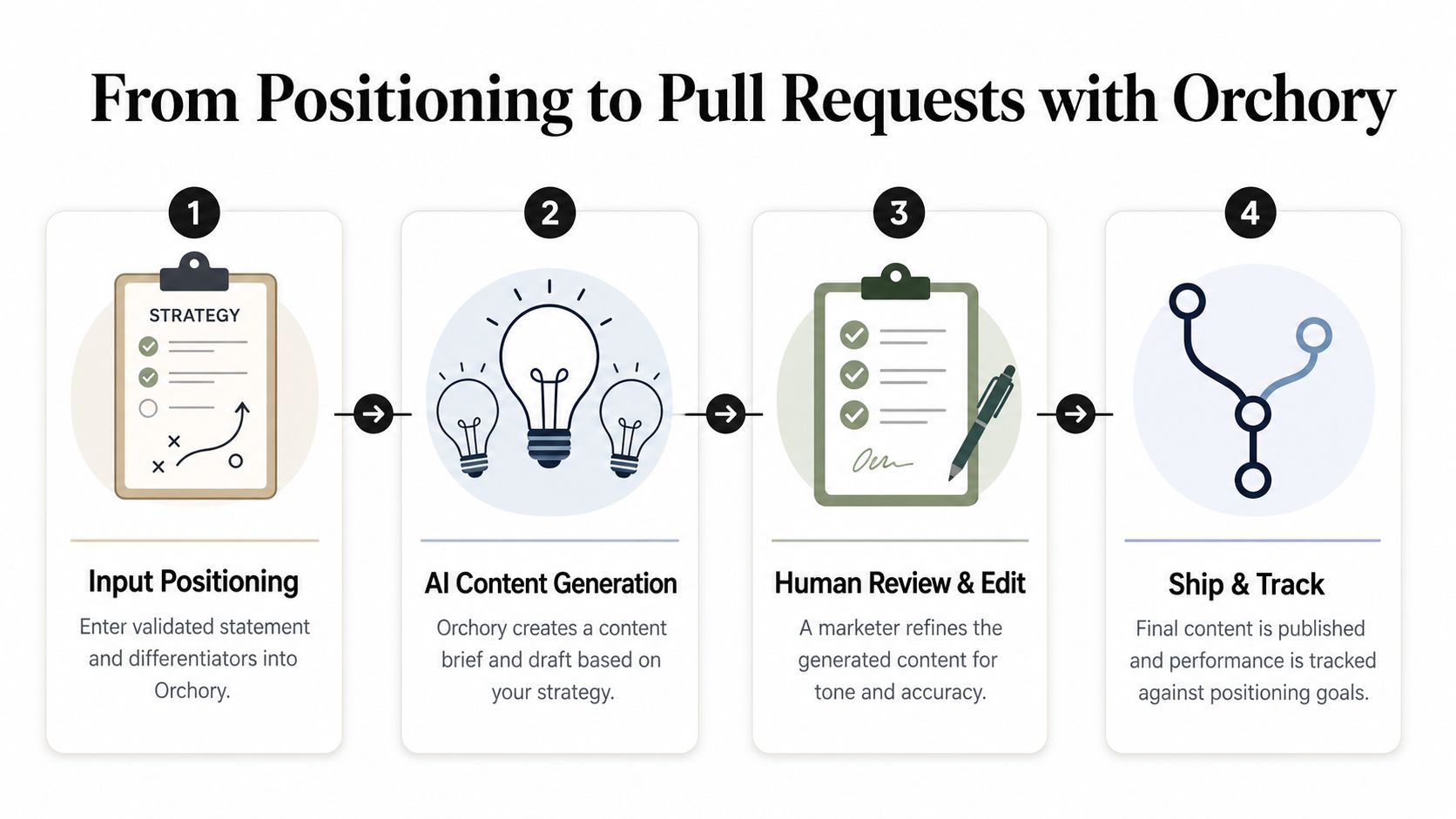
A positioning-led workflow starts with the validated statement and differentiators. The research system then compares those claims with live SERP results, identifies competitor coverage gaps, and ranks page opportunities by their relationship to the position. Each opportunity should carry a page type, search intent, supporting cluster, and evidence requirements.
A workable handoff
The workflow has four gates:
- Input positioning: Record the target customer, competitive alternative, differentiation vector, and proof constraints.
- Generate the brief: Convert the position into an intent-specific page brief with required sections and claims.
- Review the output: Check facts, tone, technical accuracy, internal links, and whether the page reinforces the wedge.
- Open the pull request: Give the developer or coding agent a reviewed implementation prompt, then approve the change through the normal repository workflow.
Orchory is an AI-driven SEO agent that performs keyword research, topic clustering, opportunity scoring, and prompt-based handoff to coding agents that can open pull requests. Its workflow keeps production control with the team through review and merge, rather than granting direct site access. The Orchory vs Ahrefs comparison shows how that output differs from a research suite, while the product's AI SEO agent workflow describes the planning-to-shipping model.
The critical guardrail is human review. Automated drafting can organize research and accelerate the first implementation, but it shouldn't invent proof, flatten technical nuance, or turn a narrow position into generic copy.
Don't treat the queue as permanent. Refresh it when competitors change their pages, when Search Console reveals new query patterns, or when customer interviews expose a different alternative. A good system turns positioning into repeated shipping decisions, not a document that waits for the next planning cycle.
Positioning in an AI-Mediated World
Search results increasingly answer questions before a visitor reaches a website. A 2026 analysis summarized by Business Journal Daily reports that 68% of Google searches in the United States end without a click, compared with about 60.45% two years earlier and an estimated 45% ten years ago. The source and dates matter, but the operational conclusion is clear: ranking without clear representation is an incomplete SEO goal.
AI systems also change how buyers compare products. A prospect may ask for a project management tool for remote engineering teams and receive a short list assembled from pages the system considers authoritative. Your position needs to survive extraction, comparison, and summarization.
Three changes belong in the workflow:
- Write decisive comparison pages: State exactly where your product fits and where it doesn't.
- Structure claims clearly: Put audience, use case, category, and differentiator in plain language that machines and humans can parse.
- Audit representation: Run periodic checks on how AI systems describe your category and whether they associate your product with the intended problem.
Positioning is living infrastructure. Update it when competitors ship meaningful alternatives, when buyers use different language, or when your proof changes. The companies that keep the statement connected to their page queue will have a better chance of being included in both traditional results and zero-click answers.
Orchory turns competitive positioning into an executable SEO queue by researching keywords, clustering intent, scoring page opportunities, and producing prompts a coding agent can ship as reviewed pull requests. Visit Orchory to connect your positioning work with the pages your team can build and deploy.
FAQs
Why should competitive positioning come before SEO for a B2B SaaS company?
What are the three pillars of a usable competitive position?
What axes should I use to build a positioning map?
How do I validate a positioning statement before committing to a content program?
How does Orchory fit into a positioning-led SEO workflow?